
Radiesse vs Facetem in Dubai: Two Calcium Hydroxylapatite Fillers Compared
Radiesse vs Facetem in Dubai: Two Calcium Hydroxylapatite Fillers Compared
Radiesse and Facetem are both calcium hydroxylapatite (CaHA) injectables, made of tiny mineral microspheres suspended in a carboxymethylcellulose gel that gives immediate volume while the microspheres prompt your own skin to produce collagen. They differ mainly in who makes them and how the microspheres are produced, and the only published comparison we found is a laboratory study, so neither can be called better overall; the choice depends on the area, the goal and the physician’s experience.
Dr Soheila works with both products. This guide explains what CaHA is, how each product is formulated, immediate volume versus collagen stimulation, diluted use for skin quality, where CaHA is and is not used, why it cannot be dissolved with hyaluronidase, the risks, who should avoid it, how a physician chooses between the two and what treatment costs in Dubai. Results vary, and suitability must be confirmed in person by a licensed physician.
What Is Calcium Hydroxylapatite (CaHA)?
Calcium hydroxylapatite is a mineral closely related to the main mineral in bone and teeth. In injectables it is made synthetically as microspheres about 25 to 45 micrometres across, suspended in a water-based gel. The gel makes the product injectable and gives the first filling effect. Once the gel has been gradually absorbed, the microspheres stay in the tissue and prompt fibroblasts, the cells that make collagen, to produce type I and type III collagen around them, and the microspheres are themselves slowly broken down by the body.
Because of this second action, CaHA belongs to the group of injectables called biostimulators, which our guide to collagen biostimulators compares, and our biostimulator treatments page gives an overview. CaHA fillers are generally regulated as medical devices rather than medicines.
How Are Radiesse and Facetem Made and Regulated?
What is Radiesse made of?
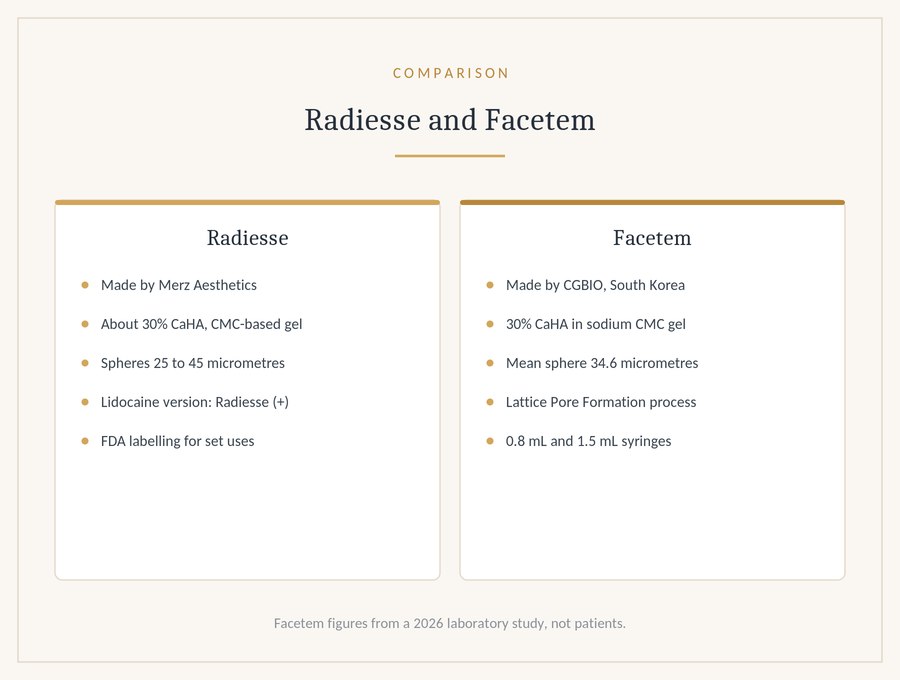
Radiesse is made by Merz Aesthetics. CaHA microspheres make up about 30% of its volume, suspended in a gel of sterile water, glycerine and sodium carboxymethylcellulose (CMC). In the United States, the FDA label covers specific uses, including moderate to severe wrinkles and folds of the lower face, volume loss in the back of the hands and, for the version that already contains lidocaine (Radiesse (+)), jawline contour in adults over 21. Approvals and labelling differ between countries, so ask your physician how the product they use is registered.
What is Facetem made of?
Facetem is made by CGBIO, a company based in Seongnam, South Korea. A 2026 laboratory paper describes it as 30% CaHA microspheres in a 70% sodium CMC gel, supplied in prefilled 0.8 mL and 1.5 mL syringes. Its microspheres are produced by a proprietary process called Lattice Pore Formation, which gives each sphere a layered, grainy surface. The paper also reports that 99.09% of the mineral was hydroxylapatite.
Regulatory approval is granted country by country and can change. The published literature we found does not set out Facetem’s approvals, so this article does not state one. Ask the clinic which approval or certification covers the syringe being used, and ask to see the packaging and batch label.
What does the published comparison show?
The comparison we found is the same 2026 laboratory study, published in the Journal of Functional Biomaterials. Mean microsphere diameter was almost identical (34.6 micrometres for Facetem and 34.9 for Radiesse). Facetem’s microspheres were rounder, and fewer were smaller than 20 micrometres (2.1% against 14.5%). No patients were involved, biological response was not tested, and the authors state that these findings do not by themselves establish a clinical advantage. We did not find a study comparing the two products in patients. Radiesse has been studied in clinical trials over many years, so it is reasonable to ask what clinical data support any product for the area being treated.
Immediate Volume or Collagen Stimulation: What Happens After Injection?
Both products are designed to work in two stages. The first is mechanical: the gel fills the treated area straight away, so some change is visible at the end of the appointment, although part of what you see in the first days is swelling. The second is biological: over the following weeks the body absorbs the gel carrier, while the microspheres stay in place and prompt your own cells to build new collagen. The result is therefore judged once swelling has settled, not on the day. Much of the evidence for the collagen response comes from studies of Radiesse.
Other injectables behave differently. Hyaluronic acid fillers hold volume by binding water, which our comparison of Radiesse and hyaluronic filler sets out, while poly-L-lactic acid products build volume more gradually, as covered in our poly-L-lactic acid versus Radiesse comparison. How long a CaHA result lasts depends on the area, the volume, the dilution and the person, and no duration can be promised for either product.
What Is Diluted or Hyperdiluted CaHA Used For?
Diluted and hyperdiluted CaHA is the same product mixed with saline, and sometimes lidocaine, before injection. The mixture spreads over a wider area, so it is used to improve skin quality and mild laxity rather than to add volume. A global consensus published in 2018 defined diluted as roughly equal parts product and diluent (1:1) and hyperdiluted as two or more parts of diluent to one of product (1:2 or more), and described the approach as off-label, meaning it goes beyond the labelled instructions. Areas discussed include the lower face, neck, chest and upper arms, and small studies have looked at the skin above the knee, as in our guide to Radiesse for cellulite.
Dilution lowers the stiffness of the gel, so a diluted mixture lifts less and spreads more. In the laboratory, Facetem’s stiffness fell to under 1% of its undiluted value when mixed with three parts of saline, and published measurements on Radiesse show the same trend. The evidence for clinical use is limited. The consensus rests on physician experience and small studies, and its authors call it preliminary. Most clinical guidance on dilution refers to Radiesse, and for Facetem we found laboratory data but no equivalent consensus. The consensus also reported more side effects when a less diluted mixture was placed too close to the surface in thin or darker skin, which is why depth and ratio are chosen for each area.
Where Is CaHA Used, and Where Is It Not?
Where is it commonly used?
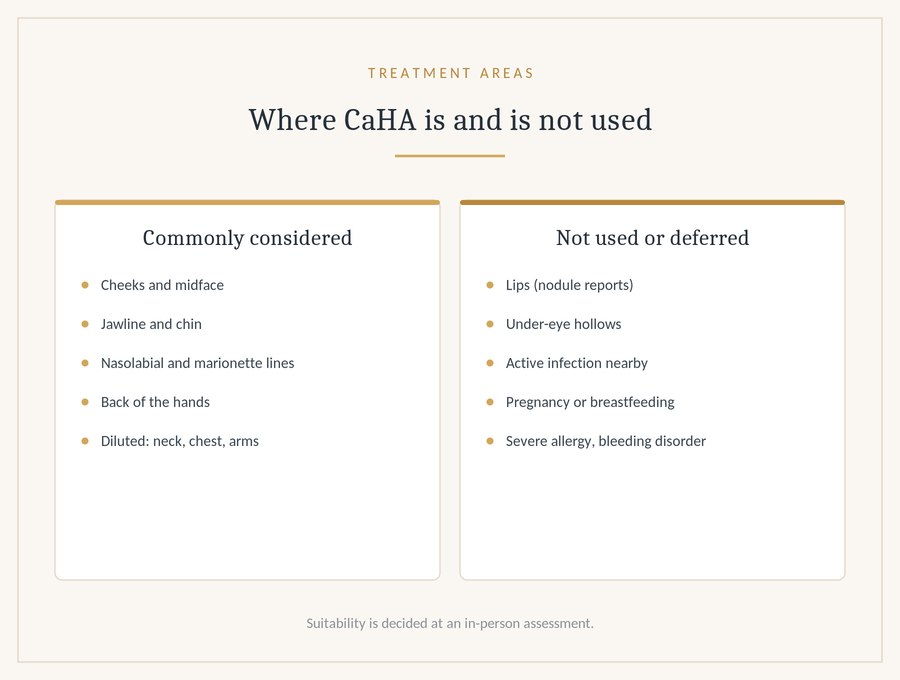
Undiluted or lightly diluted CaHA is used where a firmer gel can add support and definition, such as the cheeks and midface, the jawline and chin, the nasolabial and marionette lines and the back of the hands, which our guide to Radiesse for hands covers. Hyperdiluted mixtures are used for skin quality in areas such as the neck, chest and upper arms. Whether either product suits a given area is decided at an in-person assessment of your anatomy, skin thickness and goals.
Why is CaHA not used in the lips or under the eyes?
The tissue in the lips and under the eyes is thin and mobile, so any irregularity is more likely to show. The Radiesse labelling states that safety and effectiveness in the lips have not been established and notes published reports of nodules after lip injection. Because CaHA cannot be dissolved with hyaluronidase, a lump in these areas is also harder to correct. Hyaluronic acid fillers, which can be dissolved, are the usual choice there. The same applies to Facetem.
Can Calcium Hydroxylapatite Be Dissolved?
No. Hyaluronidase is an enzyme that breaks down hyaluronic acid, and neither Radiesse nor Facetem is made of it: the gel is carboxymethylcellulose and the particles are mineral. If too much product is placed or a lump forms, there is no routine equivalent of hyaluronidase to reverse it. A persistent lump is managed according to its type and may involve observation, massage, medication injected into the lump or, rarely, surgical removal. This is one reason CaHA is placed conservatively and in stages: adding a little more at a review is far easier than correcting too much.
What Are the Risks and Side Effects?
Common effects are swelling, redness, tenderness, bruising and itching, which usually settle within days to a couple of weeks. The Radiesse labelling also lists lumps or bumps at the injection site among the common adverse events. Nodules are firm lumps most often linked to placement that is too superficial or too concentrated, and because they cannot be dissolved, they can take time to settle. Infection can occur, and allergic reactions are uncommon but possible.
The most serious risk is filler entering or blocking a blood vessel, and the Radiesse labelling warns that this can lead to embolisation, vessel occlusion, ischaemia or infarction. Severe or increasing pain, pale, white, mottled or dusky skin, blisters or any change in vision need urgent medical attention. CaHA particles are radiopaque, so they can appear on CT scans and sometimes on standard X-rays, and you should tell any radiologist that you have had CaHA injected. Much of the published safety data on CaHA in patients concerns Radiesse, so ask what is known about the specific product and area being treated.
Who Should Avoid CaHA Fillers?
The Radiesse labelling lists severe allergies, including a history of anaphylaxis, known hypersensitivity to any component and bleeding disorders as contraindications, and for the version containing lidocaine, allergy to lidocaine or related local anaesthetics. Treatment is postponed when there is infection or inflammation in or near the area, and safety in pregnancy and breastfeeding has not been established, so it is usually deferred. Extra care is needed with autoimmune disease, a tendency to keloid or thick scars, and blood-thinning medicines or supplements, which increase bruising; never stop a prescribed medicine without the prescriber’s advice. The labelling also warns that laser or peel procedures close to a Radiesse treatment may provoke inflammation at the implant site. These precautions are generally applied to other CaHA products too, including Facetem, whose own instructions for use should also be followed. A licensed physician must assess suitability in person.
How Does a Physician Choose Between Radiesse and Facetem?
There is no ranking to apply, because the published data do not show either product to be better overall. A physician weighs the goal (lift and contour, skin quality or both), the area and the thickness of the tissue, and the dilution and technique planned. Documentation counts too: how each product is registered, what clinical data support it for the area and, for diluted use, how it behaves when mixed. The physician’s own experience of how each product handles, including how the gel flows through a needle or cannula, and your history, previous reactions, preferences and budget complete the picture.
A laboratory finding such as rounder microspheres does not by itself predict a better result in the face, and the study’s authors do not claim that it does. Dr Soheila works with Radiesse and Facetem, so the decision can rest on your anatomy and goals rather than on a brand name.
Choosing Who Treats You
Because CaHA cannot be dissolved, placement matters more than with reversible fillers. Choose a licensed physician in Dubai whose DHA licence you can verify on the DHA Sheryan portal, ask about their experience with CaHA in the specific area you want treated and with the specific product, and make sure you are assessed in person, including your history, medicines and expectations, before anything is injected.
A sound plan names the product and the volume, explains the dilution and technique, gives written aftercare, includes a review visit and tells you how to reach the clinic if something worries you. The page on Radiesse treatments gives an overview of the product. At dr-soheila.com, treatments are planned and performed by Dr Soheila Eskandari, a DHA-licensed general practitioner with aesthetic privileges with 20 years of experience in aesthetic medicine.
The Short Version
Radiesse and Facetem are both CaHA fillers: mineral microspheres in a CMC gel that adds volume at once and then stimulates collagen. Radiesse is made by Merz Aesthetics and has US labelling for specific uses. Facetem is made by CGBIO, and the published comparison we found is a laboratory study showing similar particle size and rounder microspheres, with no clinical advantage established. Neither can be called better overall, and the choice rests on the area, the goal, the dilution and the physician’s experience.
Diluted use for skin quality is off-label and rests on preliminary evidence. CaHA is not used in the lips or under the eyes, it cannot be dissolved with hyaluronidase, and lumps and blocked blood vessels are the main risks. It is avoided in severe allergy, bleeding disorders, infection, pregnancy and breastfeeding, and a licensed physician must assess suitability in person.
Questions Worth Asking
Which product will you use, and how is it registered? You should be shown the packaging and batch label and told how the product is approved.
Is my aim volume, skin quality or both? The answer shapes the product, the dilution and the depth.
What happens if I develop a lump or a change in vision? CaHA cannot be dissolved with hyaluronidase, so a review and emergency plan should exist before you are injected.
Why this product for this area, and what evidence supports it? The answer should refer to your anatomy and goals, not to one brand being better than another.
Frequently Asked Questions
What is the difference between Radiesse and Facetem?
Both are CaHA microspheres in a CMC-based gel, but they are made by different companies, and Facetem’s microspheres come from a proprietary process; a 2026 laboratory study found similar particle size with rounder Facetem microspheres, and no clinical advantage has been established.
Which is better, Radiesse or Facetem?
Neither can be called better overall; the choice depends on the area, the goal, the dilution planned and the physician’s experience, after an in-person assessment.
What is Facetem?
Facetem is a CaHA filler made by CGBIO in South Korea, described as 30% CaHA microspheres in a 70% sodium CMC gel in 0.8 mL and 1.5 mL syringes; ask the clinic how the syringe in use is registered.
How do Radiesse and Facetem work?
The gel adds volume straight away, then the body absorbs it while the microspheres prompt your own collagen; how long the result lasts varies, and no duration can be promised.
What is hyperdiluted Radiesse used for?
Mixed with two or more parts of saline, it is spread over a wider area to improve skin quality and mild laxity; the use is off-label, and the evidence is preliminary.
Can Radiesse or Facetem be used in the lips or under the eyes?
No; the tissue there is thin and mobile, lumps show more easily and CaHA cannot be dissolved, so hyaluronic acid fillers are the usual choice for these areas.
Can calcium hydroxylapatite filler be dissolved?
No; hyaluronidase breaks down hyaluronic acid, not CaHA, so lumps are managed by observation, massage, injected medication or, rarely, surgery.
What are the risks of CaHA fillers?
Swelling, bruising and tenderness are common; lumps, infection and allergy can occur, and a blocked blood vessel is rare but needs urgent care.
Who should avoid Radiesse and Facetem?
Treatment is avoided in severe allergy, bleeding disorders, infection near the area, pregnancy and breastfeeding, and extra care is needed with autoimmune disease and keloid scarring.
What does Radiesse or Facetem cost in Dubai?
Market rates generally run from around AED 2,000 to AED 4,500 per syringe of CaHA, depending on the product, syringe size and clinic, and the total depends on how many syringes your physician recommends; ask for a written quote naming the product and volume.
This article is general information about aesthetic and dermatological treatments and is not medical advice, a diagnosis, or a treatment recommendation for any individual. Outcomes vary between patients and no result is guaranteed. Prescription medications and injectable products carry risks and contraindications that must be assessed by a licensed physician during a personal consultation. Dr Soheila Eskandari is licensed by the Dubai Health Authority. Prices quoted are general market ranges for information only and are not an offer.


 English
 Arabic