
Microneedling vs Chemical Peel in Dubai: Which Layer Is Your Problem In?
Microneedling vs Chemical Peel in Dubai: Which Layer Is Your Problem In?
Microneedling and chemical peels are the two treatments most often proposed for the same complaints — dull skin, uneven texture, enlarged pores, fine lines, pigmentation, acne scarring — and patients are rarely given a clear reason why one was chosen over the other.
There is a clear reason, and it is anatomical. The two treatments reach different depths by different routes, and that difference determines which problems each one is suited to.
The Basic Difference
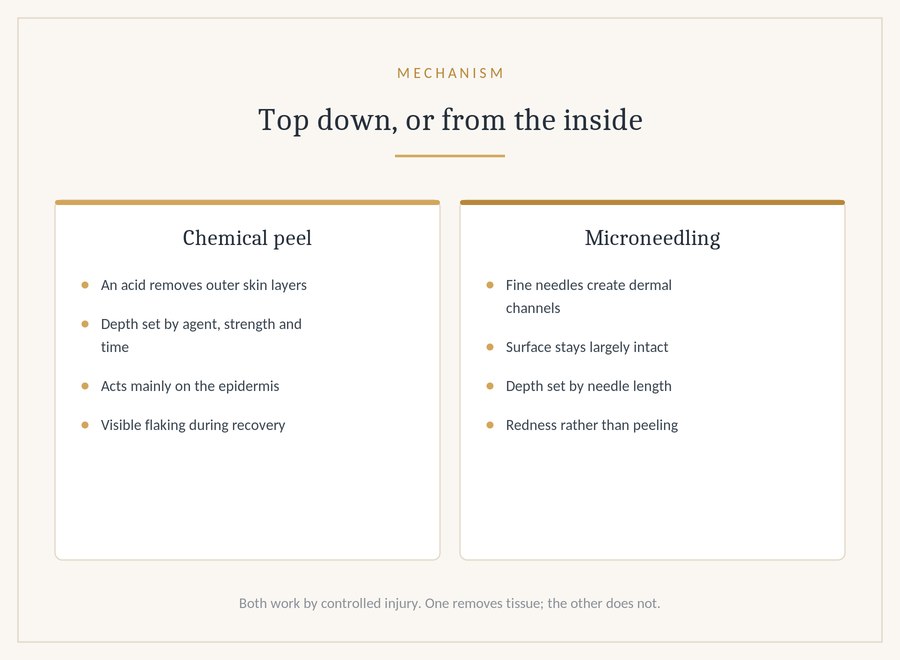
A chemical peel works from the top down. An acid applied to the skin surface causes controlled removal of the outer layers. How deep it goes depends on the agent, its concentration and how long it is left on. Superficial peels affect the epidermis; medium-depth peels reach the upper dermis; deeper peels go further and carry correspondingly more risk and downtime.
Microneedling works from the inside. Fine needles create thousands of small channels through the epidermis into the dermis, leaving the surface largely intact. The controlled injury provokes a wound-healing response that produces new collagen, with the depth set by the needle length rather than by a chemical reaction.
Both work through controlled injury and repair. A peel removes tissue; microneedling injures it without removing it. That is the distinction with practical consequences.
Which Suits Which Problem
Where Peels Are the Better Choice
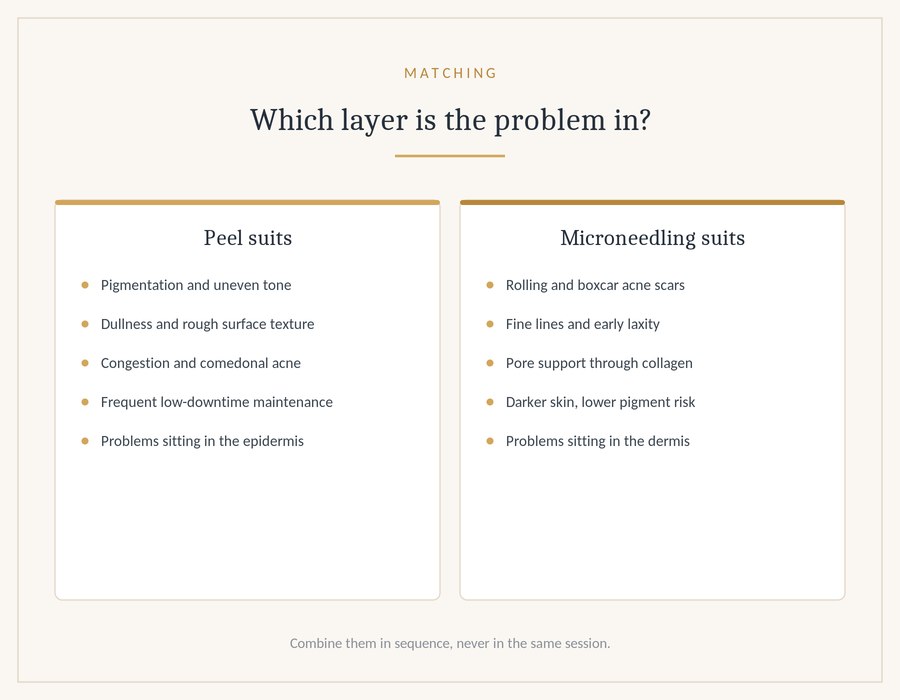
Pigmentation and uneven tone. Because pigment sits largely in the epidermis, removing those layers addresses it directly. Peels remain a standard component of pigmentation protocols.
Dullness and rough surface texture. A superficial peel produces immediate brightening by removing accumulated surface cells.
Congestion and comedonal acne. Salicylic acid is lipid-soluble and penetrates the follicle, which is why it suits oily, congested skin specifically.
Maintenance. Light peels can be repeated frequently and fit well into an ongoing routine.
Where Microneedling Is the Better Choice
Textural scarring. Rolling and boxcar acne scars involve dermal tethering and volume loss, which needs a dermal intervention. Peels at safe depths do not reach the problem.
Fine lines and skin laxity. Collagen stimulation in the dermis is the mechanism, and microneedling targets it directly.
Enlarged pores. Improving the collagen support around the pore has more effect than removing surface layers.
Darker skin types. Because the epidermis remains largely intact, microneedling carries a lower risk of post-inflammatory pigmentation than a medium-depth peel. In Middle Eastern and South Asian skin this is a significant practical advantage.
Where Either Can Work
General skin quality, mild fine lines, and overall radiance respond to both. In these cases the decision usually comes down to skin type, tolerance, downtime and what else is happening in the patient’s routine.
Downtime and Recovery
Superficial peel. Redness for a few hours, light flaking for two to four days. Most people work through it.
Medium-depth peel. Marked redness and visible peeling for five to seven days, and a meaningful social downtime that needs planning around.
Microneedling. Redness resembling sunburn for one to three days depending on needle depth, sometimes mild swelling, occasional pinpoint bruising. Generally presentable by day two or three.
In both cases the most important part of recovery is sun protection. Freshly treated skin pigments readily, and in this climate inadequate sun protection after either treatment can produce exactly the pigmentation the patient came to treat.
Risk Profiles
The principal risk of both is post-inflammatory hyperpigmentation, and it is more common in deeper skin types. With peels the risk rises with depth; with microneedling it rises with needle length and the aggressiveness of the pass.
Peels carry additional considerations: a chemical burn if the agent is left too long or the wrong concentration is used, and prolonged redness with deeper treatments. Microneedling carries a small infection risk if sterility is inadequate, and a risk of tracking pigment if it is performed over active inflammation.
Both should be avoided over active infection, and both need caution or a waiting period in anyone who has recently taken oral isotretinoin. Active inflammatory acne is a reason to treat the acne first rather than to needle over it — the approach to that is set out in the guide to acne scar treatment, where timing matters considerably.
Course Length and Cost
Neither is a single-session treatment for anything meaningful.
Peels are usually planned as a course of four to six sessions two to four weeks apart, with maintenance afterwards. Microneedling is usually three to six sessions four weeks apart, with maintenance every six to twelve months.
Market rates in Dubai generally run from around AED 500 to AED 1,200 per superficial or medium peel, and from around AED 800 to AED 2,000 per microneedling session depending on the device and whether a product is applied alongside. Because both are sold as courses, the course price is the number that matters.
Using Them Together
They are frequently combined, and sensibly so, because they address different layers. What should not happen is both in the same session — the combined injury is unnecessary and raises the risk of pigmentation and prolonged healing.
A common and reasonable structure is a course of peels to address pigmentation and surface quality, followed by microneedling for texture and collagen once the skin is settled, with light maintenance peels continuing afterwards. Which comes first depends on which problem is dominant.
Microneedling is also frequently paired with a product applied or injected during the session — growth factors, polynucleotides or hyaluronic acid preparations. Whether that adds meaningfully to the needling alone varies by product, and the combination is covered in the guide to microneedling with growth factors.
The Short Version
Peels remove surface layers and suit pigmentation, dullness and congestion. Microneedling injures the dermis without removing the surface and suits textural scarring, fine lines, pore size and collagen loss. In darker skin types microneedling generally carries a lower pigmentation risk than a medium-depth peel.
Both need a course. Both need rigorous sun protection afterwards, which matters more here than in most places. They combine well in sequence and poorly in the same session.
Questions Worth Asking
Which layer is my problem in? Pigment in the epidermis and scarring in the dermis point to different treatments.
What is my skin type, and how does that change the choice? A practitioner who raises pigmentation risk unprompted is assessing properly.
How many sessions, and what is the maintenance? Single sessions do not produce lasting change in either category.
What depth are you using and why? For both treatments, depth is the variable that determines both result and risk.
What Neither One Does
It is worth being explicit about the limits, because both are sometimes offered for problems they cannot solve.
Neither replaces lost volume. A face that has deflated needs structural treatment. Better surface quality on a hollow face does not read as younger.
Neither lifts descended tissue. Skin quality and skin position are different problems. Where laxity is the dominant feature, the options are set out in the guide to non-surgical skin tightening.
Neither treats melasma on its own. Melasma is a chronic, relapsing condition that needs a medical plan with strict sun protection at its centre. Procedures can be part of it, and aggressive procedures can make it worse.
Neither fixes deep ice-pick scars. Very narrow, deep scars generally need a targeted technique rather than a resurfacing approach.
Choosing When Budget Is Limited
If the money covers one course rather than two, the honest guidance is to treat the dominant problem properly rather than splitting the budget across both and completing neither. A partial course of each generally produces less than a full course of the right one.
And if the dominant problem is pigmentation, the least expensive element of the plan — daily broad-spectrum sun protection — is also the one that determines whether anything else holds. That is not a sales point, which is precisely why it is worth saying.
Frequently Asked Questions
Which is better, microneedling or a chemical peel?
Neither is better in general; they reach different layers. Peels remove surface layers and suit pigmentation and dullness, while microneedling stimulates the dermis and suits textural scarring, fine lines and pore size. The examination should decide.
Which is safer for darker skin?
Microneedling generally carries a lower risk of post-inflammatory pigmentation because the epidermis stays largely intact. Superficial peels are also used safely in darker skin; medium-depth peels require more caution and greater experience.
Can I have both?
Yes, but in sequence rather than in the same session. Combining them on the same day increases injury unnecessarily and raises the risk of pigmentation and slow healing. A course of one followed by the other is the usual structure.
How many sessions do I need?
Peels are typically four to six sessions two to four weeks apart; microneedling is typically three to six sessions four weeks apart. Both need maintenance afterwards, and a single session of either produces a temporary effect rather than a lasting change.
What is the downtime?
A superficial peel means redness and light flaking for two to four days; a medium-depth peel means visible peeling for five to seven days. Microneedling means sunburn-like redness for one to three days. Sun protection afterwards is essential for both.
Does microneedling hurt?
Topical anaesthetic is applied beforehand and most patients describe pressure and a scratching sensation rather than pain. Deeper settings used for scarring are more uncomfortable than superficial passes used for general skin quality.
Will either help acne scars?
Microneedling is the more appropriate of the two for rolling and boxcar scars, because those involve the dermis. Peels at safe depths do not reach that level. Very narrow ice-pick scars usually need a targeted technique rather than either resurfacing approach.
Can I have these treatments with active acne?
Salicylic acid peels are used in congested and mildly inflammatory acne. Microneedling over active inflammatory lesions is generally avoided, since it can spread inflammation and worsen pigmentation. Treating the acne first is the correct sequence.
Will they shrink my pores?
Pore size cannot be permanently changed, but improving the collagen support around the pore makes it appear smaller, and microneedling is the better of the two for that. Peels help by reducing the congestion that makes pores more visible.
What do they cost in Dubai?
Market rates generally run from around AED 500 to AED 1,200 per peel session and from around AED 800 to AED 2,000 per microneedling session depending on device and any product used. Since both require courses, the course price is the meaningful comparison.
This article is general information about aesthetic and dermatological treatments and is not medical advice, a diagnosis, or a treatment recommendation for any individual. Outcomes vary between patients and no result is guaranteed. Prescription medications and injectable products carry risks and contraindications that must be assessed by a licensed physician during a personal consultation. Dr Soheila Eskandari is licensed by the Dubai Health Authority. Prices quoted are general market ranges for information only and are not an offer.


 English
 Arabic