
Hair Mesotherapy vs PRP in Dubai: What Each Offers for Hair Loss
Hair Mesotherapy vs PRP in Dubai: What Each Offers for Hair Loss
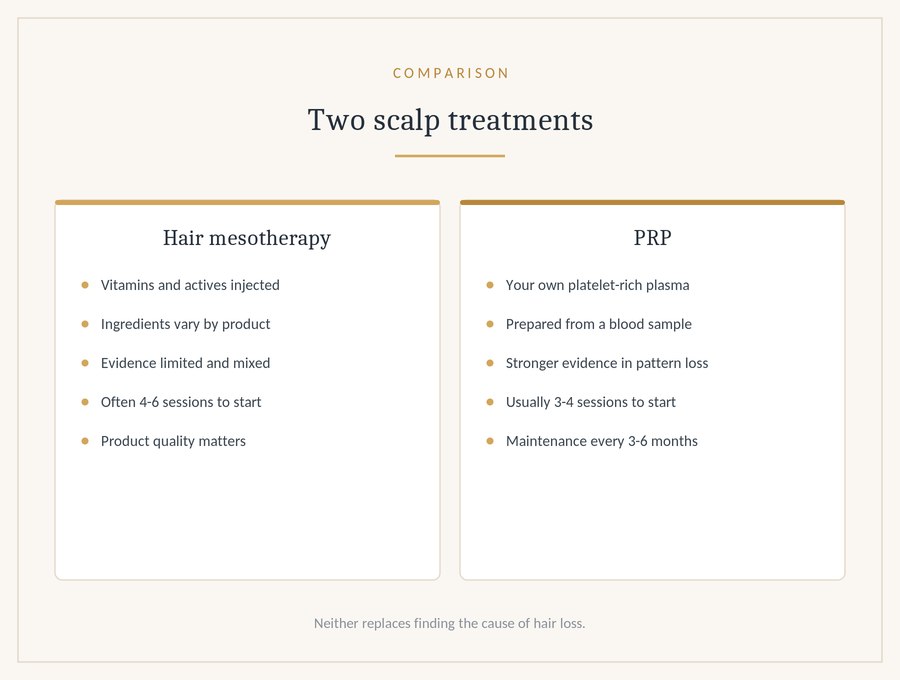
Hair mesotherapy and PRP are both injection treatments for the scalp, but they are not equivalent. PRP uses platelet-rich plasma prepared from your own blood and has the stronger, though still mixed, body of evidence, mainly for pattern hair loss. Hair mesotherapy injects mixtures of vitamins, amino acids and other active ingredients, and the evidence for it is more limited because the products vary so much. For either treatment, the most important step comes first: finding out why the hair is thinning.
Hair loss is common, and in Dubai many people try supplements, shampoos and salon treatments before seeing a doctor. This guide explains what each treatment involves, what the research does and does not show, which kinds of hair loss they may help, which kinds need medical investigation before anything is injected, how many sessions are usually advised, when results can be judged, the side effects and risks, who should avoid each treatment, and what they cost.
Why the Cause of Hair Loss Comes First
Hair loss is a symptom, not a single condition. The most common type is androgenetic alopecia, also called pattern hair loss, in which hair follicles gradually shrink under the influence of hormones and genetics. In men it usually affects the temples and crown; in women it more often shows as a widening parting and thinning over the top of the head. Another common type is telogen effluvium, a period of increased shedding that follows illness, high fever, surgery, childbirth, severe stress, crash dieting or a change in medication, and which often settles once the trigger has passed.
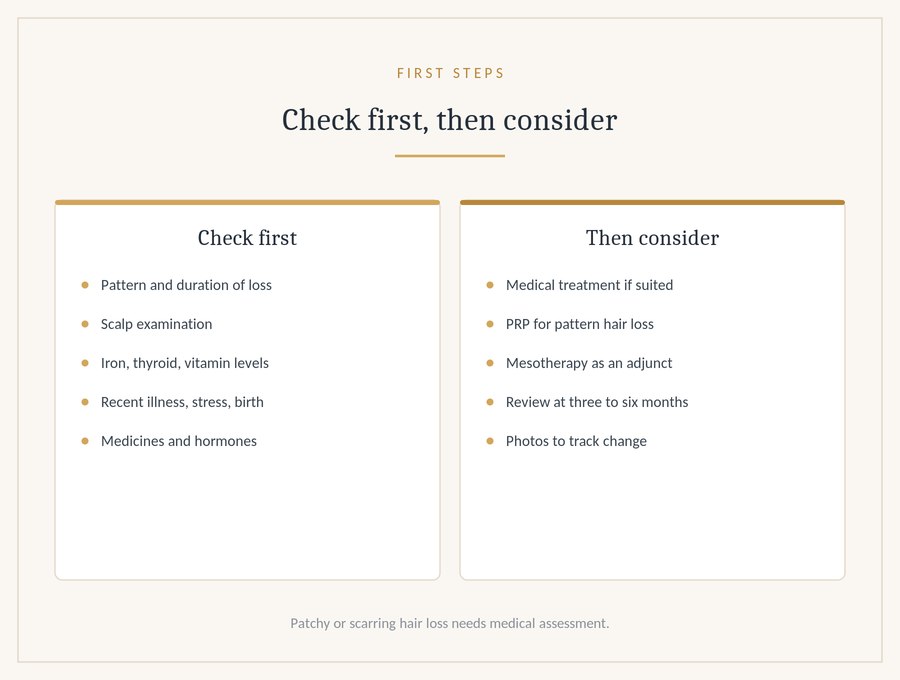
Other types need a different approach altogether. Alopecia areata causes round patches of hair loss and is an autoimmune condition. Scarring alopecias, such as lichen planopilaris and frontal fibrosing alopecia, destroy follicles so that hair does not regrow, and need prompt assessment by a dermatologist. Traction alopecia comes from tight hairstyles. Iron deficiency, thyroid disease and some vitamin deficiencies can contribute to shedding and are worth checking. This is why a physician should take a history, examine the scalp, often with a magnifying dermatoscope, and arrange blood tests where appropriate before suggesting injections. Our guide to hair loss treatment in Dubai explains these first steps in more detail.
What Each Treatment Involves
PRP: your own platelet-rich plasma
For PRP, a small amount of blood is drawn from your arm, much like a routine blood test. The sample is spun in a centrifuge to separate the plasma that contains a concentrated number of platelets. Platelets carry growth factors involved in tissue repair, and the theory is that these growth factors support hair follicles that are shrinking. The plasma is then injected into the thinning areas of the scalp through many small injections. Because it comes from your own blood, there is no foreign substance, although the preparation method and platelet concentration vary between systems.
Hair mesotherapy: a mixture of active ingredients
Hair mesotherapy involves many small, shallow injections into the scalp of a ready-made solution. Depending on the product, this may contain vitamins such as biotin, minerals, amino acids, hyaluronic acid, peptides or plant extracts. Some practitioners use mixtures that include medicines, and the regulatory status of these preparations varies from country to country. The idea is to deliver nutrients and active substances directly to the follicles. Because the term covers so many different formulations, what one clinic calls mesotherapy may be quite different from another clinic’s, which makes it important to ask exactly what is being injected and how it is regulated.
What the Evidence Shows
PRP
PRP for pattern hair loss has been studied in a number of randomised trials and several systematic reviews. Overall, these suggest that PRP can increase hair density and hair thickness in some people with androgenetic alopecia, particularly in early to moderate thinning. The evidence is not definitive: many studies are small, the way PRP is prepared and injected differs between them, follow-up is often short, and not everyone responds. PRP is therefore more accurately described as a reasonable option with supporting evidence rather than a reliable fix, and it is often used alongside medical treatment rather than instead of it. Our article on PRP hair treatment covers the procedure in more depth.
Hair mesotherapy
The evidence for hair mesotherapy is more limited and harder to interpret. Some small studies report improvements in hair density or reduced shedding, but they use different products, different schedules and different ways of measuring results, so their findings cannot easily be applied to any particular cocktail. Some studies of mixtures that contain medicines show more consistent effects than vitamin-only formulations, but these preparations raise their own regulatory and safety questions. An honest summary is that mesotherapy may help some people as part of a broader plan, but the research does not yet support confident claims about any single product.
Which Types of Hair Loss May Respond
Both treatments are mainly considered for pattern hair loss, where the follicles are still present but shrinking. They are sometimes discussed for telogen effluvium, but because this kind of shedding often settles once the trigger is removed or treated, the priority is usually to correct the underlying cause, such as low iron, and allow time for regrowth. In alopecia areata, scarring alopecia and hair loss linked to thyroid or other medical conditions, injection treatments of this kind are not the first approach and should only be considered, if at all, after specialist assessment. Our guide to alopecia treatment explains how patchy and scarring hair loss are managed differently.
The stage of hair loss matters too. Injection treatments work on follicles that are still active. Areas that have been bald and smooth for many years are unlikely to respond, and in those cases other options, including hair transplantation, may be discussed with a specialist.
Session Schedules and When to Judge Results
PRP is usually given as an initial course of three or four sessions about four weeks apart, followed by maintenance sessions every three to six months if there has been a response. Hair mesotherapy schedules vary more widely: a common approach is a course of four to six sessions or more at intervals of one to four weeks, followed by occasional maintenance, depending on the product.
Hair grows slowly and in cycles, so patience is needed. Shedding may continue for a few weeks after treatment starts, and visible change is rarely judged reliably before about three months. Many physicians review results at three to six months, using standardised photographs taken in the same light and position, and sometimes scalp measurements, rather than relying on impressions in the mirror. If there is no meaningful change after a full course, continuing the same treatment indefinitely is rarely sensible.
What Happens at a Treatment Session
A session usually starts with photographs taken in standard positions, so that progress can be compared later. The scalp is cleaned, and a numbing cream, cooling or a vibration device may be used to make the injections more comfortable. For PRP, blood is drawn and processed first, which adds around half an hour. The injections themselves are spread across the thinning areas in a grid pattern and usually take fifteen to thirty minutes.
Most people return to normal activities the same day. You may be advised not to wash your hair for some hours, to avoid hair dye, intense exercise, saunas and swimming for a day or two, and to report any unusual pain or swelling. Hair can usually be styled gently once the scalp has settled.
Realistic Expectations
When these treatments help, the change is usually modest and gradual: less shedding, slightly thicker hair and better coverage of the scalp, rather than a full head of hair. Responses differ widely, and some people see little benefit despite a complete course. Results also need maintaining, because the underlying tendency to pattern hair loss does not go away. A good plan sets out at the start what a meaningful improvement would look like for you, how it will be measured and when you will decide together whether to continue, change or stop treatment.
Combining Treatments
PRP and mesotherapy are sometimes used together, alternating between sessions or combined in a plan, and both are often used alongside medical treatments for pattern hair loss. Prescription and over-the-counter options, which a physician may discuss depending on your sex, age, health and preferences, have their own evidence base, benefits and side effects. Combining treatments can make sense, but each part of the plan should have a clear reason, and you should be able to tell which treatment is expected to do what. For a comparison of PRP with a newer regenerative option, our article on PRP versus exosomes for hair may be useful.
Lifestyle factors also matter. Adequate protein, iron and vitamin levels, management of stress and sleep, gentle hair care and avoiding tight hairstyles support any treatment. Supplements are only useful when a deficiency is present, and some, taken in excess, can cause problems of their own.
Side Effects and Risks
PRP
Scalp injections can be uncomfortable, and numbing methods are often used. Afterwards, tenderness, redness, mild swelling, small bruises and a headache are common for a day or two. Because the plasma comes from your own blood, allergic reactions to it are not expected, but any injection carries a small risk of infection, and the blood draw itself can leave a bruise on the arm. Results depend partly on how the PRP is prepared, which is why the method used should be explained.
Hair mesotherapy
Mesotherapy shares the common effects of scalp injections: discomfort, redness, swelling, small bruises and occasional headache. Because a foreign solution is injected, allergic reactions are possible. Reports in the medical literature describe uncommon but significant complications with some mesotherapy products, including infection, inflammation of the fat under the skin and, rarely, patchy hair loss or scarring. These risks are higher when products of uncertain origin or composition are used, which is why product sourcing, sterile technique and a physician who can manage complications are important.
For both treatments, increasing pain, spreading redness, fever, discharge or new areas of hair loss after treatment should be reported to the clinic promptly.
Who Should Avoid PRP or Mesotherapy?
Both treatments are usually postponed during pregnancy and breastfeeding and when there is an active infection or inflamed skin condition on the scalp. PRP is avoided in people with low platelet counts or platelet disorders, significant anaemia, active cancer treatment or some blood disorders, and blood-thinning medicines need to be discussed beforehand. Some physicians advise avoiding certain anti-inflammatory painkillers for a few days around PRP, but medicines prescribed for a medical condition should never be stopped without the advice of the prescribing doctor. Mesotherapy is avoided in people allergic to any ingredient in the solution and needs extra care in those with bleeding tendencies or autoimmune conditions. Anyone with patchy or scarring hair loss should be assessed medically before either treatment is considered.
Choosing Who Treats You
Scalp injections are medical treatments, so the person treating you should be a licensed physician whose DHA licence you can verify on the DHA Sheryan portal. Ask whether they will examine your scalp and arrange blood tests before treatment, how they decide between PRP, mesotherapy and medical options, and, for mesotherapy, exactly which product will be used and how it is regulated.
A sound plan states the number of sessions, how and when progress will be measured, and what will happen if there is no improvement. Be cautious about large prepaid packages offered before your hair loss has been diagnosed. At dr-soheila.com, treatments are planned and performed by Dr Soheila Eskandari, a DHA-licensed general practitioner with aesthetic privileges with 20 years of experience in aesthetic medicine.
The Short Version
PRP and hair mesotherapy are both scalp injection treatments, but they differ. PRP uses your own platelet-rich plasma and has the stronger, though still mixed, evidence for pattern hair loss, usually as three or four monthly sessions followed by maintenance. Hair mesotherapy injects vitamin and active mixtures whose evidence is more limited and varies by product. Results for either are judged at three to six months.
Finding the cause comes first. Shedding after illness or from low iron often needs the trigger corrected rather than injections, and patchy or scarring hair loss needs medical assessment. Both treatments carry side effects and risks, both are postponed in pregnancy and breastfeeding, and suitability should be confirmed in person by a licensed physician.
Questions Worth Asking
What type of hair loss do I have, and how do you know? A diagnosis should come before any injection plan.
Which blood tests do I need first? Iron, thyroid and vitamin levels are commonly checked before treatment.
What exactly will be injected? For mesotherapy you should know the product and its regulatory status; for PRP, how it is prepared.
How will we measure whether it is working? Standardised photographs and a review date should be agreed at the start.
Frequently Asked Questions
Which has stronger evidence, PRP or mesotherapy?
PRP has the stronger body of evidence for pattern hair loss, although studies vary, while the evidence for hair mesotherapy is more limited and depends heavily on the product used.
Can mesotherapy and PRP be combined?
Yes, they are sometimes combined or alternated, often alongside medical treatment, as long as each part of the plan has a clear purpose and progress is measured.
How many sessions are needed?
PRP usually starts with three or four sessions about a month apart, while mesotherapy courses often involve four to six or more sessions, followed by maintenance if there is a response.
When will I see results?
Because hair grows in cycles, results are rarely judged reliably before about three months, and many physicians review progress at three to six months with standardised photographs.
Do these treatments work for alopecia areata?
Patchy hair loss from alopecia areata is an autoimmune condition that is usually managed differently, so it needs medical assessment rather than routine PRP or mesotherapy.
Can women have PRP or mesotherapy for hair loss?
Yes, after assessment that usually includes iron, thyroid and sometimes hormone checks, although both treatments are postponed during pregnancy and breastfeeding.
Does PRP hurt?
Scalp injections can be uncomfortable, numbing methods are often used, and tenderness or mild headache for a day or two afterwards is common.
Are there side effects?
Both commonly cause tenderness, redness, swelling and small bruises, and mesotherapy can also cause allergic reactions and, rarely, infection, inflammation or patchy hair loss with some products.
Who should avoid PRP or mesotherapy?
They are usually avoided in pregnancy, breastfeeding and scalp infection; PRP also in platelet disorders, significant anaemia and active cancer treatment; and mesotherapy in anyone allergic to its ingredients.
What does it cost in Dubai?
Market rates generally run from around AED 1,200 to AED 2,500 per PRP session and from around AED 800 to AED 2,000 per hair mesotherapy session, with an initial course of several sessions usually advised.
This article is general information about aesthetic and dermatological treatments and is not medical advice, a diagnosis, or a treatment recommendation for any individual. Outcomes vary between patients and no result is guaranteed. Prescription medications and injectable products carry risks and contraindications that must be assessed by a licensed physician during a personal consultation. Dr Soheila Eskandari is licensed by the Dubai Health Authority. Prices quoted are general market ranges for information only and are not an offer.


 English
 Arabic