
Alopecia Treatment in Dubai: Why the Type Decides Everything
Alopecia Treatment in Dubai: Why the Type Decides Everything
Patients arrive having searched “alopecia treatment” and found a wall of options: injections, lasers, supplements, transplants, shampoos. What almost none of that content establishes first is which condition they actually have — and that single question determines whether the right answer is a prescription, a course of injections, an urgent referral, or simply time.
Alopecia means hair loss. It is a symptom, not a diagnosis. Under that one word sit conditions with different causes, different treatments and radically different outcomes: one that usually recovers on its own, one that is permanent if not caught early, one that reverses if you change a hairstyle, and one that is progressive and lifelong. Treating them as interchangeable is the most expensive mistake in this field.
The Four Patterns
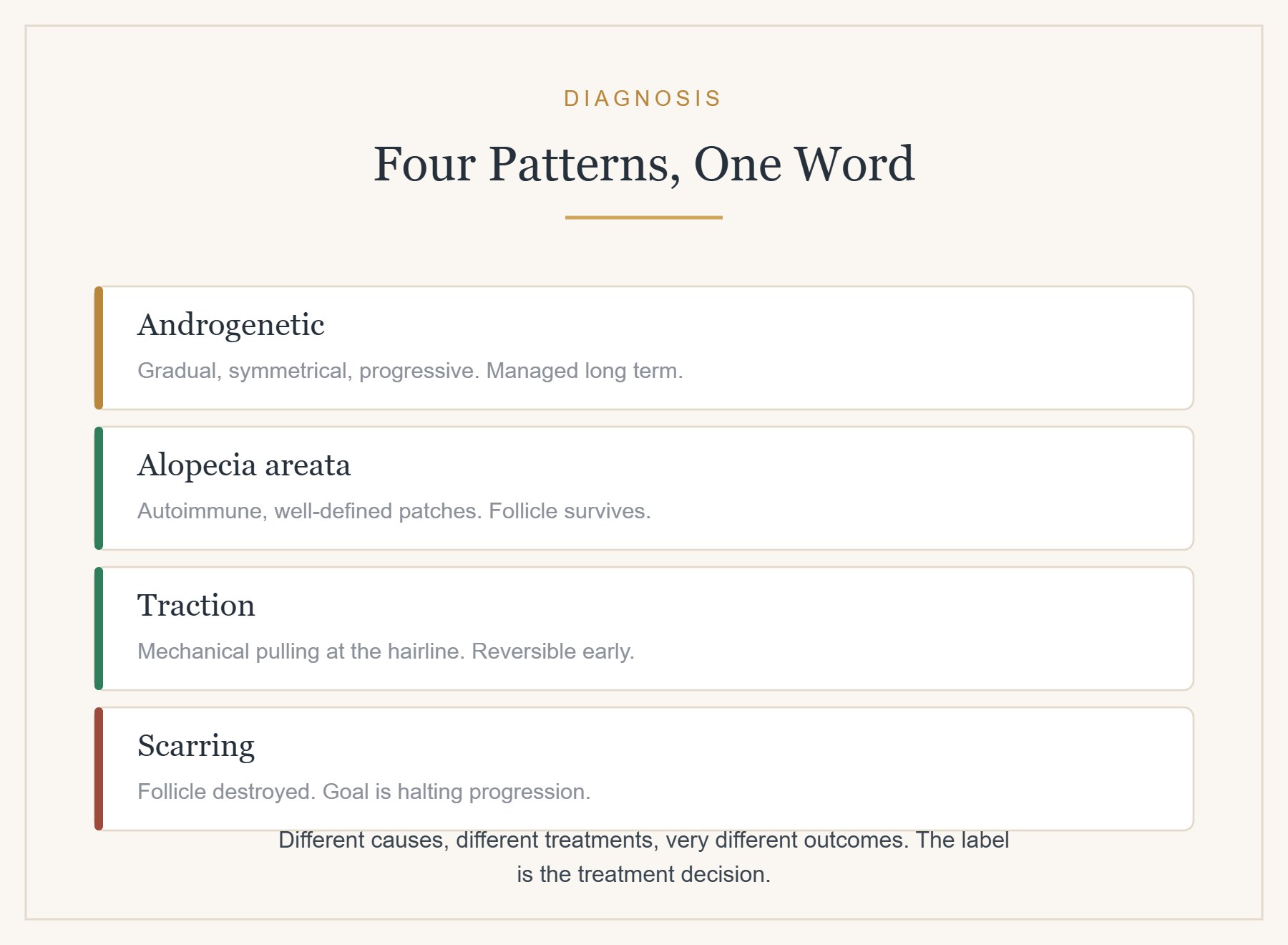
Almost everything presenting in clinic falls into one of four groups, and they are distinguishable on examination.
Androgenetic alopecia — pattern hair loss. The most common by a wide margin. Gradual, symmetrical, following a recognisable pattern: recession at the temples and thinning at the crown in men, widening of the central parting with preserved hairline in women. It is progressive and hormonally driven, and it is managed rather than cured. I have covered its specific treatments in the guide to hair loss treatment in Dubai.
Alopecia areata. Autoimmune. The immune system attacks the hair follicle, producing well-defined round or oval patches of complete loss, usually with normal-looking skin underneath. It can affect the scalp, beard, eyebrows or eyelashes. Crucially, the follicle survives — which is why regrowth is possible.
Scarring (cicatricial) alopecia. A group of inflammatory conditions that destroy the follicle and replace it with fibrous tissue. Frontal fibrosing alopecia and lichen planopilaris are the ones most often seen. Because the follicle is destroyed, regrowth in affected areas is not achievable.
Traction alopecia. Mechanical. Sustained pulling from tight styles, extensions, or repeated tight covering, typically affecting the hairline and temples. Reversible early, permanent if sustained for years.
A fifth presentation, telogen effluvium, is diffuse shedding after a trigger — illness, surgery, childbirth, crash dieting, iron deficiency, thyroid disturbance, or a stressful period. It is not strictly alopecia in the pattern sense, and it usually resolves once the trigger is corrected.
The Distinction That Decides Urgency
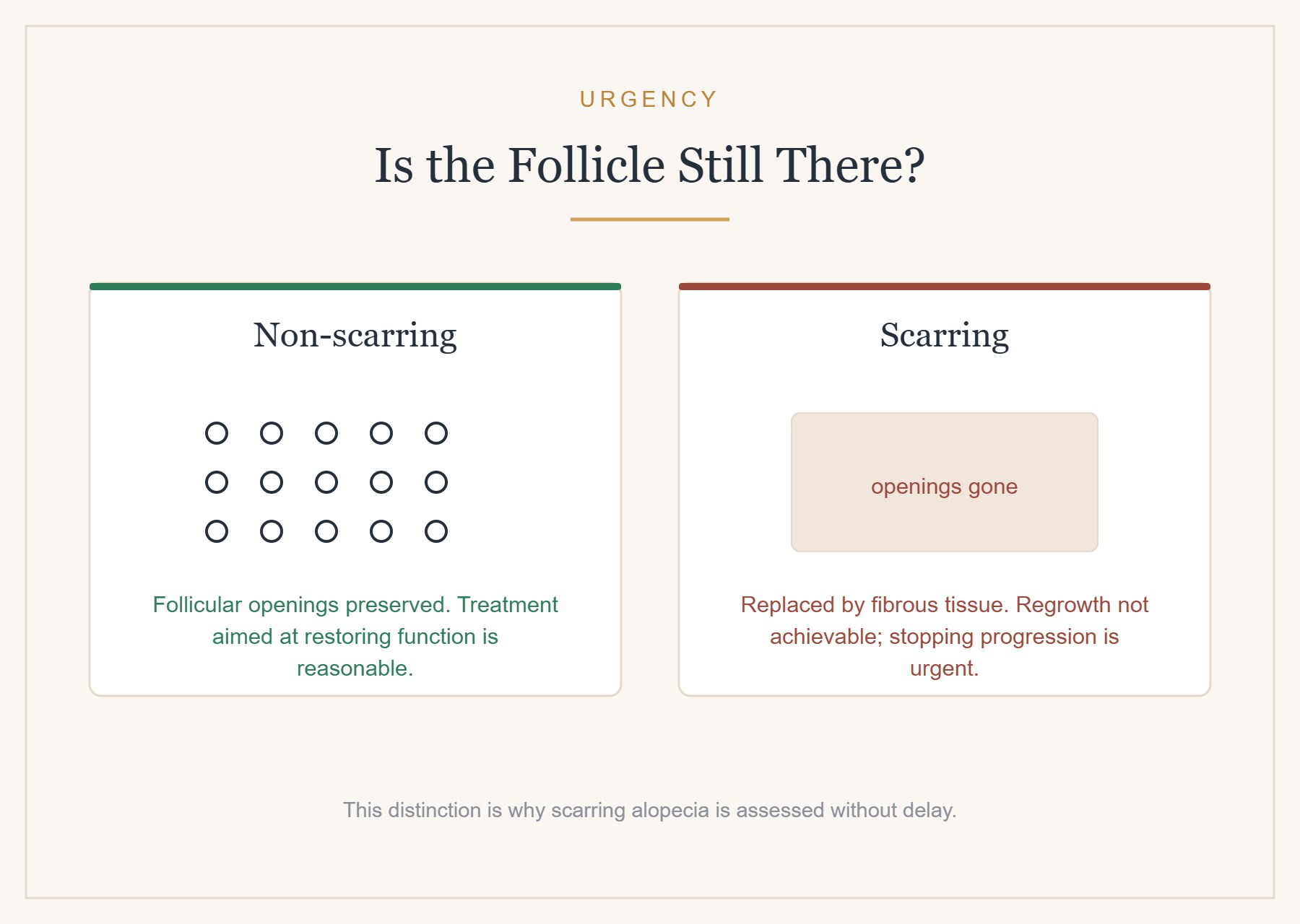
Of everything in this article, one distinction matters more than the rest: is the follicle still there?
In non-scarring alopecia — pattern loss, areata, traction caught early, effluvium — the follicular openings are preserved. You can see them on close examination. The follicle may be miniaturised, dormant or under attack, but it exists, and treatment aimed at restoring its function is reasonable.
In scarring alopecia the openings are gone. The scalp looks smooth and slightly shiny where hair used to be. No treatment brings back a follicle that has been replaced by scar tissue, and any clinic selling a regrowth package for scarring alopecia is either not examining properly or not being straight with you.
That is why scarring alopecia is treated as time-critical. The treatable target is the active inflammation at the advancing edge. Every month of delay converts more living follicles into permanent loss. A patient with frontal fibrosing alopecia who spends six months on supplements and laser caps has lost six months of hairline that will not come back.
Signs That Raise the Possibility of Scarring
None of these is diagnostic on its own, but together they change the priority of getting assessed:
Loss of the visible pore-like follicular openings in the affected area. Smooth, shiny or slightly pale patches. Redness, scale or small bumps around individual follicles. Symptoms — itching, burning, tenderness or pain — which are common in scarring conditions and largely absent in pattern loss. A hairline that appears to be moving backward as a band, with the eyebrows thinning at the same time.
How Diagnosis Is Actually Made
The assessment is not elaborate, but skipping it is how people end up on the wrong treatment.
History. Pattern and speed of onset, family history, recent illness, surgery, pregnancy, significant weight change, medication, and in women, menstrual regularity and signs of androgen excess.
Examination and pull test. The distribution tells you a great deal. A gentle pull test — grasping a small bundle and drawing it along the shaft — indicates whether active shedding is happening now.
Trichoscopy. Magnified examination of the scalp surface, and the single most useful tool in this field. It shows whether follicular openings are preserved, whether hair shaft calibre varies (characteristic of pattern loss), and whether there is perifollicular inflammation or scale suggesting a scarring process. It takes minutes and costs nothing extra in most consultations.
Blood tests. For diffuse shedding, ferritin, full blood count, thyroid function and vitamin D are commonly checked. Iron deficiency is frequent and readily correctable, particularly in menstruating women, and ferritin needs to be comfortably adequate rather than merely inside the laboratory’s normal range for hair purposes.
Scalp biopsy. Reserved for cases where scarring is suspected or the picture is unclear. It is a small procedure under local anaesthetic and it gives an answer that guesswork cannot.
What Each Type Responds To
Alopecia areata
A single small patch in a first episode has a reasonable chance of regrowing spontaneously within a year. That is worth knowing before paying for anything, because a proportion of successful “treatments” are taking credit for natural recovery.
Where treatment is used, it is directed at the immune process rather than at stimulating growth: intralesional corticosteroid injections into the patches are the usual first-line approach in localised disease, with topical treatments as alternatives. Extensive or rapidly progressive disease, and disease affecting the eyebrows and lashes, is managed differently and belongs with a dermatologist.
Prognosis is less predictable with early onset, extensive involvement, or loss along the hairline margin. Recurrence is common, which is a reasonable thing to be told in advance rather than discovered later.
Scarring alopecia
The goal is to stop progression. Treatment is anti-inflammatory and is prescribed and monitored — topical and intralesional corticosteroids, and systemic medication in active or extensive disease. Success is defined as the condition becoming quiet and the hairline stabilising, not as regrowth.
Where a stable, burnt-out scarring alopecia has left a defined area of loss, surgical options including transplantation can sometimes be considered — but only after a prolonged period without activity, because transplanting into an inflamed scalp fails.
Traction alopecia
The treatment is removing the tension, and it is the one situation where the most effective intervention costs nothing. Loosening styles, alternating them, and avoiding sustained pulling arrests the process. Where follicles survive, regrowth follows over months. Where the area has become smooth and scarred after years of traction, it does not — which is why this is worth addressing early rather than when it becomes obvious.
Telogen effluvium
Identify and correct the trigger; the shedding settles. Blood tests matter here more than anywhere. Treating with an expensive injectable course while an untreated iron deficiency continues is money working against itself.
Androgenetic alopecia
Managed with established medical therapy, with PRP as a reasonable adjunct rather than a replacement. The point patients most often miss is that maintaining current density over five years is a success, because the untreated trajectory was continued loss.
Hair Loss in This Climate
Patients in Dubai commonly attribute hair loss to hard water, heat or air conditioning. These deserve proportion rather than dismissal.
Hard water leaves mineral deposits on the hair shaft, producing dryness, dullness and breakage along the length. That is a shaft problem, not a follicle problem — it makes hair look thinner without causing loss from the root, and a shower filter or chelating shampoo addresses it.
Heat and high year-round ultraviolet damage the shaft and can inflame the scalp. Frequent tight styling under a scarf or cap contributes genuine traction.
Relocation matters more than most people expect. Moving countries brings dietary change, disrupted sleep, illness and stress, and telogen effluvium characteristically appears two to three months afterwards. A significant number of patients convinced they are losing their hair permanently are in a shedding phase that will settle.
What to Be Cautious About
Two patterns are worth naming.
The first is the package sold before the diagnosis. A course of injections quoted at a first visit, without trichoscopy, without blood tests and without a name for the condition, is selling a treatment rather than solving a problem.
The second is the promise of regrowth in scarring alopecia. It is not achievable, and a clinic that offers it has either not examined the scalp properly or is prepared to take money for something that cannot work.
A useful test of a consultation: can the practitioner tell you which of the four patterns you have, and what evidence they are basing that on?
Costs in Dubai
A dermatology consultation including trichoscopy generally runs from around AED 400 to AED 900, with blood tests billed separately. A scalp biopsy, where indicated, typically adds AED 800 to AED 2,000 including histopathology.
Treatment costs then vary enormously by diagnosis — from essentially nothing for traction alopecia to ongoing prescription costs for pattern loss to injection courses for areata.
Given how completely the diagnosis changes the plan, the consultation is the part worth paying for first. It is also the cheapest step, which is an unusual and welcome alignment.
The Short Version
Alopecia is four or five distinct conditions sharing one word. Pattern loss is managed long-term. Areata often recovers and is treated at the immune process. Traction reverses if caught early. Scarring alopecia is permanent where it has already acted, and urgent where it is still active. Effluvium resolves once the trigger is corrected.
The examination that separates these takes minutes. Every treatment decision depends on it, and no injectable, device or supplement substitutes for having it done first.
Frequently Asked Questions
Is alopecia the same as normal hair loss?
Alopecia simply means hair loss, so the word covers everything from common pattern thinning to autoimmune patchy loss to permanent scarring conditions. Because those have different causes and different outcomes, the useful question is never “do I have alopecia” but “which type”.
What is alopecia areata?
An autoimmune condition in which the immune system attacks hair follicles, producing well-defined round or oval patches of complete hair loss, most often on the scalp but sometimes in the beard, eyebrows or elsewhere. The follicles survive, so regrowth is possible.
Will alopecia areata grow back on its own?
Often yes. A single small patch in a first episode has a good chance of spontaneous regrowth within a year. Extensive involvement, early onset and loss along the hairline margin are associated with a less predictable course, and treatment is used to shorten episodes rather than guarantee an outcome.
What is scarring alopecia?
A group of conditions in which inflammation destroys the follicle and replaces it with fibrous tissue. Frontal fibrosing alopecia and lichen planopilaris are the ones most often seen. Because the follicle is gone, the realistic goal is halting progression, not regrowth.
How do I know if my hair loss is scarring?
Certain signs raise the possibility: loss of the visible follicular openings, smooth shiny patches, redness or scale around the follicles, and symptoms such as itching, burning or tenderness. Confirming it usually requires examination with trichoscopy and sometimes a scalp biopsy.
What is traction alopecia?
Hair loss caused by sustained pulling from tight styles, extensions or repeated tight covering. It typically affects the hairline and temples. Caught early it is reversible by removing the tension; sustained over years it can become scarring and permanent.
Do I need blood tests?
For diffuse shedding, usually yes. Ferritin, full blood count, thyroid function and vitamin D are commonly checked, and in women with signs of androgen excess a hormonal panel is appropriate. Correcting a deficiency is cheaper and more effective than treating around it.
Can PRP treat alopecia areata?
It is at best adjunctive. Alopecia areata has established treatments directed at the immune process, and those come first. PRP has clearer evidence in androgenetic pattern loss than in autoimmune alopecia.
Is alopecia caused by stress?
Stress is a genuine trigger for telogen effluvium, the diffuse shedding that appears two to three months after a stressful period, and it is reported as a trigger in alopecia areata. It is not the cause of pattern hair loss or scarring alopecia, and attributing everything to stress delays diagnosis.
What does assessment cost in Dubai?
A dermatology consultation with trichoscopy generally runs from around AED 400 to AED 900, with blood tests billed separately. Given how much the diagnosis changes the treatment, this is the step worth paying for before any package.
This article is general information about aesthetic and dermatological treatments and is not medical advice, a diagnosis, or a treatment recommendation for any individual. Outcomes vary between patients and no result is guaranteed. Prescription medications carry risks and contraindications that must be assessed by a licensed physician during a personal consultation. Dr Soheila Eskandari is licensed by the Dubai Health Authority. Prices quoted are general market ranges for information only and are not an offer.


 English
  Arabic