
Crepey Knees in Dubai: Treating Loose, Wrinkled Skin Above the Knees
Crepey Knees in Dubai: Treating Loose, Wrinkled Skin Above the Knees
Crepey knees treatment can soften the fine crinkling and looseness of the skin above the knee, mainly in mild to moderate cases, with options such as hyperdiluted Radiesse (calcium hydroxylapatite), skin boosters, microneedling or radiofrequency. The evidence is modest: the main published study of hyperdiluted calcium hydroxylapatite above the knee is a 2020 pilot of 20 women, in which scores improved at three months, mostly in milder cases, and no established data show how long the effect lasts. Leg strength, a steady weight and sun protection support the skin you have, and a licensed physician needs to assess your skin in person before any treatment is chosen.
Loose, crinkled skin above the knee is a concern for some people who wear shorts, swimwear or short dresses. This guide explains why it happens, what each option can and cannot do, who may suit treatment, what to expect, the risks, the off-label status of the product and what treatment costs in Dubai.
Why Does the Skin Above the Knee Crinkle and Sag?
The skin around the knee is thin and moves constantly, stretching and folding each time the joint bends. In younger skin, collagen and elastin, the proteins that give skin its strength and its ability to spring back, return it to shape. With age their amount and quality decline and the dermis, the supporting layer beneath the surface, thins, so the skin recovers more slowly and fine crinkles and a looser, draped look appear.
Other factors add to this. Years of sun exposure damage collagen and elastin, and legs are often uncovered in Dubai’s sunny climate. Weight gain stretches the skin, and weight loss can leave it less able to retract, particularly after repeated changes. Genetics also play a part, because some people inherit thinner or less elastic skin that shows changes earlier. Several of these factors cannot be changed, so assessment starts by working out which are involved.
Is it crepey skin, dimples or both?
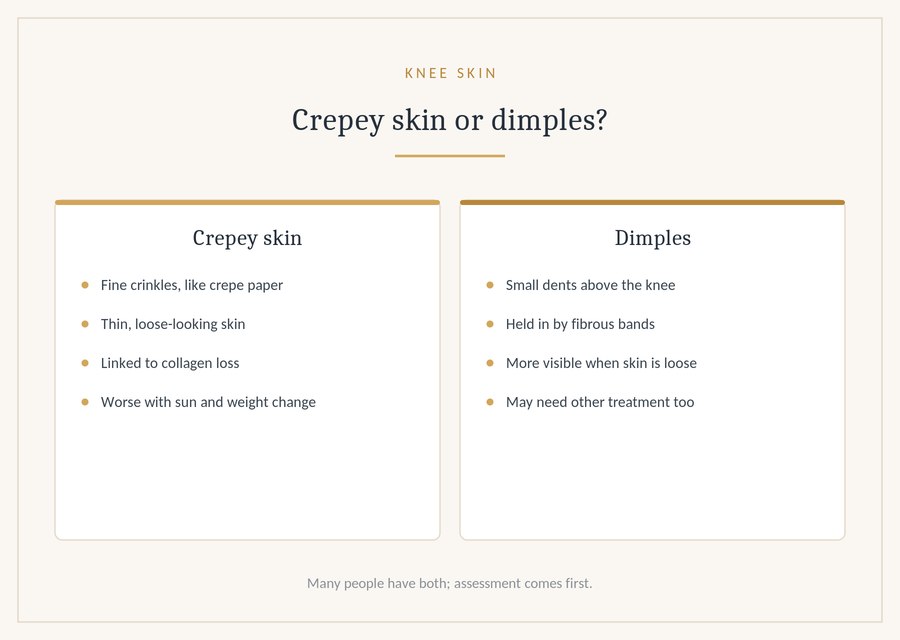
Crepey skin looks fine-lined and crinkled, like crepe paper, and often feels thin. Dimples are small depressions, commonly called cellulite, that can also appear above the knee. The two overlap, and researchers describe a link between skin laxity and dimples. Dimples are partly caused by fibrous bands that tether the skin to deeper tissue, so treatment aimed at skin quality may not be enough for deeper ones. Our guide to Radiesse for cellulite covers them in more detail.
Crepey Knees Treatment Options: What Can Help?
Options include injections that stimulate collagen, treatments that improve hydration or trigger repair, and everyday measures. None removes excess skin, and the evidence differs between them.
How does hyperdiluted Radiesse work?
Radiesse is a filler made of tiny calcium hydroxylapatite particles suspended in a gel. When it is mixed with extra saline, it is used less to add volume and more as a biostimulator, a material that prompts the skin to produce new collagen. Consensus guidelines from 2018 describe a 1:1 mix as diluted and 1:2 or more as hyperdiluted; the knee study used 1:4, meaning one part product to four parts diluent. A small pilot study of the neck and upper chest reported increased collagen and elastin and a thicker dermis in skin samples after diluted treatment. Our article on collagen biostimulators explains this group of treatments.
Dr Soheila uses diluted Radiesse (calcium hydroxylapatite) for crepey, loose skin above the knees, after an in-person assessment of the skin. The page on Radiesse treatment gives an overview of the product.
What did the 2020 knee study find?
A 2020 pilot study in Dermatologic Therapy reviewed 20 women, aged 38 to 61, treated with 1:4 hyperdiluted calcium hydroxylapatite above the knees. The mixture was injected through a fine cannula in a single session and then massaged in. In a blinded evaluation, three dermatologists scored photographs taken before treatment and three months later using the Knee Cellulite Severity Score, a 0 to 9 scale that rates the number and depth of dimples and the degree of skin laxity. Average scores fell from about 5 (moderate) to about 2 (mild), with the greatest improvement in women who started with milder scores and a smaller one in those with severe scores.
The authors list the limits themselves: the study was small and retrospective, included only women and did not assess how long the effect lasts. It also had no untreated comparison group, and the treating physician was one of the three scorers. A 2024 systematic review of Radiesse on the body noted that diluted and hyperdiluted approaches have yet to be supported by randomised controlled trials. The findings are encouraging but preliminary.
Is Radiesse approved for use on the knees?
In the United States, Radiesse is approved for specific uses such as moderate to severe facial wrinkles and folds and volume loss in the backs of the hands. The skin above the knee is not among them, so this use is off-label there. Off-label use is recognised in medical practice, but the regulator has not assessed the product for that purpose, so the limits of the evidence should be explained to you.
Do skin boosters help crepey knees?
Skin boosters are injectable products, most often based on hyaluronic acid, placed in or just under the skin to improve hydration and skin quality rather than to add volume. They may suit dry, finely lined skin, but they are not designed to lift loose skin or fill dimples, and knee-specific evidence is limited. Our comparison of how skin boosters differ explains the main products.
Can microneedling or radiofrequency help?
Microneedling uses fine needles to make tiny controlled channels in the skin, which prompts a repair response that includes new collagen; it is used mainly to improve texture and fine lines. Radiofrequency devices deliver controlled heat to the deeper skin to tighten it and stimulate collagen over a course of sessions. A review of cellulite treatments reports improvement with laser, light and radiofrequency devices, but many of the studies had flawed methods. Microfocused ultrasound has been reported for lax knee skin, although the knee study’s authors note that it did not specifically address depressions. These options are used instead of, or alongside, injections, depending on how thin, loose or dimpled the skin is. Read more in our guides to microneedling and skin tightening.
What can you do yourself?
Daily habits do not reverse crepey skin, but they influence how it looks and how quickly it progresses. Strength training for the thighs builds the muscle beneath the skin, which can improve contour, although it does not tighten the skin itself. A stable weight avoids repeated stretching and shrinking, and broad-spectrum sunscreen on exposed legs limits further ultraviolet damage to collagen and elastin. These measures apply whether or not you choose treatment.
Who Suits Treatment, and Who Should Consider Other Options?
Who may be a suitable candidate?
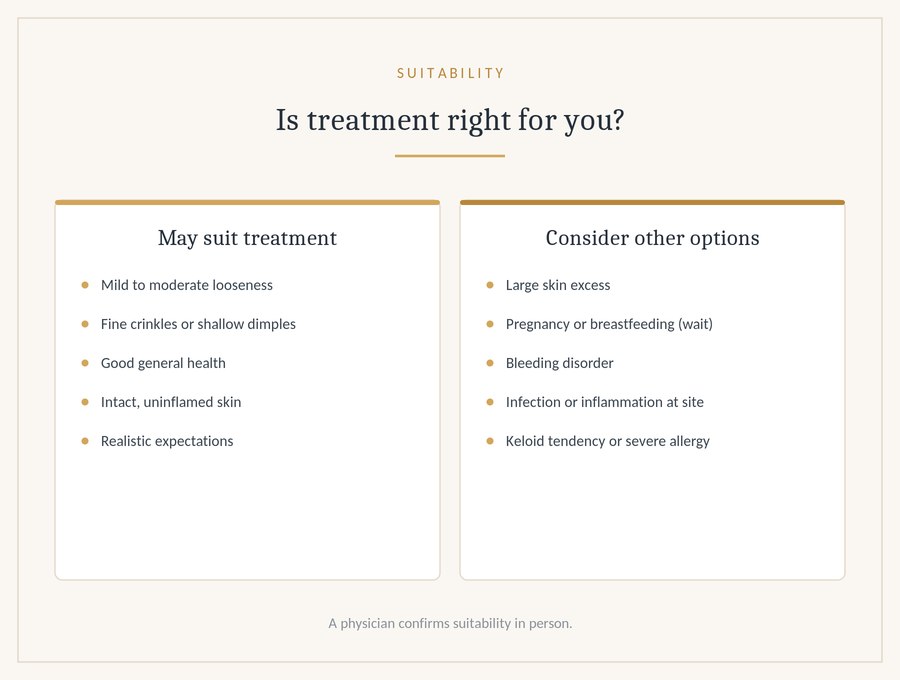
Treatment is usually considered for adults with mild to moderate crinkling, looseness or shallow dimples above the knee who are in good general health, have intact, uninflamed skin and hold realistic expectations. In the knee study, women with milder scores improved the most, and the authors suggest that earlier treatment may work better. The study excluded women with illnesses or medicines that affect wound healing, significant scarring, immunosuppression or autoimmune disease, so these points need individual discussion.
When does another approach make more sense?
Injections and devices can improve the quality of the skin, but they cannot remove excess skin. When there is a large amount of loose, hanging skin, for example after major weight loss, hyperdiluted Radiesse, microneedling and radiofrequency are unlikely to make a meaningful difference, and surgery is usually the option discussed. Deep, widespread dimples or skin problems in the area, such as infection or inflammation, also change the plan.
What Happens at the Appointment and What to Expect Afterwards
The consultation and the injections
The consultation covers your medical history, medicines, allergies, previous treatments, scarring tendency, pregnancy or breastfeeding, and what you would like to change. The skin is examined, and photographs are often taken so that changes can be compared at review. In the knee study, the product was mixed with saline and a little lidocaine immediately before use, injected through a fine cannula in a fan pattern and then massaged in, and the women avoided exercising the area for 24 hours. They rated discomfort during treatment at an average of 2.3 out of 10, and experience varies from person to person.
Recovery: swelling, redness and bruising
Swelling, redness and bruising are common, and temporary skin irregularities can occur. The authors of the knee study reported only minor effects of this kind, lasting two to three weeks. In their detailed results, redness and swelling occurred in almost all of the women and settled within about five days, bruising occurred in 9 of the 20 and lasted one to two weeks, and irregularities occurred in 3 and settled within days. Follow your physician’s aftercare instructions.
When do results appear, and how long do they last?
Calcium hydroxylapatite works by stimulating the skin’s own collagen production, a gradual process, so any change builds slowly rather than appearing at once. The knee study assessed results at three months, a reasonable point at which to judge the outcome. There are no established data on how soon the first change appears or how long it lasts, because the study did not assess duration. Whether to repeat treatment is decided at review, based on how your skin looks.
Risks, Side Effects and Who Should Avoid Treatment
The common effects are those seen in the knee study: swelling, redness, bruising and temporary surface irregularities. Lumps or nodules are a recognised risk of calcium hydroxylapatite, and the risk is higher when less-diluted product is placed too superficially, particularly in thin or darker skin. The US label for the backs of the hands reports lumps in 12% of patients, some lasting up to a year; that is hand data, not knee data, and the knee study followed patients for only three months. Infection is possible with any injection.
Rarely, product can enter a blood vessel and block blood flow, which can damage tissue; in the face, such events have been linked to skin necrosis, vision loss and stroke. Injecting slowly and with low pressure aims to reduce the risk. Severe pain, a pale or dusky patch of skin, or a rapidly worsening change after treatment needs immediate contact with the clinic or emergency care.
Who should avoid or postpone treatment?
Product labels list reasons not to inject, including a history of anaphylaxis or multiple severe allergies, hypersensitivity to any component, bleeding disorders, active inflammation or infection at the site, and a tendency to keloid or other raised scarring or to inflammatory skin conditions. If lidocaine is part of the mix, allergy to local anaesthetics must also be disclosed. Treatment is postponed during pregnancy and breastfeeding. Blood-thinning medicines increase bruising and should be discussed with the prescribing doctor, not stopped without advice. Suitability can only be confirmed by a licensed physician in person.
How Much Does Crepey Knees Treatment Cost in Dubai?
Market rates for Radiesse in Dubai generally run from around AED 2,000 to AED 4,500 per syringe. The total depends on the number of syringes, which is decided after assessment and varies with the area, whether one or both legs are treated and the severity of the changes. Before treatment starts, the plan should state the product, the number of syringes and what follow-up is included. Skin boosters, microneedling and radiofrequency are priced separately.
Choosing Who Treats You
As this is an off-label use that depends on dilution and injection technique, the person injecting should be a licensed physician whose DHA licence you can verify on the DHA Sheryan portal. Ask about their experience with this treatment on the thigh and knee, how they assess the skin before injecting, and what they would do if a lump appeared.
A sound plan names the product and its dilution, the number of syringes, a review at around three months, written aftercare and a clear way to reach the clinic. The page on cellulite treatment gives an overview of the options for dimples. At dr-soheila.com, treatments are planned and performed by Dr Soheila Eskandari, a DHA-licensed general practitioner with aesthetic privileges with 20 years of experience in aesthetic medicine.
The Short Version
Skin above the knee crinkles and sags because it is thin, moves constantly and loses collagen and elastin with age, with sun, weight change and genetics adding to the effect. Crepey knees treatment can include hyperdiluted Radiesse, studied in a 2020 pilot of 20 women where scores improved at three months, mainly in milder cases, as well as skin boosters, microneedling and radiofrequency. The research is small and retrospective, and durability is unknown.
Swelling, redness, bruising and surface irregularities can last two to three weeks, and lumps, infection and rare vascular events are possible. Treatment is postponed in pregnancy and breastfeeding, and large skin excess after major weight loss is usually a surgical question. Dr Soheila uses diluted Radiesse for crepey, loose skin above the knees after an in-person assessment; its use on the knee is off-label in the United States.
Questions Worth Asking
Is my concern crepey skin, dimples or both? The answer decides whether skin-quality treatment alone is likely to be enough.
What does the evidence for this treatment actually show? Expect to hear about the small 2020 study and the lack of durability data.
Is surgery a better fit for the amount of loose skin I have? Large skin excess is not something injections or devices can remove.
How many syringes will I need, and what review is included? The plan should state both before you agree.
Frequently Asked Questions
What causes crepey skin above the knees?
Thin skin that folds with every bend of the knee, falling collagen and elastin with age, sun damage, weight change and inherited skin type all contribute.
Can crepey knees be treated without surgery?
Mild to moderate crinkling and looseness can often be improved to a degree with injections, devices and skin care, but none of these removes excess skin, and results vary.
Does hyperdiluted Radiesse work for crepey knees?
A 2020 pilot of 20 women reported improved scores at three months, mainly in milder cases, but it was small and retrospective, and results vary.
How long do the results last?
This is not established, because the knee study followed patients for three months and did not assess duration, so no reliable figure can be given.
Is Radiesse approved for use on the knees?
Not in the United States, where its approved uses are specific areas such as the face and the backs of the hands, so use above the knee is off-label.
What are the side effects of treatment?
Swelling, redness, bruising and skin irregularities lasting two to three weeks were reported in the knee study; lumps, infection and rare vascular events are also possible.
Do skin boosters, microneedling or radiofrequency help crepey knees?
They can improve hydration, texture or firmness in some people, but they do not remove loose skin, and knee-specific evidence for them is limited.
Who should avoid this treatment?
People with bleeding disorders, severe allergies, active infection or inflammation at the site or a keloid tendency, and those who are pregnant or breastfeeding, should avoid or postpone it.
Can I stop crepey knees from getting worse?
Sun protection, a steady weight and thigh strength help the skin you have, but age and genetics cannot be changed, so some progression may still occur.
What does crepey knees treatment cost in Dubai?
Market rates for Radiesse in Dubai generally run from around AED 2,000 to AED 4,500 per syringe, and the total depends on the number of syringes needed after assessment.
This article is general information about aesthetic and dermatological treatments and is not medical advice, a diagnosis, or a treatment recommendation for any individual. Outcomes vary between patients and no result is guaranteed. Prescription medications and injectable products carry risks and contraindications that must be assessed by a licensed physician during a personal consultation. Dr Soheila Eskandari is licensed by the Dubai Health Authority. Prices quoted are general market ranges for information only and are not an offer.

 English
 Arabic