
Crepey Upper Arms in Dubai: Treating Loose, Wrinkled Skin on the Arms
Crepey Upper Arms in Dubai: Treating Loose, Wrinkled Skin on the Arms
Crepey arms treatment starts with matching the option to the problem. Thin, crinkled skin with mild looseness is usually treated with collagen-stimulating injections, such as diluted calcium hydroxylapatite or poly-L-lactic acid, skin boosters or skin-tightening devices, while a large amount of hanging skin can only be removed with surgery (brachioplasty). The evidence for non-surgical treatment of the upper arms comes from small studies and consensus guidance, so improvement is usually gradual and partial, and a licensed physician should examine your arms in person first.
The skin on the inner upper arm is thin, has little support beneath it and loses collagen and elastin with age, sun exposure and weight change. This guide covers why it becomes crepey, how each option works, what the evidence shows, who each option suits, what to expect, the risks, who should avoid treatment and what it costs in Dubai.
Why Does the Skin on the Inner Upper Arm Become Crepey?
Crepey skin is thin, finely wrinkled skin that looks crinkled, like crepe paper, and springs back slowly when pinched and released. The inner upper arm is prone to it because the skin there tends to be thinner than on the outer arm, many people have little fat or muscle beneath it, and it is stretched and folded each time the arm moves.
Collagen, elastin and ageing
From early adulthood the skin makes less collagen, which gives it thickness, and its elastin fibres, which let it spring back, become fewer and more fragmented. The hormonal changes of the menopause and smoking speed up skin thinning. Genetics play a part, and muscle bulk also tends to fall with age, so the skin loses some of its support.
Sun, weight change and daily life
Ultraviolet light breaks down collagen and elastin. In a city with strong sun all year the outer arm takes most of it, while the inner arm is usually less exposed, so ageing and weight change often matter more there. Weight gain stretches the skin, and weight loss, especially when rapid, leaves more skin than the arm needs. How well skin retracts afterwards depends on age, genetics, sun damage, smoking and how long the weight was carried.
Crepey, Loose or Fuller? Working Out What You Have
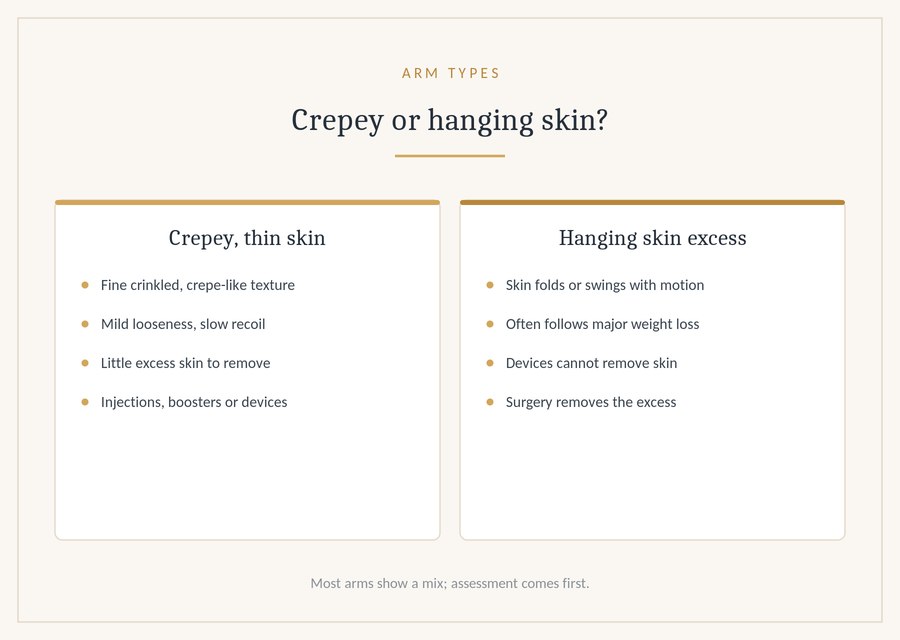
Three different problems are often called crepey arms. Crepey skin is a quality problem: thin, crinkled skin with mild looseness. Hanging skin is a quantity problem: more skin than the arm needs, which folds or swings when you move, often after major weight loss. Fullness is a volume problem: fat on the upper arm, which skin treatments do not remove. Many people have a mixture, and the mixture decides which option is realistic.
At an assessment, a physician examines the arm at rest and raised, checks how the skin recoils after a gentle pinch, judges how much of the bulk is skin and how much is fat, and asks about weight history and any previous surgery in the armpit or breast.
What Are the Options for Crepey Arms Treatment?
There is no single standard treatment. The main options are collagen-stimulating injections, energy-based skin tightening, skin boosters, everyday measures and surgery, and they are often combined. Our guide to collagen biostimulators explains the injectable group in more detail, and our article on crepey knees treatment covers a similar problem on another body area.
Diluted Radiesse (calcium hydroxylapatite)
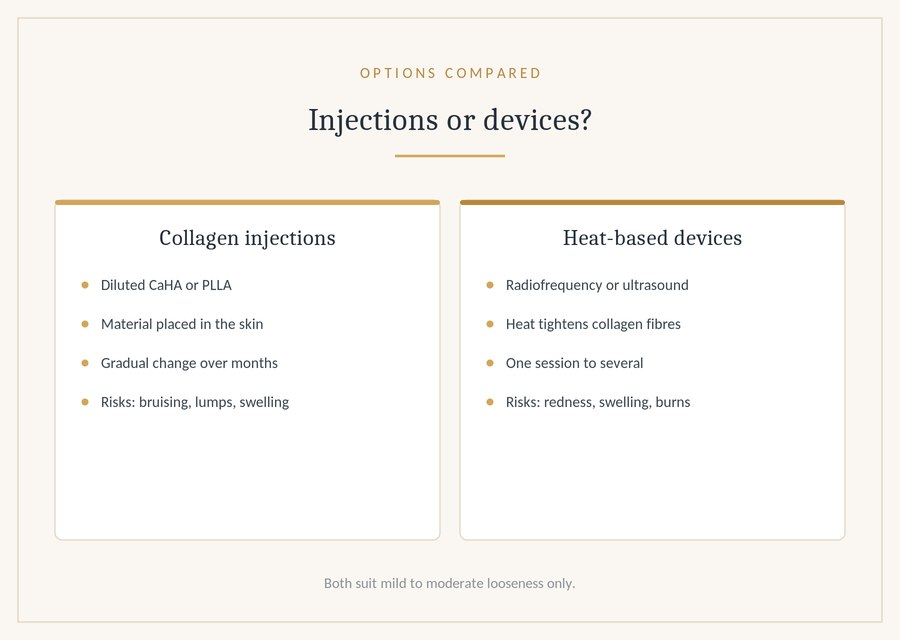
Calcium hydroxylapatite (CaHA) is a mineral similar to that in bone, supplied in Radiesse as microscopic spheres suspended in a gel. When the product is diluted (or, at higher dilutions, hyperdiluted) with saline, local anaesthetic or both, and placed in the skin with a needle or blunt cannula, the aim is stimulation rather than volume: the spheres prompt the skin to make new collagen and elastin. Biopsy studies show new collagen and elastin forming over several months, so change is gradual.
Evidence for the upper arm is limited. In a case series of ten women, CaHA diluted 1:2 was injected into the upper arms in a single session, and skin elasticity was higher after three months. An international consensus supports hyperdiluted CaHA for mild laxity and thin skin on the upper arms, but not where the looseness is mainly excess fat, and a systematic review of its use on the body noted that diluted techniques have not yet been tested in randomised controlled trials. In the US the FDA has not approved Radiesse for the upper arms, so use there is off-label, meaning outside the approved uses.
It suits mild to moderate crepiness in thin skin with little excess fat or skin. Dilution ratios are not standardised, the case series used one session, and how long the benefit lasts on the arm is not established. Dr Soheila uses diluted Radiesse (calcium hydroxylapatite) for crepey, lax skin on the body, including the upper arms, after an in-person assessment. The Radiesse treatment page gives an overview, and our article on Radiesse for cellulite covers another body use of diluted calcium hydroxylapatite.
Poly-L-lactic acid (PLLA) biostimulators
Poly-L-lactic acid is a biodegradable material, used in products such as Sculptra, injected as a suspension of microscopic particles. It does not add volume straight away: the particles provoke a slow tissue response that leads the skin to lay down new collagen over weeks to months, so improvement is gradual and treatment usually involves more than one session.
For the body, an international consensus statement describes the evidence as mostly observational and case-series data, with potential benefit in areas including the upper arms, and calls for standardised protocols. Use on the arms is generally off-label. PLLA suits thin, mildly lax skin where a slower, cumulative effect is acceptable, and like the other options in this group it cannot remove excess skin. Our comparison of Sculptra and Radiesse explains how the two materials differ.
Radiofrequency and microfocused ultrasound
Radiofrequency (RF) and microfocused ultrasound with visualisation (MFU-V) use controlled heat in the skin to tighten collagen fibres and prompt new collagen over the following months. RF delivers energy through electrodes on the skin surface; MFU-V focuses ultrasound at set depths below it, guided by an image on screen. Neither involves a cut, but both can be uncomfortable.
The evidence is stronger for the face and neck than for the body. For the upper arms, an international consensus supports MFU-V for mild to moderate laxity, but the data are limited to small studies, and systematic reviews of ultrasound and radiofrequency for sagging skin found few randomised trials and called for standardised research. Change appears gradually over a few months and is generally mild to moderate rather than dramatic.
Some protocols use one session and others a course of several, depending on the device, so ask for the plan in writing. These options suit mild to moderate looseness with little excess fat, and they are not an alternative to surgery for a large amount of hanging skin. Our guide to skin tightening in Dubai covers non-surgical tightening in more depth.
Skin boosters
Skin boosters are injectable preparations, such as lightly crosslinked or non-crosslinked hyaluronic acid or polynucleotides, placed at many tiny points in the skin to improve hydration, elasticity and texture. They suit crinkled texture and early looseness better than hanging skin. Published data on the upper arm are scarce: one small study in nine people who had lost a lot of weight gave two sessions 30 days apart and found more elastic fibres in the treated arm under the microscope, but it did not measure how the arms looked.
Strength training, skin care and a stable weight
These measures do not tighten skin that has lost its recoil, but they change how the arm looks and support other treatment. Resistance exercise for the triceps, biceps and shoulders builds muscle under the skin, which improves contour and takes up some slack, although exercise cannot remove fat from one chosen area. A stable weight avoids repeated stretching, and losing weight gradually with enough protein and resistance training helps preserve muscle. Daily sunscreen, a moisturiser containing urea or ceramides, not smoking and, for suitable people, a prescription retinoid (not in pregnancy) support skin quality over months. Discuss diet and weight-loss medicines with your doctor.
Surgery (brachioplasty) for significant skin excess
Brachioplasty, or arm lift, removes excess skin, and sometimes fat, from the inner arm and closes the incision, usually leaving a scar that runs from the armpit towards the elbow. It is the option for a large amount of hanging skin, such as after major weight loss, when injections and devices cannot take up the slack. A surgeon performs it, often under general anaesthesia.
The scar fades over many months but does not disappear. Risks include delayed wound healing, widened scars, fluid collection (seroma) or bleeding, infection, numbness from nerve injury, swelling from lymphatic damage, asymmetry and the need for revision. Recovery involves a compression garment and limits on lifting and stretching for several weeks. A stable weight and not smoking lower the risks.
What to Expect: Sessions, Results and Recovery
The consultation covers your medical history, medicines, allergies, pregnancy or breastfeeding, and previous treatment or surgery near the arm, and should end with a written plan naming the product or device, the number of sessions and a review date. For injections, the skin is cleaned and may be numbed, and the product is placed along the inner arm through a needle or cannula.
Collagen takes time to form, so expect gradual change over weeks to months, and a review at around three months before more treatment is decided. Session numbers differ by option, as described above, and the written plan should state them. How long benefits last on the arm is not well established for any non-surgical option, so repeat treatment is planned from how the arm looks at review.
After injections, expect tenderness and swelling, avoid heavy lifting, strenuous arm exercise and heat such as saunas for the period your physician advises, and follow any massage instructions. After heat-based treatments, protect the skin from the sun.
Side Effects and Risks
Bruising, swelling, tenderness and redness are common after injections and usually settle within days to a couple of weeks. Small firm lumps can form along the injection lines, most often when product is placed too shallowly or is not well dispersed, and they may appear days to months later. CaHA and PLLA cannot be dissolved with hyaluronidase, so prevention matters. Less commonly there can be infection, asymmetry or an allergic reaction, and, rarely, a blocked blood vessel, which needs urgent care. Contact the clinic urgently for severe or worsening pain, a pale, dusky or cold patch of skin, fever, or spreading redness.
Heat-based devices can cause redness, swelling, bruising, temporary numbness or tingling and, less often, blistering or burns.
Who Should Avoid Treatment?
Injectable biostimulators are usually postponed in pregnancy and breastfeeding, because data are limited, and avoided when there is infection, inflammation or active skin disease in the area, a known allergy to a component or a history of severe allergic reactions. Extra care is needed with bleeding disorders or blood-thinning medicines, autoimmune or connective tissue conditions and a tendency to thick scars. Anyone who has had lymph nodes removed or radiotherapy in the armpit, or who has lymphoedema, needs clearance from their treating team first. Radiofrequency is avoided with a pacemaker or other implanted electronic device or metal implants in the treated area, and heat treatments are not used over skin cancer or open wounds. Only a licensed physician can judge suitability, in person.
Choosing Who Treats You
Body injections and energy devices are medical treatments, so the person treating you should be a licensed physician whose DHA licence you can verify on the DHA Sheryan portal. Ask about their experience with this specific treatment on the arms, whether they examine your arms and weigh up skin, fat and muscle first, and whether they will say plainly when surgery is the more suitable route.
A sound plan names the product or device, the dilution or settings, the number of sessions and the cost in writing, explains what is off-label, and includes a review at around three months, written aftercare and a way to reach the clinic. The page on biostimulator treatments gives an overview of this group. At dr-soheila.com, treatments are planned and performed by Dr Soheila Eskandari, a DHA-licensed general practitioner with aesthetic privileges with 20 years of experience in aesthetic medicine.
The Short Version
Crepey upper arms come from thin skin losing collagen and elastin through ageing, sun, hormonal change and weight change. Mild to moderate crepiness and looseness can be treated with diluted calcium hydroxylapatite, poly-L-lactic acid, skin boosters or heat-based devices, which work gradually over months and are supported mainly by small studies. Surgery is for a large amount of hanging skin, and strength training, sun protection and a stable weight support every option.
Bruising, swelling and tenderness are common; lumps, infection and other complications are less common, and some injectables cannot be dissolved. Treatment is postponed or avoided in pregnancy, breastfeeding, local infection and certain medical conditions, and suitability must be confirmed in person by a licensed physician.
Questions Worth Asking
Is my problem skin quality, skin excess or fat? The answer decides whether injections, devices or surgery are realistic.
What is the evidence for this treatment on the upper arms, and is it off-label? Expect a plain answer that the data are small studies.
How many sessions will I need, and when is the review? The plan should state sessions, intervals and a review date in writing.
What happens if I develop a lump or another problem? Some products cannot be dissolved, so ask about prevention and follow-up.
Frequently Asked Questions
Can crepey arms be treated without surgery?
Mild to moderate crepiness and looseness can often be improved gradually with injections or devices, but a large amount of hanging skin can only be removed surgically.
Why are the inner upper arms so prone to crepey skin?
The skin there tends to be thin, has little support beneath it and is stretched and folded constantly, and it loses collagen and elastin with age, hormonal change and weight change.
How does diluted Radiesse work on the arms?
Diluted calcium hydroxylapatite is placed in the skin to prompt new collagen and elastin, so change is gradual and builds over months.
Is there evidence for diluted calcium hydroxylapatite on the arms?
Evidence is limited to small studies, including a case series of ten women; randomised controlled trials are lacking, and the US FDA has not approved it for the upper arms.
How many sessions will I need?
It depends on the option: diluted calcium hydroxylapatite was studied as one session on the arms, skin boosters as two sessions a month apart, PLLA is usually a course, and devices range from one session to several.
How long do the results last?
Duration on the arm is not well established for any non-surgical option, so repeat treatment is planned from how the arm looks at review.
Can exercise tighten crepey arms?
Strength training builds muscle under the skin and improves contour, but it cannot restore lost skin elasticity or remove fat from one chosen area.
When is surgery the more suitable option?
When there is a large amount of hanging skin, as after major weight loss, because injections and devices cannot remove skin.
Who should not have treatment for crepey arms?
Treatment is usually postponed in pregnancy and breastfeeding and avoided with local infection, known allergy, certain medical conditions or, for radiofrequency, an implanted electronic device; anyone with armpit lymph node surgery needs clearance from their treating team first.
What does crepey arms treatment cost in Dubai?
Market rates generally run from around AED 2,000 to AED 4,500 per syringe of Radiesse, and the total depends on the number of syringes used; other options vary widely by device, area and number of sessions, so ask for a written quote after an assessment.
This article is general information about aesthetic and dermatological treatments and is not medical advice, a diagnosis, or a treatment recommendation for any individual. Outcomes vary between patients and no result is guaranteed. Prescription medications and injectable products carry risks and contraindications that must be assessed by a licensed physician during a personal consultation. Dr Soheila Eskandari is licensed by the Dubai Health Authority. Prices quoted are general market ranges for information only and are not an offer.


 English
 Arabic