
AestheFill vs Sculptra in Dubai: Two Polylactic Acid Biostimulators Compared
AestheFill vs Sculptra in Dubai: Two Polylactic Acid Biostimulators Compared
AestheFill and Sculptra are both polylactic acid biostimulators: injectable particles that prompt the skin to make its own collagen, so volume and firmness improve gradually over months rather than straight away. Sculptra uses poly-L-lactic acid and has the longer research record, including US FDA approvals, while AestheFill uses poly-D,L-lactic acid made into microspheres, and there is no clinical trial showing that either gives better results than the other.
This guide explains how polylactic acid works, how the two products differ in their chemistry and preparation, which areas they are used for, what a course involves, how long results last, the risks, including nodules, and who should avoid treatment. It also covers costs in Dubai. Results vary between people, and suitability must be confirmed in person by a licensed physician.
What Is Polylactic Acid?
A material the body absorbs
Polylactic acid is a synthetic polymer that the body breaks down slowly into lactic acid, which is then removed through normal metabolism. It has been used in medicine for decades, for example in dissolvable stitches. In aesthetic medicine, tiny particles of polylactic acid are suspended in a carrier gel and injected under the skin or deeper, near the bone.
How it stimulates collagen
Once injected, the particles cause a controlled response in the surrounding tissue. Cells called fibroblasts are drawn to the particles and lay down new collagen around them over the following weeks and months. As the particles are slowly absorbed, the new collagen remains. The fullness you see on the day of treatment comes mainly from the water used to mix the product and fades within days. The lasting change develops gradually, which is why polylactic acid is described as a biostimulator rather than a filler.
Why the result is gradual
Because the body makes the collagen, results appear over around two to three months after each session and continue to develop for some time after a course. This suits people who prefer a slow, natural-looking change, but it does not suit anyone who needs an immediate result for an event.
How Do AestheFill and Sculptra Differ?
The polymer
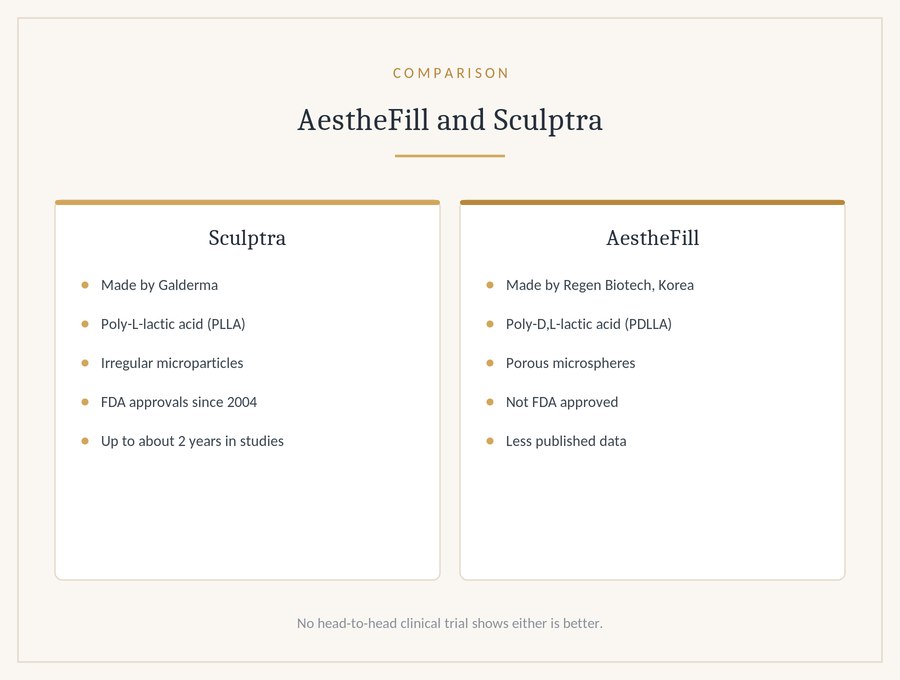
Sculptra, made by Galderma, contains poly-L-lactic acid, often shortened to PLLA. AestheFill, made by Regen Biotech in South Korea, contains poly-D,L-lactic acid, or PDLLA, which combines two mirror-image forms of the lactic acid unit. The manufacturer of AestheFill describes PDLLA as forming a more flexible polymer, and some authors suggest it may be absorbed in a slightly different way, but there are no head-to-head clinical trials showing a difference in results.
Particle shape
Sculptra particles are irregular microparticles. AestheFill is produced as porous microspheres, which the manufacturer describes as allowing more uniform distribution in the tissue. Particle shape and size influence how the product is mixed and injected, but how much they affect outcomes in patients has not been established.
Preparation
Both products come as a dry powder in a vial with a carrier, carboxymethylcellulose, and must be mixed with sterile water, sometimes with local anaesthetic added, before injection. Sculptra was traditionally hydrated for a day or more before use, although newer consensus recommendations describe shorter protocols. AestheFill is often promoted as quicker to prepare, but a laboratory study comparing polylactic acid products found that AestheFill took longer to reconstitute than Sculptra under its test conditions, and experts disagree about what drives preparation time. In practice, both products need careful mixing to avoid clumps, which are linked to nodules.
Evidence and approvals
Sculptra was approved by the US FDA in 2004 for facial fat loss in people with HIV, in 2009 for nasolabial folds and other facial wrinkles, and later for cheek wrinkles. Its long-term studies report results lasting up to around two years. AestheFill has a smaller body of published research, much of it from Asia, and is not among the products approved by the US FDA. That is a difference in regulation and evidence, not proof that results differ. As with any injectable, ask how the product in use is registered in the UAE.
Which Areas Are They Used For?
The face
On the face, polylactic acid is mainly used where volume has been lost gradually: the temples, the cheeks, the area in front of the ears, the sides of the jaw and the lines from the nose to the mouth. It is spread over broad areas rather than used to sculpt a precise point, so it suits overall volume loss and thinning skin more than a specific shape. Our guide to temple volume loss describes one common area.
The body
Diluted polylactic acid is also used off-label on the body, for example for crepey skin on the arms, knees and décolletage, and for the buttocks. These uses need larger amounts and several sessions, and the evidence is more limited. The articles on crepey arms and crepey knees look at the options for those areas.
Areas where it is not used
Polylactic acid is not used in the lips, in the thin skin under the eyes or in other areas where the skin is very thin and mobile, because nodules are more likely and more visible there. It cannot be dissolved, so it is placed conservatively.
Who Is a Good Candidate for a Biostimulator?
Polylactic acid tends to suit people with gradual, widespread volume loss and thinning skin, for example hollowing at the temples, a flatter midface or a face that looks tired rather than having one specific line. It is often considered from the late thirties onwards, when collagen loss becomes more visible, and by people who prefer a slow change that friends and colleagues are unlikely to notice as a sudden difference.
It is less suitable for people who want precise shaping of one feature, such as the chin or lips, where a hyaluronic acid filler gives more control, or for those with significant skin laxity, where no injectable can replace a surgical lift. Because the body’s own response produces the result, it is also less predictable in people whose collagen response is reduced, for example heavy smokers. Our overview of collagen biostimulators explains how they compare with other options.
How Should I Prepare?
Tell the physician about all medicines and supplements, as blood thinners, aspirin, fish oil and some herbal products increase bruising; do not stop a prescribed medicine without advice from the doctor who prescribed it. Mention any previous fillers or implants in the areas to be treated, including long-lasting non-dissolvable products, any dental work planned in the coming weeks and any history of cold sores. Because the result builds slowly and swelling is common for a few days, schedule the course well ahead of important events and plan to be available for the follow-up sessions.
What Does a Course Involve?
The assessment
The physician assesses where volume has been lost, how thick and elastic the skin is, and whether the concern is better treated with a biostimulator, a hyaluronic acid filler or a combination. Your medical history, medicines, allergies, previous fillers and tendency to scarring are reviewed.
The injections
After the skin is cleaned and numbing is applied if needed, the mixed product is injected with a needle or a blunt cannula, usually deep under the skin or near the bone on the face. The physician distributes it evenly and may massage the area at the end. A session usually takes thirty to forty-five minutes.
How many sessions and vials
A course commonly involves two or three sessions spaced around four to six weeks apart, with the number of vials depending on the degree of volume loss and the areas treated. Spacing the sessions allows the physician to see how much collagen has formed before adding more, which helps avoid overcorrection.
Aftercare and massage
Massage of the treated area is commonly advised after treatment, with the frequently quoted guide being five minutes, five times a day, for five days, although your physician may give different instructions. Swelling and tenderness are expected for a few days, and strenuous exercise, saunas and facials are usually avoided briefly.

How Long Do Results Last?
The fullness seen on the day of treatment fades within days. The collagen response becomes visible over the following weeks, and the result builds through the course. Sculptra studies report results lasting up to around two years, and AestheFill materials describe similar durations, although published data for AestheFill are more limited. Many people choose a maintenance session every year or two. Duration depends on age, metabolism, sun exposure, smoking and how much volume was lost to begin with.
What Are the Risks?
Common and expected effects
Swelling, tenderness, redness and bruising at the injection sites are common and usually settle within days to two weeks.
Papules and nodules
The most widely recognised complication of polylactic acid is the formation of small lumps under the skin. Some can be felt but not seen and soften over time, while others are visible and persistent. They are linked to inadequate mixing, too concentrated a product, injection too close to the surface and use in thin, mobile areas. Because polylactic acid cannot be dissolved like hyaluronic acid, nodules are managed with massage, injected medication or, rarely, removal.
Less common complications
Infection, delayed inflammatory reactions, discolouration and allergic reactions can occur. As with any injection in the face, there is a rare risk of the product entering or pressing on a blood vessel, and severe pain or skin colour change needs urgent review.
Who Should Avoid AestheFill and Sculptra?
Treatment is postponed during pregnancy and breastfeeding, during active infection or inflammation at the site, and around illness. It is avoided in people with known allergy to any component. People with autoimmune conditions, a tendency to keloid or hypertrophic scarring, bleeding disorders or those taking blood-thinning medicines need a careful assessment first. Anyone who needs an immediate result, or who is unable to attend a course and follow massage instructions, is usually better served by another option. A licensed physician must confirm suitability in person.
AestheFill, Sculptra or Another Biostimulator?
Dr Soheila works with Sculptra and AestheFill. The choice between them depends on the area, the amount of volume loss, the skin, previous treatments and the physician’s experience with each product, rather than on one being superior. Calcium hydroxylapatite products such as Radiesse are another type of biostimulator, which add some immediate support as well as stimulating collagen, and our comparison of Sculptra and Radiesse explains how they differ. The pages on Sculptra and AestheFill describe each treatment.
Choosing Who Treats You
Biostimulators need careful mixing, placement and follow-up, so choose a licensed physician whose DHA licence you can verify on the DHA Sheryan portal and who uses these products regularly. Ask how the product will be prepared, how many vials and sessions are planned, and how nodules would be managed if they occurred.
A sound plan also includes written aftercare with massage instructions, reviews between sessions and photographs to track gradual change. At dr-soheila.com, treatments are planned and performed by Dr Soheila Eskandari, a DHA-licensed general practitioner with aesthetic privileges with 20 years of experience in aesthetic medicine.
The Short Version
AestheFill and Sculptra are polylactic acid biostimulators that prompt the body to make its own collagen, so volume and firmness improve gradually over months. Sculptra uses poly-L-lactic acid and has more published research and FDA approvals. AestheFill uses poly-D,L-lactic acid microspheres and has less published data. No trial shows that either is better overall.
A course of two or three sessions, four to six weeks apart, is common, and results may last up to around two years. Swelling and bruising are common, and nodules are the main complication, reduced by careful preparation and placement. Neither product is used in the lips or under the eyes, and pregnancy, breastfeeding, infection and allergy are reasons to avoid treatment. A licensed physician must assess suitability in person.
Questions Worth Asking
Which product do you recommend for me, and why? The answer should relate to your areas, skin and goals rather than to a claim that one product is stronger.
How many vials and sessions will I need, and what is the total cost? A course is easier to judge when the full plan is clear from the start.
How do you prepare the product to reduce the risk of nodules? Careful mixing, dilution and placement are central to how these products behave.
What massage and aftercare should I follow? You should leave with clear written instructions.
Frequently Asked Questions
What is the difference between AestheFill and Sculptra?
Both are polylactic acid biostimulators; Sculptra contains poly-L-lactic acid and has more published research and FDA approvals, while AestheFill contains poly-D,L-lactic acid microspheres, and no trial shows either is better overall.
Which is better, AestheFill or Sculptra?
Neither can be called better in general; the choice depends on the area, the skin, the amount of volume loss and the physician’s experience with each product.
How do polylactic acid injections work?
The particles prompt fibroblasts to lay down new collagen over weeks and months, and as the particles are slowly absorbed, the new collagen remains.
When will I see results from AestheFill or Sculptra?
The fullness on the day fades within days, and the collagen response becomes visible over around two to three months, building through the course.
How many sessions are needed?
Commonly two or three sessions spaced about four to six weeks apart, with the number of vials depending on the areas and the degree of volume loss.
How long do AestheFill and Sculptra last?
Sculptra studies report results lasting up to around two years, and AestheFill is described similarly, although its published data are more limited.
Can AestheFill or Sculptra be dissolved?
No, polylactic acid cannot be dissolved with hyaluronidase, so it is placed conservatively and any nodules are managed with massage, injected medication or, rarely, removal.
What are the risks of polylactic acid injections?
Swelling, bruising and tenderness are common; papules and nodules are the main complication, and infection, delayed reactions and vascular problems are rare.
Who should avoid AestheFill and Sculptra?
People who are pregnant or breastfeeding, have infection at the site, allergy to the components or a tendency to keloid scarring should avoid it, and autoimmune conditions need assessment first.
What do AestheFill and Sculptra cost in Dubai?
Market rates generally run from around AED 1,800 to AED 4,500 per vial of Sculptra and around AED 1,500 to AED 3,500 per session of AestheFill, and a course usually needs several vials, so ask for the full total in writing.
This article is general information about aesthetic and dermatological treatments and is not medical advice, a diagnosis, or a treatment recommendation for any individual. Outcomes vary between patients and no result is guaranteed. Prescription medications and injectable products carry risks and contraindications that must be assessed by a licensed physician during a personal consultation. Dr Soheila Eskandari is licensed by the Dubai Health Authority. Prices quoted are general market ranges for information only and are not an offer.


 English
 Arabic