
Natural Lip Filler in Dubai: How Subtle, Balanced Lip Enhancement Is Planned
Natural Lip Filler in Dubai: How Subtle, Balanced Lip Enhancement Is Planned
Natural lip filler in Dubai means using a small, carefully planned amount of hyaluronic acid gel, often around 0.5 to 1 ml in a first session, to improve the balance between the lips and the rest of the face rather than to make the lips as large as possible. The aim is a softer, better-defined and more proportionate lip that moves normally, with further small amounts added in stages only if the first result, judged once swelling has settled, calls for them.
This guide explains how the lips and face are assessed, why volumes are kept small and treatment is staged, how softer and firmer gels differ, how an overfilled look and filler migration are avoided, when filler is dissolved, and which risks and exclusions apply. If you are still deciding, our overview of lip filler in Dubai covers the basics. This is general information, and your own physician’s instructions always take priority.
What Does Natural Lip Filler in Dubai Actually Mean?
Natural describes how a result looks, not a product or a fixed volume, and it means different things to different people. The phrase “natural lip filler Dubai” covers a wide range of requests, from a change that others barely notice to visibly fuller lips that still look proportionate.
In planning terms, natural usually means lips that suit the face, with an upper and lower lip that balance each other, a soft feel, normal movement when speaking and smiling, and no obvious sign that filler has been used. This is the aim of careful planning, not a promise, because results depend on your anatomy, the gel used and how you heal. The first step is agreeing what natural means for you; photographs of lips you like can help, although your anatomy sets the limits.
How Are Your Lips and Face Assessed Before Treatment?
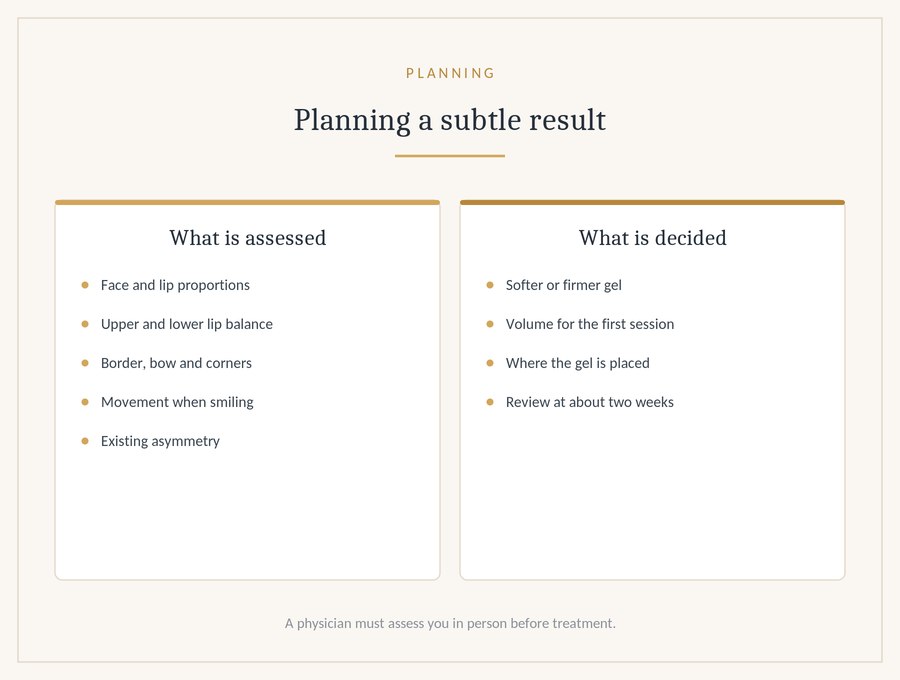
A proper assessment looks at the whole face first and the lips second, at rest, while smiling and while speaking.
What is looked at in the face?
The lips sit in the lower third of the face, so the physician considers the length of the upper lip, the position of the chin, the width of the mouth and how much of the upper teeth shows at rest and when smiling. A recessed chin or a long upper lip can change which proportion suits you. Photographs are usually taken for comparison.
What is looked at in the lips?
The lips are then assessed in detail: the balance of upper to lower lip, the sharpness of the border, the Cupid’s bow, the two vertical ridges of the philtrum, the corners of the mouth and any asymmetry, which almost everyone has. A lower lip that is somewhat fuller than the upper is a common reference point, but anatomy and preferences vary, so it is a guide and not a rule. Lips also thin and lose definition with age, so definition may matter more than size. Skin quality, scars and any previous filler are noted, together with your medical history, medicines and cold sore history.
The outcome of an assessment may be a smaller plan than you expected, a different order of treatment, or advice not to treat.
How Much Filler Is Used for a Subtle Result?
A subtle first session often uses about 0.5 to 1 ml of hyaluronic acid gel in total across both lips, and a standard filler syringe holds 1 ml. The exact amount depends on your lips, the change you want and the gel chosen, and can be less than 0.5 ml. Small volumes matter because the lips are small, mobile structures where minor differences change the shape, and adding more later is far easier than taking it away.
For context, a 12-month, manufacturer-supported randomised trial of 60 people with very thin to moderately thick lips, published in Dermatologic Surgery, compared two hyaluronic acid lip gels. To raise lip fullness by at least one grade on a five-point scale, the mean volume injected was about 1.5 ml for one gel and 1.9 ml for the other, with an optional touch-up allowed at two weeks. That is what a measurable gain required, not a recommended amount. A subtle plan usually uses less, and a clearly fuller result generally needs more gel, more sessions, or both.
Why is lip filler often done in stages?
Staging means treating in steps: a modest first session, a review at around two weeks once swelling has settled, then a further small touch-up only if the lips need it. The interval is a clinical decision, and some physicians wait longer than the two weeks allowed in the trial above. Staging lets you see how your lips swell and how the gel settles before more is added. The drawbacks are an extra appointment and a longer route to the final shape. Each later session should take account of the gel still present, and the total volume used should be recorded.
What Is the Difference Between Hydrating and Shaping Fillers?
Hyaluronic acid fillers differ in how firmly they hold their shape. Softer, flexible gels spread evenly, leave the lips smoother and gently fuller, and move easily with the mouth. This is often called a hydration-style effect, because hyaluronic acid binds water. Firmer, more cohesive gels hold their form better and suit places where structure matters, such as the lip border, the Cupid’s bow and the philtrum ridges.
Neither type is better in general. A soft gel alone cannot create a crisp outline, while a firm gel used generously in a thin, mobile lip can feel hard and look stiff. Some plans use a soft gel for the body of the lip and a small amount of firmer gel only where definition is needed. Most published lip studies measure fullness, so evidence for hydration as a separate benefit is limited.
Dr Soheila works with Stylage and Juvederm. Stylage is a range of cross-linked hyaluronic acid gels made by Vivacy that contain mannitol, an antioxidant, and it includes gels designed for the lips. Juvederm is a range of cross-linked hyaluronic acid gels made by Allergan Aesthetics, from soft gels designed for lips and fine lines around the mouth to firmer gels designed for deeper structure. Both ranges include softer and firmer options, so the choice follows your lips, not a brand name.
How Is the Overfilled Look Avoided?
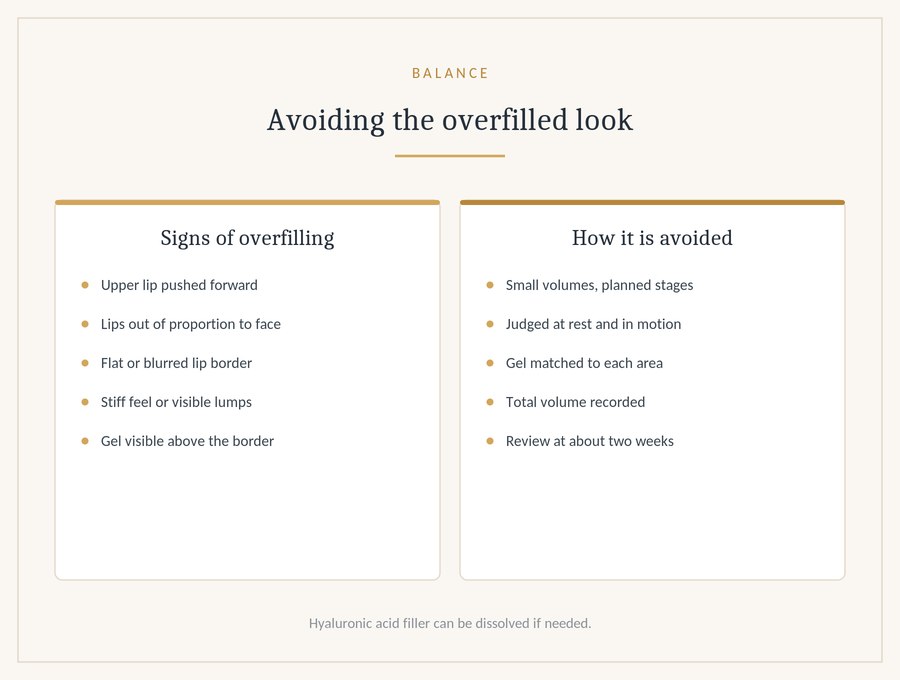
The overfilled look usually comes from too much gel placed too quickly, or from a gel that is too firm for the area, and it is easier to prevent than to correct. Common signs are an upper lip that tilts forward or looks pushed out, lips that seem out of proportion to the rest of the face, a flattened philtrum, a blurred or ridged border and a stiff feel.
To prevent it, the volume is kept modest and added in stages. The lips are judged at rest and in movement, not only in a still photograph, and no adjustment is made while swelling is present. The gel is matched to the area, with firmer gel used sparingly. The total volume over time is tracked, because repeated sessions can add up before earlier gel has broken down. The target is proportion with your face, not a copied shape or trend.
What is filler migration?
Filler migration describes gel that appears to have moved beyond the area where it was placed, for example a soft ridge above the border of the upper lip, sometimes called a filler moustache. Whether gel truly travels or simply spreads along tissue planes under pressure from volume and constant mouth movement is debated, and how often it happens is not well established. Larger volumes, injection too close to the border or too superficially, and repeated treatment over existing gel are commonly cited contributors. Small volumes, careful choice of gel and depth, and spaced sessions help reduce the likelihood, and hyaluronidase can dissolve displaced gel.
Can Lip Filler Be Dissolved?
Yes, hyaluronic acid filler can be dissolved with hyaluronidase, an enzyme that breaks down hyaluronic acid. It is used urgently if filler blocks a blood vessel, and may also be considered for lips that look overfilled or uneven, gel that has shifted and lumps that do not settle. The effect usually begins within hours and builds over a day or two, and more than one session may be needed. Outside an emergency it is usually done once swelling has settled, at around two weeks. It works only on hyaluronic acid products, so your physician needs to know what was used. Risks include rare allergic reactions, swelling, bruising and lips that look flat for a while afterwards. Our guide to dissolving filler in Dubai explains the process.
What Does the Swelling Timeline Look Like?
Swelling is expected. It usually peaks within the first one to two days, eases over days three to five and has mostly settled by around two weeks, which is when the result should be judged. In the randomised trial above, the most common reactions were swelling, bruising and tenderness, mostly mild or moderate, and most had resolved within 14 days. Our day-by-day guide to lip filler swelling in Dubai sets out the course, and our article on how long lip filler lasts explains the longer-term picture, which is typically described in months rather than years.
What Are the Risks of Lip Filler?
Common effects are swelling, bruising, tenderness, redness, small lumps and temporary asymmetry, and they usually fade within about two weeks. Cold sores can be triggered in people who carry the virus. Less common problems include infection, allergic reactions, and lumps or swelling that appear weeks or months later, which need in-person assessment.
Vascular occlusion: what to watch for
The most serious risk is vascular occlusion, where filler blocks or compresses a blood vessel and reduces the blood supply to the skin and lip. It is uncommon, but it is an emergency because tissue can be damaged within hours, and no technique removes the risk entirely. Warning signs are severe or increasing pain, white or pale skin, a mottled, dusky or blue colour, slow return of colour after pressing the skin and, later, blisters or open sores. Any change in vision needs emergency care at once.
Treatment is prompt hyaluronidase, and consensus guidance states that any clinic injecting hyaluronic acid filler should keep it on site and be trained to use it. If you notice these signs, contact the clinic immediately, or go to the nearest emergency department and say that you have had filler.
Who Should Avoid Natural Lip Filler?
Lip filler is usually postponed in pregnancy and breastfeeding, during an active cold sore, infection or inflammation near the mouth, and when there is a known allergy to hyaluronic acid or lidocaine. Extra care is needed with bleeding disorders, blood-thinning medicines, autoimmune conditions, a history of severe allergy or abnormal scarring, and previous long-lasting or non-dissolvable filler in the lips. Filler is intended for adults, and treatment may be advised against if expectations cannot be met realistically. Avoid booking within about two weeks of an important event. A licensed physician must assess suitability in person.
If you would like only a slight change in how much upper lip shows, our comparison of the lip flip versus lip filler explains how the two options differ.
Choosing Who Treats You
Choose a licensed physician whose DHA licence you can verify on the DHA Sheryan portal and who has experience with lips specifically. Ask whether your face and lip proportions are assessed before anything is injected, which gel will be used and why, how much is planned for the first session, and whether hyaluronidase is kept on site with a clear plan if a vascular complication is suspected.
A sound plan also includes written aftercare, a way to reach the clinic outside appointment hours and a review at around two weeks. The lip filler treatment page gives an overview of the treatment. At dr-soheila.com, treatments are planned and performed by Dr Soheila Eskandari, a DHA-licensed general practitioner with aesthetic privileges with 20 years of experience in aesthetic medicine.
The Short Version
Natural lip filler in Dubai is planned around the proportions of your lips and face, not a target size. A first session often uses about 0.5 to 1 ml of hyaluronic acid gel, with a review at around two weeks and further small amounts added only if needed. Softer gels suit gentle fullness and firmer gels suit definition, and the choice follows the lip, not the brand.
Keeping volumes small and staging treatment lowers the chance of an overfilled look or migration, and hyaluronic acid filler can be dissolved with hyaluronidase. Swelling settles by around two weeks. Risks include vascular occlusion, which needs urgent care, and suitability must be confirmed in person by a licensed physician.
Questions Worth Asking
How much gel do you plan to use today, and why? A subtle first session is often around 0.5 to 1 ml, with the reasoning explained.
Which gel will you use, and what is it designed for? The answer should refer to firmness and the job each area needs, not only a brand name.
When is my review, and what happens if I want more or less? Expect a review at around two weeks, with the option of a small touch-up or, if needed, dissolving.
Is hyaluronidase kept here, and what is the plan if a vessel is blocked? It should be on site, with a clear emergency protocol.
Frequently Asked Questions
What is natural lip filler?
A small, planned amount of hyaluronic acid gel placed to balance the lips with the face. Natural is the aim of the plan, not a product or a promise.
How much filler is used for a subtle result?
A first session often uses about 0.5 to 1 ml across both lips, depending on lip size, the change wanted and the gel; a clearly fuller result generally needs more.
Why is lip filler often done in stages?
A modest first session, a review at around two weeks and a small touch-up only if needed let you see the result before more gel is added.
What is the difference between hydrating and shaping lip fillers?
Softer gels give gentle fullness and a smoother look and move easily, while firmer gels hold definition at the border and Cupid’s bow; the choice depends on the lip.
How is the overfilled look avoided?
By keeping volumes small, adding gel in stages, matching the gel to each area, judging the lips at rest and in movement, and tracking the total volume used.
What is filler migration, and can it be reduced?
It is gel that appears to move beyond the lip border; small volumes, careful choice of gel and depth, and spaced sessions reduce the likelihood, and hyaluronidase can dissolve it.
Can natural lip filler be dissolved?
Yes, hyaluronidase breaks down hyaluronic acid filler; it is usually used once swelling has settled, but at once if a blood vessel is blocked.
What are the risks of lip filler, including vascular occlusion?
Swelling, bruising and lumps are common; infection, allergic reactions and vascular occlusion are less common, and severe pain, pale or dusky skin or vision change needs urgent care.
Who should avoid lip filler?
It is usually postponed in pregnancy, breastfeeding, active cold sores, infection or known allergy, and needs extra care with bleeding disorders or blood thinners; a physician must assess you in person.
What does natural lip filler cost in Dubai?
Market rates generally run from around AED 1,000 to AED 2,000 per 1 ml syringe, depending on the product and the injector; a subtle plan may use half a syringe or one, so ask how the price is calculated.
This article is general information about aesthetic and dermatological treatments and is not medical advice, a diagnosis, or a treatment recommendation for any individual. Outcomes vary between patients and no result is guaranteed. Prescription medications and injectable products carry risks and contraindications that must be assessed by a licensed physician during a personal consultation. Dr Soheila Eskandari is licensed by the Dubai Health Authority. Prices quoted are general market ranges for information only and are not an offer.


 English
 Arabic