
Mesotherapy for Pigmentation in Dubai: What the Evidence Supports
Mesotherapy for Pigmentation in Dubai: What the Evidence Supports
Pigmentation is the single most common skin concern Dr Soheila sees in Dubai — and the one where patients have most often already wasted money before they arrive. Brightening serums, over-the-counter creams from three different countries, a laser package bought during a promotion, and a stack of half-used products in a bathroom cabinet. The pigment is still there, and in some cases it is worse.
This guide explains what pigmentation mesotherapy actually is, what the clinical trial evidence shows, why melasma behaves differently from every other kind of dark patch, and what a realistic treatment plan in Dubai looks like. It is deliberately specific about what does not work, because that is usually the more useful half.
First: Not All Dark Patches Are the Same Condition
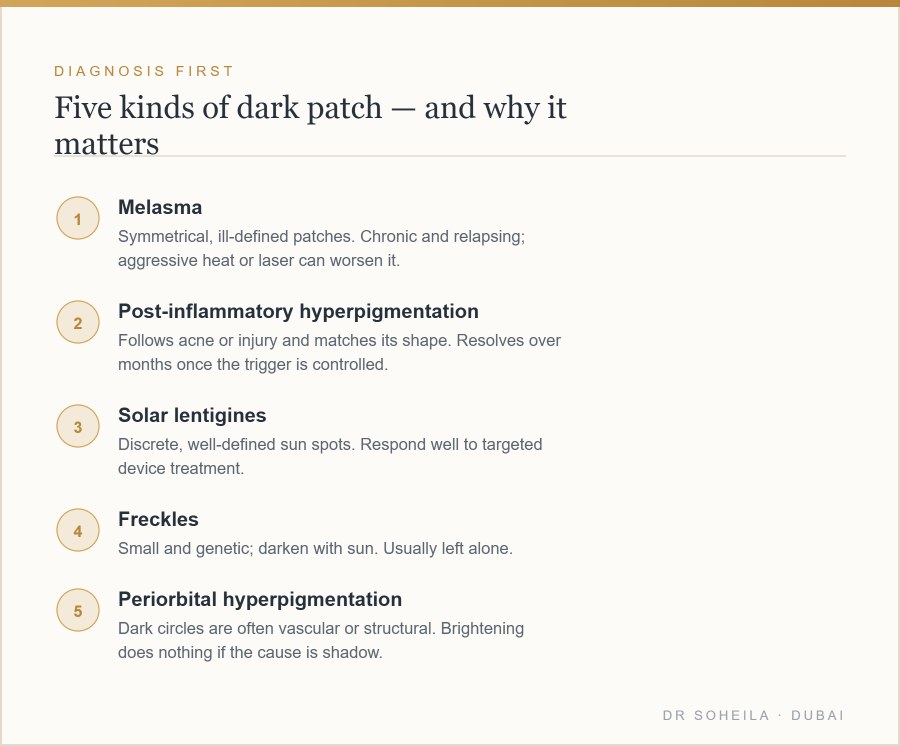
This is the point where most treatment plans go wrong. “Pigmentation” describes an appearance, not a diagnosis. The same brown patch on two different faces can require opposite approaches.
| Type | What it looks like | Key treatment consideration |
|---|---|---|
| Melasma | Symmetrical patches on cheeks, forehead, upper lip; ill-defined borders | Chronic and relapsing. Aggressive heat or laser can worsen it permanently |
| Post-inflammatory hyperpigmentation | Follows acne, injury, eczema, or a procedure; matches the shape of the original insult | Resolves over months if the trigger is controlled. Treat the cause first |
| Solar lentigines | Discrete, well-defined brown spots on sun-exposed areas | Responds well to targeted device treatment |
| Freckles | Small, genetic, darken with sun | Usually left alone; treatable if the patient wants |
| Periorbital hyperpigmentation | Dark circles — often vascular or structural, not pigment at all | Frequently misdiagnosed; brightening does nothing if the cause is shadow |
Dr Soheila examines pigmentation under Wood’s lamp where appropriate, because it separates epidermal pigment — which sits near the surface and responds relatively well — from dermal pigment, which sits deeper and is far more stubborn. Many patients have both. Knowing the mix changes what is realistic.
What Mesotherapy for Pigmentation Actually Means
Mesotherapy is a delivery method, not a drug. It means depositing small volumes of active solution into the dermis via a series of shallow micro-injections, rather than relying on a cream to penetrate the skin barrier from outside.
The reason this matters for pigmentation is straightforward: the skin barrier is very good at its job. A topical brightening agent has to survive formulation, cross the stratum corneum, reach an effective concentration at the melanocyte, and stay there. Most do not, which is why the results from over-the-counter products are usually modest.
Intradermal delivery bypasses that problem. The active reaches the target layer at a known concentration.
What is in the solution
Formulations vary by clinic and by patient. The evidence-backed components most commonly used include:
- Tranexamic acid — the most studied active in this category for melasma specifically. It works by interrupting the plasminogen pathway that links UV exposure and inflammation to melanocyte stimulation.
- Glutathione — an antioxidant with a large marketing footprint and a much smaller evidence base than its popularity suggests.
- Vitamin C (ascorbic acid) — antioxidant and tyrosinase inhibitor; useful as an adjunct.
- Non-cross-linked hyaluronic acid — hydration and barrier support, which matters more than people expect in pigment control.
- Vitamins and amino acids — general skin conditioning; supportive rather than primary.
Dr Soheila’s approach is to build the formulation around what the evidence supports for the specific diagnosis, rather than using one generic cocktail for every pigmentation patient.
What the Clinical Evidence Actually Shows
Tranexamic acid is where the real data sits, so it is worth being precise.
A split-face randomised study compared tranexamic acid mesotherapy against normal saline in melasma patients. The tranexamic acid side showed a statistically significant reduction in melasma severity — mean half-face modified MASI scores fell from 3.19 to 1.52 — while the saline side showed no significant change. Split-face design is useful here because each patient acts as their own control, which removes most confounding from sun exposure and skincare.
A separate randomised controlled trial compared tranexamic acid mesotherapy against oral tranexamic acid in melasma patients also receiving Q-switched fractional 1064 nm Nd:YAG laser, with follow-up after the treatment course.
A systematic review and meta-analysis covering 22 randomised controlled trials and roughly 1,280 patients found tranexamic acid effective across oral, topical, and injected routes, with treatment durations in the included studies ranging from eight weeks to nearly two years.
Two honest caveats:
- Effect sizes are meaningful, not dramatic. A MASI reduction of roughly 50% is a genuinely good clinical result in melasma, but it is improvement, not clearance. Anyone promising clearance of melasma is either misinformed or not being straight with you.
- The evidence for glutathione mesotherapy is considerably weaker than its popularity. It is widely offered across the region as a “whitening” treatment. Dr Soheila does not present it as an evidence-led primary treatment for melasma, and patients should be sceptical of clinics that do.
Why Dubai Makes Pigmentation Harder
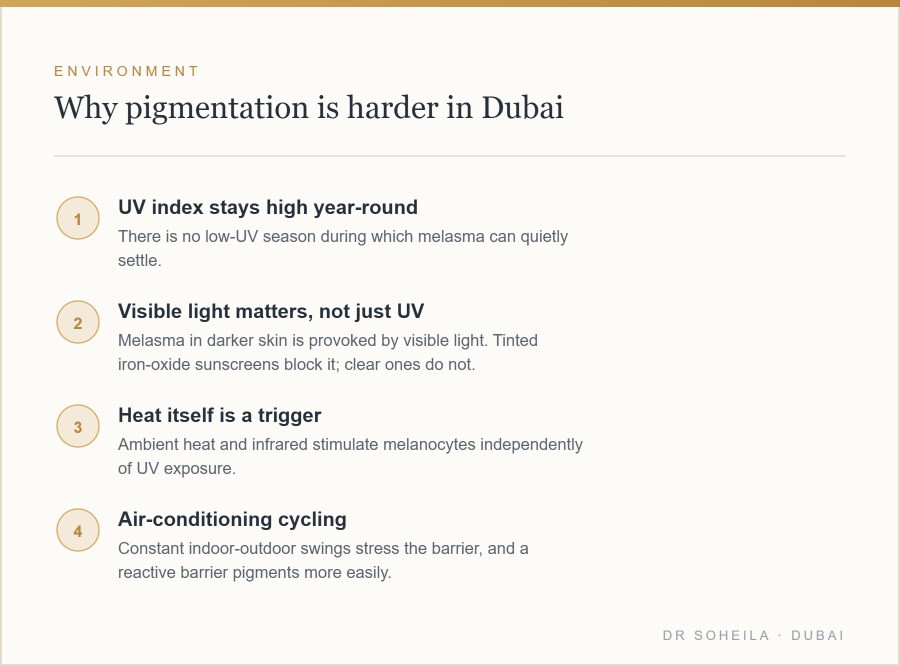
The environment here works against you in a way that is genuinely different from a temperate climate.
- UV index stays high year-round. There is no low-UV season during which melasma can quietly settle. Treatment gains erode continuously unless photoprotection is genuinely consistent.
- Visible light and infrared matter, not just UV. This is under-appreciated. Melasma in darker skin types is provoked by visible light as well as UV, which is why a conventional UVA/UVB sunscreen can be insufficient. Tinted formulations containing iron oxides provide visible-light protection that clear sunscreens do not.
- Heat itself is a trigger. Ambient heat and infrared exposure stimulate melanocytes independently of UV. Walking from a car park to an entrance in August is a real exposure.
- Indoor-outdoor cycling. The pattern of heavily air-conditioned interiors and intense outdoor heat stresses the skin barrier, and a compromised barrier is more reactive and more prone to post-inflammatory pigment.
Our guide to sun and water damage in Dubai goes into the environmental side in more depth, and it is directly relevant if pigmentation is your concern.
What a Realistic Course Looks Like
Consultation
Diagnosis first. Dr Soheila will examine the pattern, take standardised photographs, assess depth where indicated, and take a proper history — pregnancy, hormonal contraception, thyroid function, medications that cause photosensitivity, previous treatments and how the skin reacted to them. Melasma that started with a pregnancy behaves differently from melasma that started after a laser package.
Preparation phase
In most cases, treatment does not begin at the first appointment. A period of topical preparation and strict photoprotection comes first — typically two to four weeks. This is not a delay tactic. Starting injections into skin that is actively inflamed or unprotected produces worse results and a higher risk of post-inflammatory pigment.
The treatment sessions
Numbing cream for 20 to 30 minutes. The solution is delivered by fine needle or mesotherapy gun across the affected area in a grid pattern. A session takes 20 to 30 minutes. Discomfort is mild to moderate — most patients describe it as tolerable rather than pleasant.
Typical protocols run every two weeks for four to six sessions, with reassessment before deciding whether to continue. Published trial protocols have used intervals of two weeks over twelve weeks.
Immediately after
Redness and small injection points for a few hours; occasional pinpoint bruising. Most patients return to normal activity the same day. Makeup can usually be applied the following morning.
Aftercare that actually matters
- Sunscreen SPF 50, tinted with iron oxides, applied every morning and reapplied. This is not a suggestion — in melasma it is the treatment
- No sun exposure, sauna, steam, or hot yoga for 48 hours
- No exfoliating acids or retinoids for 3 to 5 days after each session
- Gentle cleansing, barrier-supporting moisturiser
- Report any unusual darkening promptly rather than waiting for the next appointment
Timeline: What to Expect and When
| Point in course | What is typically visible |
|---|---|
| After session 1 | Little to no pigment change. Skin may feel better hydrated |
| After sessions 2–3 | Early softening of patch edges; overall tone slightly more even |
| After sessions 4–6 | The meaningful change. Comparable to the MASI reductions reported in trials |
| 3–6 months after | Result holds or drifts depending almost entirely on photoprotection and hormonal status |
| Maintenance | Melasma usually needs ongoing maintenance. Solar lentigines usually do not |
Who It Suits, and Who It Does Not
Good candidates
- Confirmed melasma, particularly epidermal or mixed type
- Post-inflammatory hyperpigmentation where the underlying trigger is now controlled
- Patients with darker Fitzpatrick skin types who are poor candidates for aggressive laser
- Anyone who has already had a poor or worsening response to heat-based devices
- Patients willing to commit to a course and to daily photoprotection
Not appropriate
- Pregnancy and breastfeeding — pregnancy-related melasma often improves after delivery, and there is no safety data for injected actives
- Personal or family history of thrombosis, or current anticoagulation — a specific caution with tranexamic acid, which should be discussed with your physician
- Active infection or inflammatory skin disease in the treatment area
- Any pigmented lesion that is changing, irregular, or asymmetric. That needs dermatological assessment for skin cancer before any cosmetic treatment. This is not a formality
- Patients unwilling to use sunscreen. The result will not hold, and the money is better kept
Cost of Pigmentation Mesotherapy in Dubai
Market rates in DHA-licensed clinics generally sit around AED 700 to AED 1,800 per session, with a course of four to six sessions the usual recommendation. Some clinics package courses at a reduced per-session rate.
What legitimately varies the cost:
- The formulation. Pharmaceutical-grade tranexamic acid and a properly compounded solution cost more than a generic vitamin cocktail.
- Area treated. Full face differs from cheeks only, or from a targeted upper lip and forehead pattern.
- Who performs it. Physician-led treatment with proper diagnosis is priced differently from a therapist running a standard protocol.
- Whether diagnosis and review are included. A course sold without a diagnostic consultation should give you pause.
The honest financial advice on pigmentation is this: the single highest-return purchase is a good tinted sunscreen, used every day. Everything else is an addition to that, not a substitute for it. A patient who buys a six-session course and does not use sunscreen has wasted the course. A patient who uses sunscreen properly and buys nothing else will still see improvement.
Mesotherapy Compared With Other Options
| Approach | Strength | Limitation |
|---|---|---|
| Topical prescription creams | Strong evidence, low cost, home use | Barrier limits delivery; irritation risk; adherence often poor |
| Mesotherapy | Direct dermal delivery; low heat; safer in darker skin | Requires a course; improvement not clearance |
| Chemical peels | Effective for epidermal pigment | Depth and agent must be chosen carefully in darker skin |
| Laser and light devices | Excellent for discrete sun spots | Can rebound or worsen melasma; heat is a trigger |
| Oral tranexamic acid | Good trial evidence in melasma | Systemic; contraindicated with thrombotic risk; physician-supervised only |
In practice, the best pigmentation results usually come from combining approaches rather than choosing one — daily topical and photoprotection as the foundation, mesotherapy as the in-clinic accelerator, and a device only where the diagnosis supports it.
Red Flags When Choosing a Clinic
- No diagnosis. If nobody examined your skin and named the condition, you are buying a protocol, not a treatment.
- “Whitening” language. Legitimate treatment aims to even tone and reduce excess pigment, not to lighten your natural skin colour.
- Guaranteed clearance. Melasma is chronic and relapsing. No clinician can honestly guarantee clearance.
- Laser proposed immediately for melasma. Heat-based treatment for melasma is a considered decision, sometimes the right one, but it should never be the reflex first offer.
- No sunscreen conversation. If photoprotection did not come up in the first ten minutes, the plan is incomplete.
- Undisclosed formulation. You are entitled to know what is being injected into your skin.
Treating With Dr Soheila
Dr Soheila Eskandari treats pigmentation as a medical problem with a cosmetic presentation. That means diagnosis before protocol, a preparation phase before injections, and an honest conversation about what melasma in particular can and cannot be expected to do.
Patients who arrive frustrated after several failed rounds of treatment usually share one of two histories: they were never given a diagnosis, or they were treated with heat when their condition was heat-sensitive. Both are correctable, but the correction starts with a proper assessment rather than another package.
If your pigmentation concern is specifically under the eyes, read our guide to under-eye treatment first — periorbital darkness is frequently structural or vascular rather than pigmentary, and brightening treatments do nothing for it. If your skin quality overall is the concern, skin boosters and Profhilo address a different problem and are sometimes combined with pigment work.
Frequently Asked Questions
Does mesotherapy work for melasma?
The best evidence is for tranexamic acid mesotherapy. A split-face randomised trial showed mean half-face MASI scores falling from 3.19 to 1.52 with tranexamic acid versus no significant change with saline. Expect meaningful improvement over a course, not clearance — melasma is a chronic, relapsing condition.
How many sessions do I need?
Typically four to six sessions at two-week intervals, with reassessment before continuing. Published protocols have run treatment over roughly twelve weeks. Melasma usually requires ongoing maintenance afterwards.
Is pigmentation mesotherapy painful?
Mild to moderate. Numbing cream is applied for 20 to 30 minutes beforehand. Most patients describe repeated small pricks rather than significant pain. The session lasts 20 to 30 minutes.
Is it safe for darker skin tones?
Generally yes, and it is often preferred over heat-based devices in higher Fitzpatrick types precisely because it avoids the thermal injury that can trigger post-inflammatory hyperpigmentation. Technique and post-care still matter.
Can I do this while pregnant?
No. Pregnancy and breastfeeding are contraindications. Pregnancy-associated melasma frequently improves after delivery, so the usual advice is to focus on photoprotection and reassess afterwards.
What is the difference between mesotherapy and skin boosters?
Skin boosters primarily deliver hyaluronic acid for hydration and skin quality. Pigmentation mesotherapy delivers targeted brightening actives such as tranexamic acid into the dermis. They are different treatments with different goals and can be combined.
Will my pigmentation come back?
Melasma is relapsing by nature — it typically returns without maintenance and consistent photoprotection. Post-inflammatory pigmentation usually does not return once the underlying trigger is controlled. Solar lentigines can recur with continued sun exposure.
Why does my clinic say I need sunscreen every day even indoors?
Because visible light and infrared, not just UV, stimulate melanocytes — particularly in darker skin. Tinted sunscreens containing iron oxides block visible light in a way clear formulas do not. In Dubai, ambient heat and short outdoor transitions add up.
Is glutathione injection effective for pigmentation?
It is heavily marketed and the evidence base is considerably weaker than its popularity suggests. Dr Soheila does not present glutathione as an evidence-led primary treatment for melasma. Be cautious of clinics that build a whole protocol around it.
How much does pigmentation mesotherapy cost in Dubai?
Market rates in DHA-licensed clinics generally range from AED 700 to AED 1,800 per session, with four to six sessions typically recommended. Cost varies with formulation, area treated, and whether diagnosis and review appointments are included.
This article is general information about aesthetic and dermatological treatments and is not medical advice, a diagnosis, or a treatment recommendation for any individual. Outcomes vary between patients and no result is guaranteed. Any changing, irregular, or asymmetric pigmented lesion requires medical assessment before cosmetic treatment. Dr Soheila Eskandari is licensed by the Dubai Health Authority. Prices quoted are general market ranges for information only and are not an offer.


 English
  Arabic