
PRP vs Polynucleotides in Dubai: Your Own Blood or Salmon DNA for Skin?
PRP vs Polynucleotides in Dubai: Your Own Blood or Salmon DNA for Skin?
PRP and polynucleotides are both sold as “regenerative” skin treatments, both are injected into the skin in many small points, and both are offered for the same concerns: dull skin, fine lines, uneven texture and tired-looking under-eyes. It is no surprise that patients struggle to tell them apart.
They are, however, made of entirely different things, they act through different routes, and each has situations where it is the more sensible choice. Knowing the difference makes it much easier to judge whether a recommendation fits your skin or simply fits a price list.
What Each Treatment Is
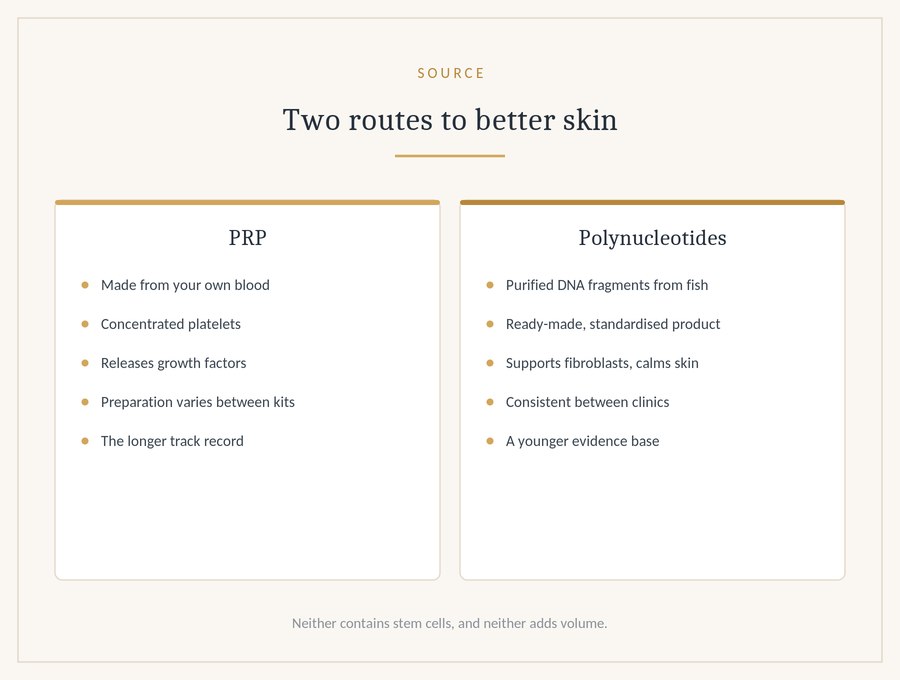
PRP — platelet-rich plasma. A small sample of your own blood is drawn and spun in a centrifuge to concentrate the platelets. Platelets release growth factors, signalling proteins involved in the body’s normal repair process. The concentrated plasma is then injected into the skin or applied during microneedling.
Polynucleotides. Purified fragments of DNA, usually derived from salmon or trout, processed into an injectable gel. Products in this group include Rejuran, Plinest and others, and a closely related form is often labelled PDRN. They are proposed to support the cells that produce collagen and to calm inflammation. The fuller background is in the guide to polynucleotide skin boosters.
Neither contains stem cells, and neither adds volume. Both work on the quality of the skin rather than its shape.
Where the Evidence Stands
PRP has been studied for skin rejuvenation, acne scarring and hair loss for many years. For skin, results are moderate and variable, and some of the best-supported uses combine PRP with microneedling, particularly for acne scars. A major limitation is that preparation methods differ widely between kits and clinics, so two treatments both called “PRP” may contain very different platelet concentrations.
Polynucleotides have a growing body of research, much of it from Korea and Italy, showing improvement in skin texture, elasticity and fine lines, including in the thin skin under the eyes. The evidence is promising but younger, and a meaningful share of studies involve manufacturers. Because they are standardised products, however, the same product should behave consistently from clinic to clinic.
Neither has the kind of large, independent evidence base that would make one clearly superior across the board. The better question is which one suits a particular skin problem.
How They Compare in Practice
Preparation and Source
PRP is autologous — it comes from you — so there is no question of reacting to a foreign substance, and it requires a blood draw and processing at each visit. Polynucleotides are a ready-made product; they avoid the blood draw but involve a substance derived from fish, which is highly purified yet worth mentioning if you have a fish allergy.
Sessions and Timing
PRP for skin is commonly given as three sessions about four weeks apart, followed by maintenance every six to twelve months. Polynucleotides are commonly given as three to four sessions two to three weeks apart, with maintenance at similar intervals. In both cases a single session is not a course.
Downtime
Both leave small raised bumps and redness at the injection points, and both can bruise. PRP injected into the face can cause more generalised swelling for a day or two. Polynucleotide bumps usually settle within one to three days. Neither is ideal the day before an important event.
Under the Eyes
The skin under the eyes is thin and reacts easily. Polynucleotides are frequently chosen here because they are designed to improve skin quality with a low tendency to cause puffiness. PRP can also be used but tends to swell more in this area. Neither replaces filler where the problem is a true hollow, and neither removes pigmentation. The causes of dark circles are set out in the guide to dark circles treatment.
Matching the Treatment to the Concern
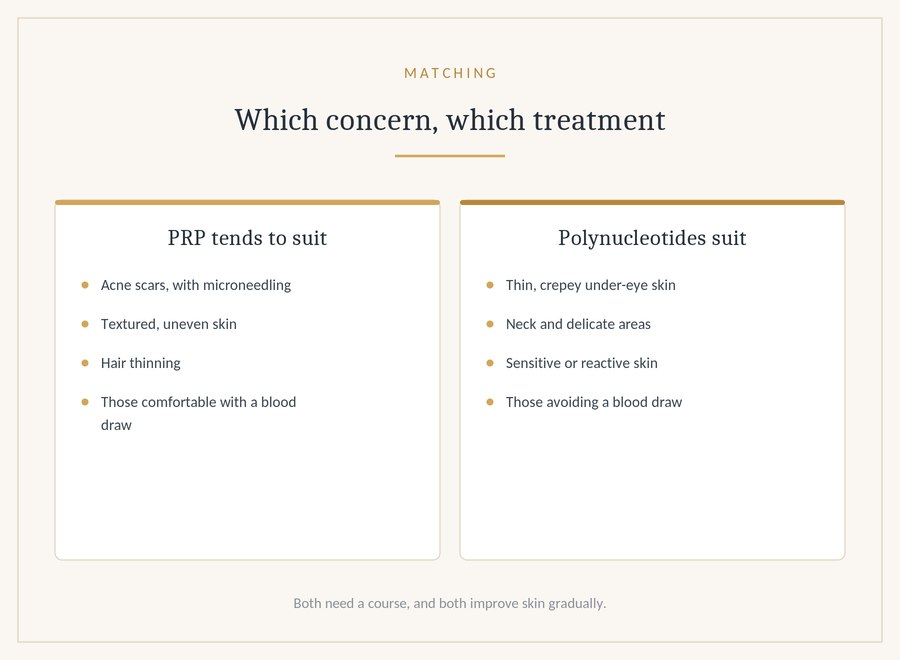
Acne scars and textured skin. PRP combined with microneedling has a longer track record and is often the first choice. The approach is covered in the guide to microneedling with growth factors and the guide to acne scar treatment.
Thin, crepey skin around the eyes and neck. Polynucleotides are often preferred for their consistency and gentler reaction in delicate areas.
Sensitive, reactive or inflamed skin. The anti-inflammatory profile proposed for polynucleotides can make them a sensible option, though evidence for this specific use is still developing.
General dullness and early fine lines. Either can help modestly. Here the choice often comes down to budget, tolerance of a blood draw and how many sessions fit your schedule.
Hair thinning. PRP has more established use for hair; the comparison with newer options is set out in the guide to PRP versus exosomes for hair loss.
Using Both
They can be combined in a plan — for example PRP with microneedling for texture on the cheeks and polynucleotides for the under-eye area — but they are best spaced apart rather than given in the same session, so that the effect and any reaction can be attributed to the right treatment.
What Neither Treatment Does
Neither restores lost volume, lifts sagging tissue or relaxes expression lines. A face that has deflated needs structural treatment, and expression lines respond to muscle-relaxing injections. Expecting a skin-quality treatment to do the work of filler or toxin is the most common reason for disappointment with both.
Results in both cases are gradual and moderate: smoother texture, a little more firmness and better light reflection over several months, rather than a visible transformation.
Safety
Both are generally well tolerated in suitable patients. Common effects are temporary bumps, redness, swelling and bruising. Infection is rare with proper technique.
PRP is usually avoided in people with certain blood disorders, low platelet counts or active infection, and anticoagulant medication increases bruising. Polynucleotides are avoided with a known allergy to the product or its source, and both are generally postponed during pregnancy and breastfeeding. A full medical history is part of every consultation.
Cost in Dubai
Market rates generally run from around AED 500 to AED 1,500 per PRP session and from around AED 800 to AED 2,500 per polynucleotide session, depending on the area, the product and the clinic. The clinic’s PRP service is described on the PRP page.
Because both are given as courses with maintenance, compare the full course price rather than a single session.
Preparing for Treatment and Caring for the Skin Afterwards
A little preparation reduces bruising and helps the skin settle quickly, whichever treatment is chosen.
Before treatment. Tell the clinic about any blood-thinning medication, supplements such as fish oil or high-dose vitamin E, and any history of cold sores, since injections around the mouth can trigger an outbreak. Never stop a prescribed medication without speaking to the doctor who prescribed it. For PRP, being well hydrated and having eaten makes the blood draw easier.
On the day. Arrive without makeup if possible. Topical anaesthetic is usually applied for twenty to thirty minutes beforehand, and the injections themselves take around fifteen to thirty minutes.
The first day. Avoid makeup for at least twelve hours, and avoid touching or pressing the small bumps. Cool compresses can help with swelling.
The first two days. Avoid saunas, steam rooms, hot baths and intense exercise, which can increase swelling and bruising. Sleep with the head slightly raised if the under-eye area was treated.
Throughout the course. Daily sun protection matters, particularly after microneedling, when freshly treated skin is more prone to pigmentation. Active products such as retinoids and exfoliating acids are usually paused for a few days around each session.
Following these steps does not change the final result dramatically, but it makes the days after treatment more comfortable and reduces the chance of visible bruising.
The Short Version
PRP uses growth factors concentrated from your own blood; polynucleotides are purified DNA fragments from fish. PRP has the longer history, particularly with microneedling for acne scars, but its preparation varies widely. Polynucleotides are standardised and often preferred for thin under-eye skin and reactive skin, with a younger evidence base.
Both improve skin quality gradually and moderately, both need a course, and neither adds volume or lifts. The right choice depends on the specific problem, and an honest consultation will tell you when neither is the right tool.
Questions Worth Asking
Why this treatment rather than the other for my skin? The answer should refer to your specific concern.
For PRP: what preparation system do you use? Protocols vary, and a practitioner who knows theirs is paying attention.
For polynucleotides: which exact product? Products differ in concentration and indication.
How many sessions, and what will change? A realistic answer describes gradual improvement, not a transformation.
Frequently Asked Questions
What is the difference between PRP and polynucleotides?
PRP is made from your own blood and contains concentrated platelets and the growth factors they release. Polynucleotides are purified DNA fragments, usually from salmon or trout, supplied as a ready-made injectable product. Both aim to improve skin quality, through different routes.
Which works better?
Neither is better in general. PRP with microneedling has a longer track record for acne scars and texture, while polynucleotides are often preferred for thin under-eye skin and reactive skin. The choice depends on the concern.
Is salmon DNA safe?
Polynucleotide products are highly purified and generally well tolerated. They are avoided in people with a known allergy to the product or its source, which is why allergies should always be discussed beforehand.
Which is better for under the eyes?
Polynucleotides are frequently chosen for the thin under-eye skin because they tend to cause less puffiness. Neither treats a true hollow or pigmentation, so the cause of the dark circles needs to be established first.
How many sessions will I need?
PRP for skin is commonly three sessions about four weeks apart; polynucleotides are commonly three to four sessions two to three weeks apart. Both need maintenance, typically every six to twelve months.
What is the downtime?
Both cause small bumps, redness and possible bruising. PRP can cause more facial swelling for a day or two; polynucleotide bumps usually settle within one to three days.
Can I have both?
Yes, in a planned sequence rather than the same session — for example PRP with microneedling for texture and polynucleotides for the under-eye area.
Do either of them add volume?
No. Both improve skin quality. Volume loss needs structural treatment, and expression lines need muscle-relaxing injections.
When will I see results?
Changes build gradually over the course and are best judged four to six weeks after the final session.
What do they cost in Dubai?
Market rates generally run from around AED 500 to AED 1,500 per PRP session and from around AED 800 to AED 2,500 per polynucleotide session. Since both are given as courses, the full course price is the figure to compare.
This article is general information about aesthetic and dermatological treatments and is not medical advice, a diagnosis, or a treatment recommendation for any individual. Outcomes vary between patients and no result is guaranteed. Injectable treatments carry risks and contraindications that must be assessed by a licensed physician during a personal consultation. Dr Soheila Eskandari is licensed by the Dubai Health Authority. Prices quoted are general market ranges for information only and are not an offer.


 English
  Arabic