
NCTF Skin Booster in Dubai: What Is Actually in the Vial
NCTF Skin Booster in Dubai: What Is Actually in the Vial
NCTF is sold on its ingredient list. The vial contains fifty-nine components, the marketing says, and that number does a great deal of persuasive work. What is rarely explained is which of those components has clinical evidence behind it, and how much of the result comes from the one ingredient nobody mentions in the headline: plain hyaluronic acid, delivered by needle into skin that responds to being needled.
This guide sets out what NCTF actually contains, what the evidence supports and where it thins out, how it differs from the other skin boosters on the same clinic menu, and what a realistic course and cost look like.
What NCTF Is
NCTF stands for New Cellular Treatment Factor. It is a mesotherapy product, meaning it is delivered by multiple small injections into the superficial dermis rather than placed in a single deposit the way a filler is.
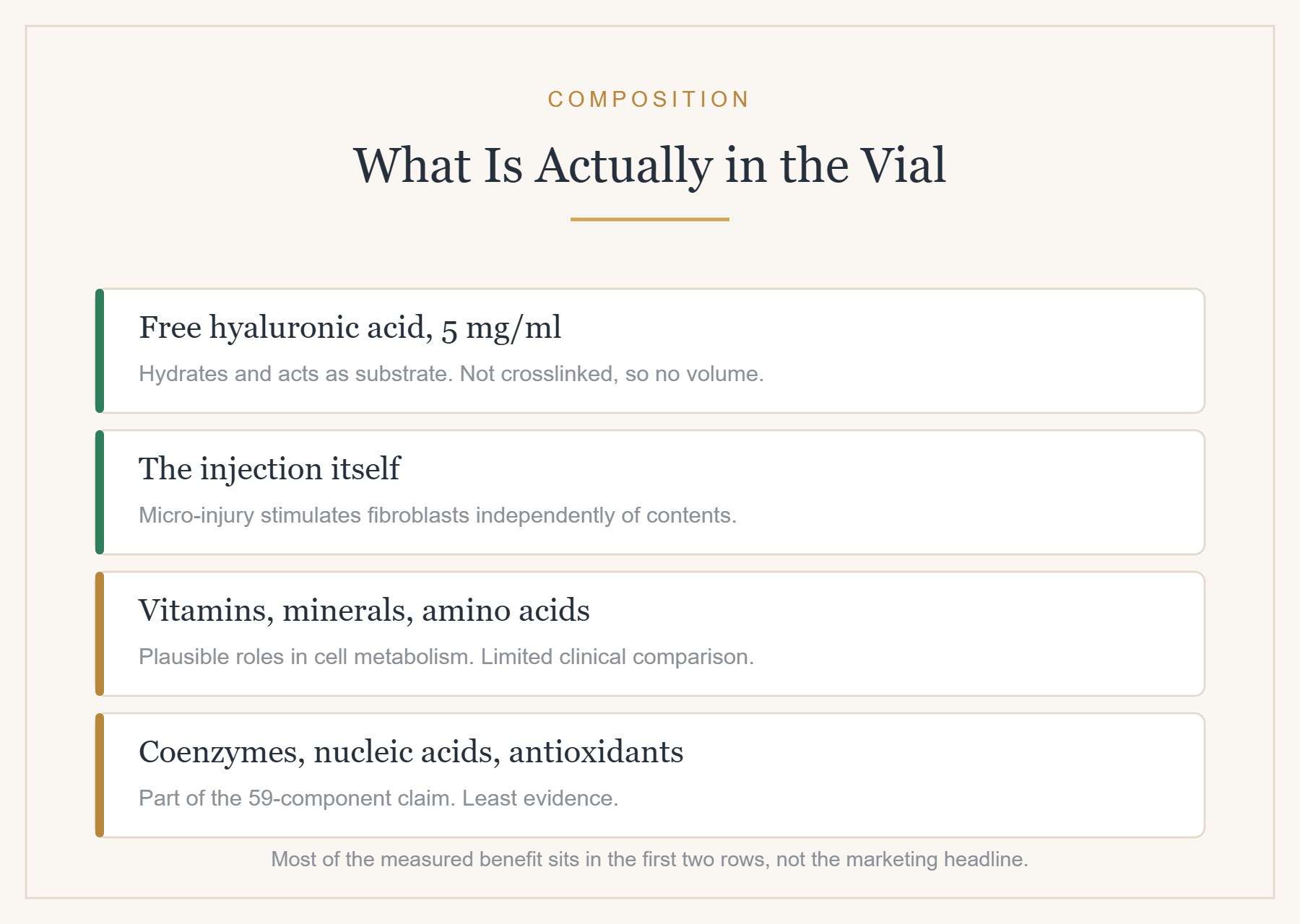
The version used in almost all aesthetic practice is NCTF 135HA. The number refers to the concentration of the polyrevitalising complex, and the HA denotes the addition of free, non-crosslinked hyaluronic acid at 5 mg per millilitre. There is a version without hyaluronic acid, but it is rarely what patients are offered.
The complex itself contains vitamins, minerals, amino acids, coenzymes, nucleic acids and antioxidants — the building blocks a fibroblast uses. The logic is straightforward and appealing: supply the cell with raw material and it will function better.
The Distinction That Matters
Free hyaluronic acid is not the same as the crosslinked hyaluronic acid in a filler. Crosslinking binds the molecules together so the gel holds its shape and resists breakdown, which is what allows a filler to create structure and last a year.
The hyaluronic acid in NCTF is uncrosslinked. It does not hold shape and it does not last long — it is metabolised within days. Its role is to hydrate and to act as a substrate, not to add volume. Anyone expecting a skin booster to fill a line or restore a cheek has been told the wrong thing about what it does.
What the Evidence Supports
This deserves a careful answer, because the gap between what is claimed and what is demonstrated is wider here than in most of aesthetic medicine.
That injecting hyaluronic acid into the dermis improves skin hydration and quality is reasonably supported. Studies of injectable hyaluronic acid skin boosting show measurable improvement in hydration, elasticity and patient-rated skin quality.
That the micro-injury of mesotherapy itself contributes is also plausible and consistent with what is known about needling. Multiple superficial injections create a wound-healing response that stimulates fibroblast activity independently of what is injected.
That the fifty-nine-component complex outperforms hyaluronic acid alone is where the evidence is thin. The individual ingredients have defensible roles in cellular metabolism, and laboratory work supports some of them. What is largely missing is well-controlled clinical work comparing the full formulation against hyaluronic acid by itself in human skin. Most published studies on NCTF are small, some are open-label, and several are connected to the manufacturer.
The reasonable position: NCTF is a well-formulated product that does what injectable hyaluronic acid skin boosting does, with a plausible but not clearly demonstrated additional benefit from the complex. That is not a reason to avoid it. It is a reason to be sceptical of pricing that treats the ingredient list as proven advantage.
Where It Sits Among the Skin Boosters
Several products occupy this category and they are frequently presented as interchangeable. They are not.
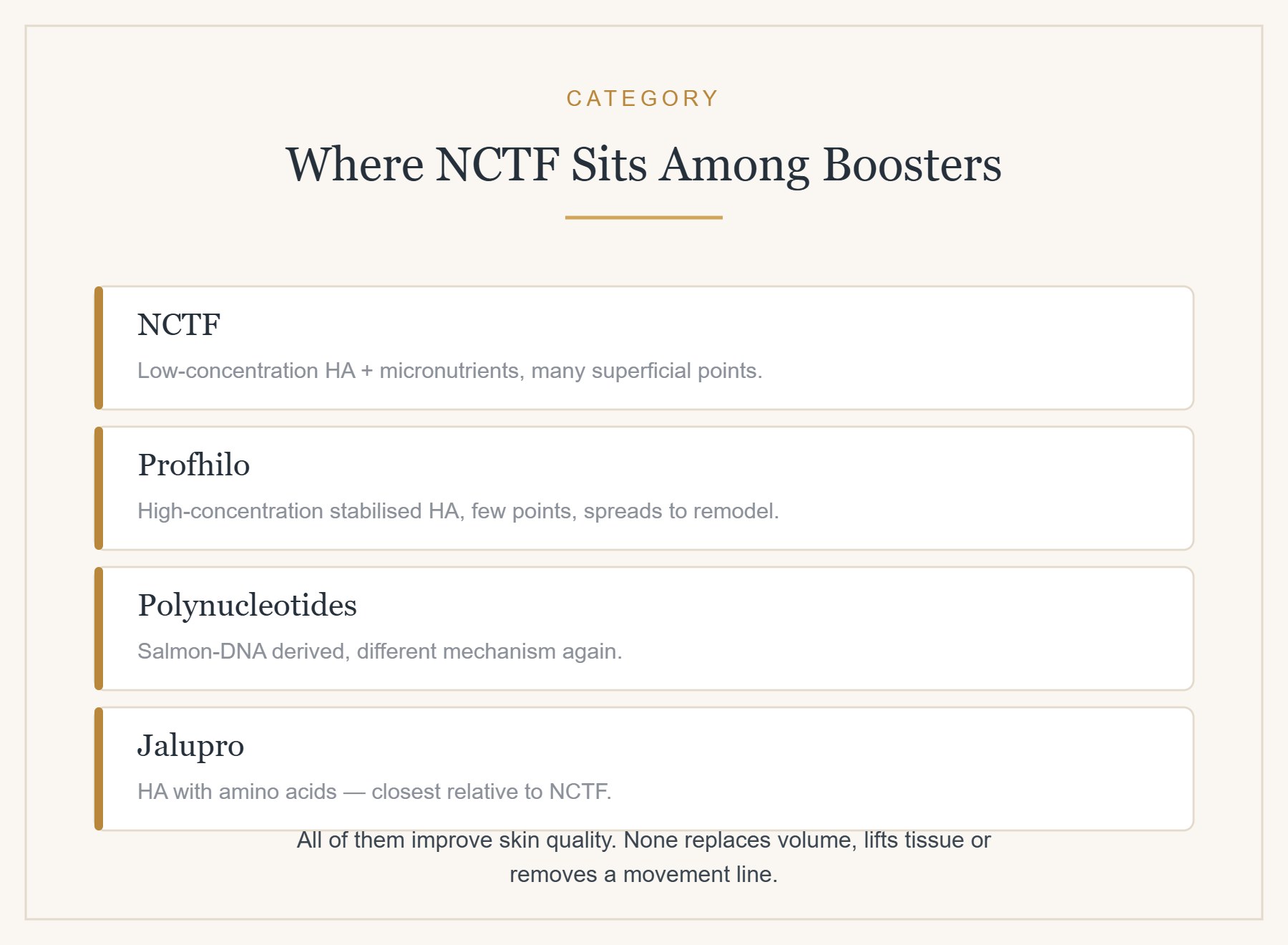
NCTF is low-concentration hyaluronic acid plus micronutrients, delivered in many superficial injections across the whole area. It suits general skin quality, dullness and fine crepiness.
Profhilo is a high-concentration stabilised hyaluronic acid designed to spread through tissue after placement, delivered in a small number of defined points. Its claim is remodelling rather than nutrition, and I have compared the two families in more detail in the guide to Profhilo versus skin boosters.
Polynucleotide products such as those based on salmon DNA work through a different mechanism again, and are covered separately in the guide to polynucleotide skin boosters.
Jalupro combines hyaluronic acid with amino acids, positioning it closest to NCTF of the group.
What all of them share is the limit: they improve skin quality. None of them replaces lost volume, lifts descended tissue or removes a wrinkle caused by muscle movement. A patient whose main concern is structural will be disappointed by every product in this category, and the useful consultation says so rather than selling a course.
Who It Suits
The best candidates have reasonable facial structure and want improvement in the quality of the skin itself: dullness, dehydration, early fine lines, the slightly papery texture that appears around the eyes and on the neck before any real laxity has developed.
It also suits patients who want something before an event but do not want the change to be visible as a treatment. Improved light reflection reads as looking well rather than looking done.
Smokers and patients with significant sun damage often see a worthwhile difference, because their baseline skin quality is further from where it could be.
Patients with significant laxity or volume loss are the group most likely to feel it did nothing, because they were treating the wrong problem. That is a selection error rather than a product failure.
What a Course Involves
Topical anaesthetic is applied for twenty to thirty minutes. The product is then delivered either by hand, as a series of small injections placed a centimetre or so apart, or with a mesotherapy device that standardises depth and spacing.
Hand injection gives more control over depth in difficult areas such as around the eyes. A device is faster and more consistent across broad areas like the cheeks or neck. Neither is inherently better and most practitioners use both depending on the region.
A standard initial course is three to four sessions spaced two to four weeks apart, followed by maintenance every three to six months. The first session alone produces a short-lived hydration effect that fades; the course is where the change in skin quality accumulates.
What the Days Afterwards Look Like
Small raised bumps appear at each injection point and are expected. They usually settle within a few hours and almost always within a day. Pinpoint bruising is common, particularly around the eyes where the skin is thin and vessels sit close to the surface.
Makeup is generally avoided for the rest of the day, and vigorous exercise, saunas and steam rooms for twenty-four hours. Most people are entirely presentable the following morning, but scheduling a session the day before an important event is a poor idea.
The Aftercare That Determines Whether It Lasts
This is the part patients most often skip, and in this climate it matters more than elsewhere.
The treatment improves the skin’s capacity to hold water and stimulates fibroblast activity. Ultraviolet exposure works directly against both — it degrades dermal collagen and drives the pigment response that undoes the evenness people were paying for. Daily broad-spectrum protection is not an upsell here; it is what determines whether the result is still visible in three months.
Hydration and sleep sound like generic advice but are genuinely relevant, because the treatment supports a process rather than imposing a result. A patient who completes a course and then goes back to four hours of sleep and no sunscreen will find the benefit brief.
Realistic Expectations
Two habits make the difference between satisfaction and disappointment.
The first is photographing properly before the first session — same lighting, same angle, no makeup. Skin quality changes gradually and the eye adapts. Patients routinely underestimate their own improvement because they are comparing against a memory rather than an image.
The second is judging at the right time. Assess four to six weeks after the final session, not between sessions. The hydration effect immediately after any single appointment is temporary and misleading in both directions.
The honest summary of what a good course delivers: skin that looks better rested, reflects light more evenly, and feels less dry and tight. What it does not deliver is a change in facial shape, a lift, or the removal of an established wrinkle.
Safety and Who Should Not Have It
The safety profile of superficial hyaluronic acid mesotherapy is good. Because the product is uncrosslinked and placed superficially in small volumes, the vascular risks associated with filler are considerably lower, though not theoretically zero.
The realistic concerns are bruising, transient swelling, and — uncommonly — a hypersensitivity reaction to a component of the complex. Infection is rare and is a function of technique and product handling rather than the product itself.
It is avoided in pregnancy and breastfeeding, where there is active infection or inflammatory skin disease in the treatment area, and in anyone with known allergy to any component. Anticoagulant medication does not rule it out but increases bruising, which is worth knowing before an event. A history of keloid scarring warrants a conversation about injection density.
Costs in Dubai
Market rates generally run from around AED 900 to AED 2,000 per session depending on the area treated and the clinic. Full face, or face with neck, sits at the upper end.
Because a course of three to four sessions is the standard protocol, the package price is the number that matters. A single-session price quoted without reference to the course is not really a price for the treatment being discussed.
One point worth raising: the cost difference between NCTF and a plain hyaluronic acid skin booster is largely the complex, and the complex is the part with the least clinical evidence behind it. That does not make it a bad choice — but it is a reasonable thing to weigh rather than assume.
The Short Version
NCTF is a competently formulated injectable skin booster that improves hydration, texture and radiance across a course of three to four sessions. Both the hyaluronic acid and the act of needling contribute to that, and the much-advertised fifty-nine-component complex is plausible but not clearly proven to add more.
It suits someone whose facial structure is fine and whose skin quality is the concern. It does not restore volume, lift tissue or replace a filler, and the most useful thing a consultation can establish is which of those you actually came in for.
Frequently Asked Questions
What is NCTF?
NCTF is a mesotherapy product containing hyaluronic acid together with a mixture of vitamins, minerals, amino acids, coenzymes and nucleic acids. The most commonly used version in aesthetic practice is NCTF 135HA, which contains free hyaluronic acid at 5 mg/ml.
Does the vitamin complex actually do anything?
That is the honest uncertainty. The individual components have plausible roles in skin metabolism, and laboratory work supports some of them. What is thin is controlled clinical evidence showing the complex outperforms hyaluronic acid alone in human skin. Treat it as a reasonable formulation rather than a proven advantage.
How many sessions will I need?
A typical initial course is three to four sessions spaced two to four weeks apart, followed by maintenance every three to six months. A single session produces a short-lived hydration effect rather than a lasting change.
Is it the same as Profhilo?
No. Profhilo is a high-concentration stabilised hyaluronic acid designed to spread and remodel, placed in a small number of defined points. NCTF is a lower-concentration mesotherapy product with added micronutrients, delivered in many superficial injections across the area.
Does it hurt?
It involves many small superficial injections, which most patients find uncomfortable rather than painful. Topical anaesthetic applied beforehand makes it considerably easier, and a mesotherapy gun spreads the discomfort differently from manual injection.
What is the downtime?
Small raised bumps at each injection point are expected and usually settle within a few hours to a day. Pinpoint bruising is common, particularly around the eyes. Most people are presentable the next day, but same-day events are a poor idea.
Can it be used around the eyes?
Yes, and the periorbital area is one of the more common requests. The skin there is thin, so injection depth and volume matter more, and bruising is more likely. It improves skin quality and fine crepiness; it does not correct hollowing, which needs volume.
Who should avoid it?
It is avoided in pregnancy and breastfeeding, where there is active infection or inflammatory skin disease in the area, and in anyone with known sensitivity to the components. Anticoagulant medication increases bruising and warrants a conversation first.
When will I see a difference?
Improved hydration and light reflection appear within one to two weeks. The more meaningful change in skin quality builds across the course and is best judged four to six weeks after the final session rather than between sessions.
What does it cost in Dubai?
Market rates generally run from around AED 900 to AED 2,000 per session depending on the area treated and the clinic. Because a course of three to four sessions is standard, the package price rather than the single-session price is the meaningful figure.
This article is general information about aesthetic and dermatological treatments and is not medical advice, a diagnosis, or a treatment recommendation for any individual. Outcomes vary between patients and no result is guaranteed. Prescription medications carry risks and contraindications that must be assessed by a licensed physician during a personal consultation. Dr Soheila Eskandari is licensed by the Dubai Health Authority. Prices quoted are general market ranges for information only and are not an offer.


 English
  Arabic