
Botox Aftercare in Dubai: The First Four Hours, Two Weeks and Warning Signs
Botox Aftercare in Dubai: The First Four Hours, Two Weeks and Warning Signs
Botox aftercare in Dubai is mostly about the first four hours and the first day. Stay upright, avoid rubbing or pressing the treated areas, skip strenuous exercise, saunas and steam until the next day, and give the treatment about two weeks to settle before judging the result. Most people go straight back to work, and the small bumps and redness at the injection points usually fade within an hour.
This guide explains why aftercare matters, what to do in the first four hours, the first day and the first two weeks, when results appear, which side effects are normal, which warning signs need a call to the clinic, and how aftercare changes for different areas. It also covers how Dubai heat and gym routines fit in, and what treatment costs. Every plan should be confirmed in person by a licensed physician.
What Is Botox Aftercare For?
Why the first hours matter
Botox is a purified botulinum toxin type A that relaxes the specific muscles it is injected into. Once it is placed, the medicine binds to the nerve endings in that muscle over the following hours. Until it has bound, firm pressure, heavy rubbing or a big rise in blood flow to the area could, in theory, move a small amount of product towards neighbouring muscles. That is why most aftercare advice focuses on the first few hours and the first day.
What aftercare cannot change
Good aftercare reduces the chance of bruising and avoids unnecessary risk, but it cannot rescue an unsuitable dose or poor placement. The result depends mainly on the assessment, the product, the dose and the injection technique. Aftercare is the final step in that process rather than a substitute for it, which is why the review appointment matters as much as the rules for the first day.
How Should I Prepare Before Treatment?
Aftercare starts before the appointment. Avoid alcohol for the day before treatment, and tell the doctor about every medicine and supplement you take, including blood thinners, painkillers and herbal products, because some of them increase the chance of bruising. Mention any previous reactions to botulinum toxin, any neuromuscular condition, pregnancy or breastfeeding, and any recent illness or skin infection in the area, because these can change whether treatment is suitable or when it should happen.
Arrive with clean skin if you can, or allow a few minutes for makeup to be removed. Plan the rest of the day so that you do not need to go straight to the gym, a sauna or a long outdoor event. If you have a wedding, a photo shoot or an important trip coming up, book treatment at least two to three weeks beforehand so that the full effect has developed and any small adjustment can be made at the review.
What Should I Do in the First Four Hours?
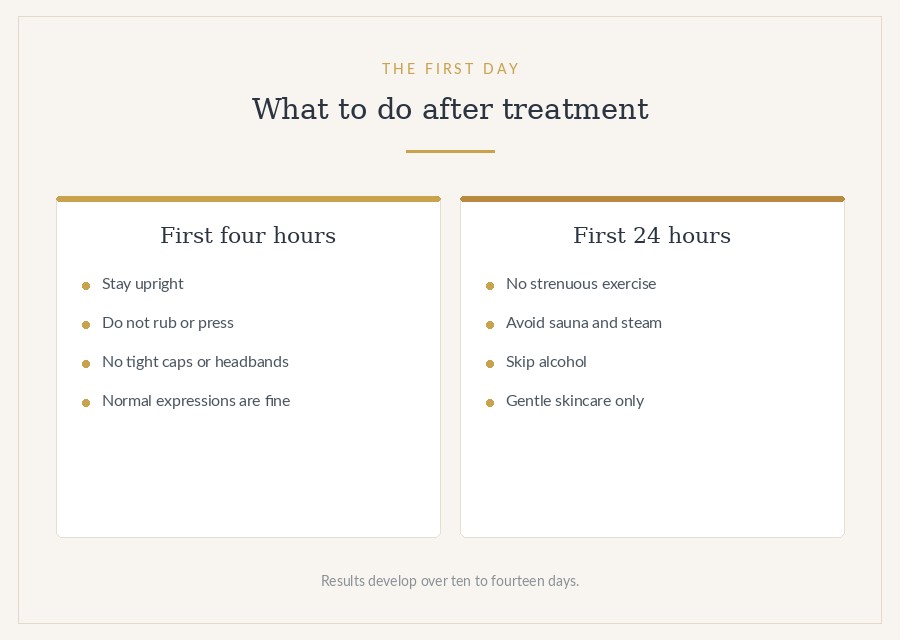
Stay upright and avoid lying flat or bending forward for long periods. Do not rub, massage or press on the treated areas, and avoid tight headbands, caps, swimming goggles or helmets that sit on the forehead. Normal facial expressions are fine; you do not need to keep your face still. If a small bump or a dot of blood appears, a clean tissue held gently against the skin without pressing is enough.
It is also sensible to avoid touching the area with unwashed hands, to leave makeup off for the first few hours where possible, and to postpone any appointment that involves lying face down, such as a massage. If you feel faint after the injections, which can happen with any needle procedure, sit down and let the team know before you leave.
What About the First 24 Hours?
Exercise and heat
Leave strenuous exercise until the next day. Running, heavy weights, hot yoga and spin classes raise blood flow and pressure in the face and make bruising more likely. The same applies to saunas, steam rooms, hot baths and long spells in direct midday sun. A gentle walk is fine. In Dubai, where many people train early in the morning or in heated studios, the simplest approach is to book the treatment on a day when you can skip the evening session and train again the following morning.
Alcohol and medicines
Alcohol widens blood vessels and can make bruising worse, so it is sensible to avoid it on the day of treatment. If you take blood-thinning medicines, do not stop them on your own; this decision belongs to the doctor who prescribed them. Over-the-counter supplements that can increase bruising, such as high-dose fish oil or vitamin E, should be mentioned at the consultation beforehand so the doctor can advise on timing.
Makeup and skincare
Most clinicians suggest leaving makeup off for a few hours and then applying it gently with clean brushes. Use a mild cleanser that evening and avoid scrubs, exfoliating acids, retinoids and devices such as cleansing brushes on the treated areas until the next day. Sunscreen can be applied gently.
What Should I Avoid in the First Two Weeks?
For about two weeks, avoid treatments that press firmly on the face or heat the skin deeply, such as facial massage, microcurrent devices, radiofrequency, intense pulsed light, laser resurfacing and microneedling over the treated areas. If you have another treatment planned, such as a skin booster or filler, tell the clinic so that the order and spacing can be arranged sensibly.
Flying, travelling and normal work are fine. Dental treatment that involves long periods with the mouth stretched open is better scheduled a few days apart from treatment around the mouth or jaw. Sleeping on your back is not required after the first night, and there is no evidence that sleeping on your side after day one changes the result.
Can Botox Be Combined With Other Treatments?
Botox is often planned alongside skin boosters, filler or skin treatments, but the order matters. Many clinicians prefer to treat with Botox first and add filler or skin boosters at the review, once the muscles have relaxed and the face can be assessed at rest. Where several injectables are given on the same day, the doctor will usually treat different areas and adjust the aftercare advice to cover all of them. Heat-based treatments, peels and microneedling over the same area are usually spaced at least two weeks apart.
When Will I See Results?
Most people notice the first softening of movement after two to four days. The full effect usually develops by around ten to fourteen days, which is why a review is normally booked at two weeks. Results then last around three to four months for most areas, sometimes a little longer after repeated treatments, and movement returns gradually rather than suddenly.
Different products start at slightly different speeds; Dysport, for example, is often noticed a day or so earlier than Botox, although the overall timeline is similar. Muscles that are larger or stronger, such as the jaw muscles, may take two to four weeks to show their full change and longer to show a visible slimming effect.
Which Side Effects Are Normal?
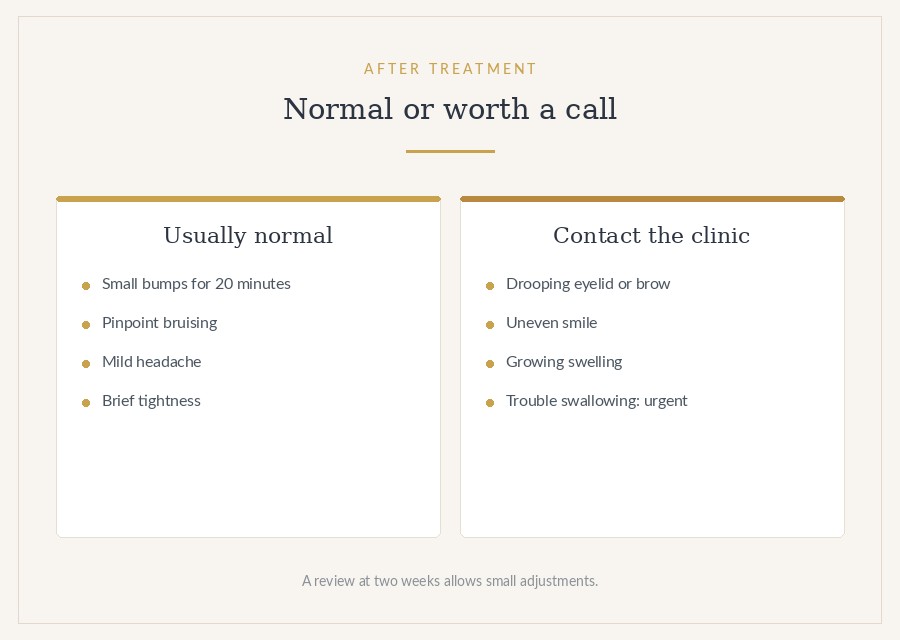
Small raised bumps at the injection points usually settle within twenty to thirty minutes. Mild redness, tenderness and pinpoint bruising are common and usually fade within a few days to a week. A mild headache on the first day or two is reported by some people, particularly after forehead and frown-line treatment. Some people notice a feeling of tightness or heaviness in the forehead for the first week or two while they adjust to the reduced movement.
Which Warning Signs Should I Report?
Contact the clinic if you notice a drooping upper eyelid, a heavy or lowered brow, an uneven smile, difficulty closing an eye fully, or a bruise or swelling that keeps growing. These effects are uncommon and are usually temporary, but they deserve an assessment. An eyelid droop, for example, can sometimes be helped with prescribed eye drops while the effect wears off, and small asymmetries can often be balanced at the review.
Seek urgent medical help if you develop difficulty swallowing, speaking or breathing, double vision or generalised muscle weakness after any botulinum toxin treatment. These effects are very rare at cosmetic doses, but they need immediate attention rather than a wait-and-see approach.
Why Is the Two-Week Review Important?
The review is when the result can be judged properly. Before two weeks, the effect is still developing, and adding more product too early can lead to an over-treated look. At the review, the doctor checks movement and symmetry, answers questions and, where needed, adds a small amount to balance the result. It is also the right time to record the dose and areas so that the next treatment can be planned more precisely.
Most people repeat treatment when movement has clearly returned, usually every three to four months, rather than on a fixed calendar date. Topping up before the previous treatment has worn off is not usually needed, and spacing treatments sensibly helps keep the result natural. If this is your first treatment, the guide to first-time Botox explains what to expect at each stage.
Common Myths About Botox Aftercare
You must not lie down for a whole day
Most guidance asks you to stay upright for about four hours. After that, normal sleep is fine.
Exercising the face makes it work faster
Some clinicians suggest gentle frowning and raising the brows in the first hour, and some studies suggest a small effect on onset speed, but the evidence is limited. It will not harm the result, but it is not required.
Arnica or special creams are needed
There is no strong evidence that arnica changes bruising after small injections. Gentle cold compresses wrapped in a cloth, used without pressure, are a reasonable option on the first day if bruising appears.
Does Aftercare Change by Area?
Forehead, frown lines and crow’s feet
These are the areas where the standard advice matters most: stay upright, avoid pressure from caps and headbands, and avoid heat and heavy exercise until the next day.
Jaw muscles
For masseter treatment, avoid massaging the jaw and chewing very hard food for the rest of the day. Chewing may feel slightly weaker for a few weeks, which is expected.
Around the mouth
After a lip flip or treatment around the mouth, drinking through a straw, whistling or pronouncing some sounds can feel different for a week or two. Avoid dental appointments on the same day where possible.
Underarms
After treatment for excessive sweating, avoid strenuous exercise, saunas and antiperspirants on the day. A regular deodorant can usually be used from the next day.
How Do Dubai Conditions Affect Aftercare?
Heat, strong sun and long outdoor afternoons all increase blood flow to the skin. On the day of treatment, it is sensible to avoid long outdoor exposure in the middle of the day, beach afternoons, desert trips and steam rooms. Air-conditioned indoor environments are fine. Many people choose a late-afternoon appointment so that the first four hours fall in the evening.
Choosing Who Treats You
Botulinum toxin is a prescription medicine, so it should be prescribed and injected by a licensed physician after an assessment. You can verify a doctor’s DHA licence on the DHA Sheryan portal. Ask which product is used, how the dose is chosen, whether a review is included and how the clinic can be reached if you have a concern after treatment.
The page on anti-wrinkle treatment describes the treatment, and the guide to how long Botox lasts explains the timeline in more detail. At dr-soheila.com, treatments are planned and performed by Dr Soheila Eskandari, a DHA-licensed general practitioner with aesthetic privileges with 20 years of experience in aesthetic medicine.
The Short Version
For the first four hours, stay upright, do not rub or press the treated areas and avoid tight headwear. For the rest of the day, skip strenuous exercise, saunas, steam, long sun exposure and alcohol, and keep skincare gentle. For two weeks, avoid facial massage and heat-based devices over the treated areas.
Results start after two to four days and are complete by ten to fourteen days, when a review is sensible. Small bumps, redness and pinpoint bruising are normal and short-lived. A drooping eyelid or brow, an uneven smile or a growing swelling should be reported to the clinic, and any difficulty swallowing, speaking or breathing needs urgent medical help.
Questions Worth Asking
Which product and dose are you using, and why? The dose should match the strength of your muscles and the result you want.
Is a two-week review included? A review allows small adjustments once the full effect has developed.
What should I do if I notice a droop or asymmetry? You should know exactly how to reach the clinic after treatment.
When can I train, travel or book other treatments? Ask for a plan that fits your schedule before the appointment rather than after it.
Frequently Asked Questions
How long should I stay upright after Botox?
Most clinicians advise staying upright for about four hours after treatment. After that, normal sleep and positions are fine.
When can I exercise after Botox?
Light walking is fine on the same day. Strenuous exercise, hot yoga and heavy weights should wait until the next day.
Can I wear makeup after Botox?
Most clinicians suggest waiting a few hours and then applying makeup gently with clean brushes, without rubbing the treated areas.
Can I drink alcohol after Botox?
It is sensible to avoid alcohol on the day of treatment because it can make bruising more likely.
When will I see the results of Botox?
The first change usually appears after two to four days, and the full effect develops by about ten to fourteen days.
Is bruising normal after Botox?
Pinpoint bruising is common and usually fades within a few days to a week. A bruise or swelling that keeps growing should be reported.
What should I do if my eyelid droops after Botox?
Contact the clinic for an assessment. The effect is usually temporary, and prescribed eye drops can sometimes help while it wears off.
Can I fly after Botox?
Yes. Flying does not affect the result, although it is sensible to stay upright for the first four hours.
When can I have a facial or massage after Botox?
It is sensible to wait about two weeks before facial massage, microneedling or heat-based devices over the treated areas.
What does Botox cost in Dubai?
Market rates generally run from around AED 800 to AED 1,500 per treated area, or roughly AED 30 to AED 60 per unit, depending on the product, the dose and the clinic. A personal quote follows the consultation.
This article is general information about aesthetic and dermatological treatments and is not medical advice, a diagnosis, or a treatment recommendation for any individual. Outcomes vary between patients and no result is guaranteed. Prescription medications and injectable products carry risks and contraindications that must be assessed by a licensed physician during a personal consultation. Dr Soheila Eskandari is licensed by the Dubai Health Authority. Prices quoted are general market ranges for information only and are not an offer.


 English
 Arabic