
Nefertiti Lift in Dubai: Neck Bands, Jawline Definition, Results and Risks
Nefertiti Lift in Dubai: Neck Bands, Jawline Definition, Results and Risks
A Nefertiti lift is a botulinum toxin treatment for the lower face and neck: small doses are injected along the jawline and into the vertical bands of the platysma muscle so that the muscle pulls the lower face down less. In suitable people in Dubai, this can soften neck bands and make the jawline look a little more defined for around three to four months, but it does not tighten loose skin, remove fat or lift tissue the way surgery does.
This guide explains how the platysma muscle affects the neck and jawline, who tends to benefit from a Nefertiti lift and who usually needs a different approach, what the treatment involves, how long results last, the risks, including rare effects on swallowing, and who should avoid it. It also covers costs in Dubai. Results vary between people, and suitability must be confirmed in person by a licensed physician.
What Is a Nefertiti Lift?
Where the name comes from
The treatment takes its name from Queen Nefertiti of ancient Egypt, whose sculpted bust shows a long neck and a clean jawline. The technique was described in the medical literature in 2007, and the name has stayed in use because it describes the aim: a smoother transition between the jaw and the neck.
A muscle treatment, not a surgical lift
Despite the name, a Nefertiti lift is not a lift in the surgical sense. Nothing is cut, stitched or repositioned. It uses the same prescription medicine as anti-wrinkle injections in the upper face, botulinum toxin type A, to reduce the downward pull of one muscle. Any improvement comes from that muscle relaxing, which is why the effect is gradual, subtle and temporary.
How Does the Platysma Muscle Affect the Neck and Jawline?
A thin sheet of muscle
The platysma is a thin, broad muscle that runs from the upper chest and collarbones, up the front and sides of the neck, over the jawbone and into the lower face, where it blends with the muscles that pull the corners of the mouth down. When you grimace or tense your neck, you can usually see it working.
Why bands and a blurred jawline appear
With age, the front edges of the platysma often separate and become more visible as vertical cords, called platysmal bands, which are most noticeable when you speak or tense the neck. Because the muscle also pulls down on the lower face, a strong platysma can blur the line of the jaw. Skin laxity, loss of bone support, fat under the chin and the descent of the jowls also change the neck and jawline, and these do not respond to a muscle treatment.
Who Is a Good Candidate for a Nefertiti Lift?
People who may benefit
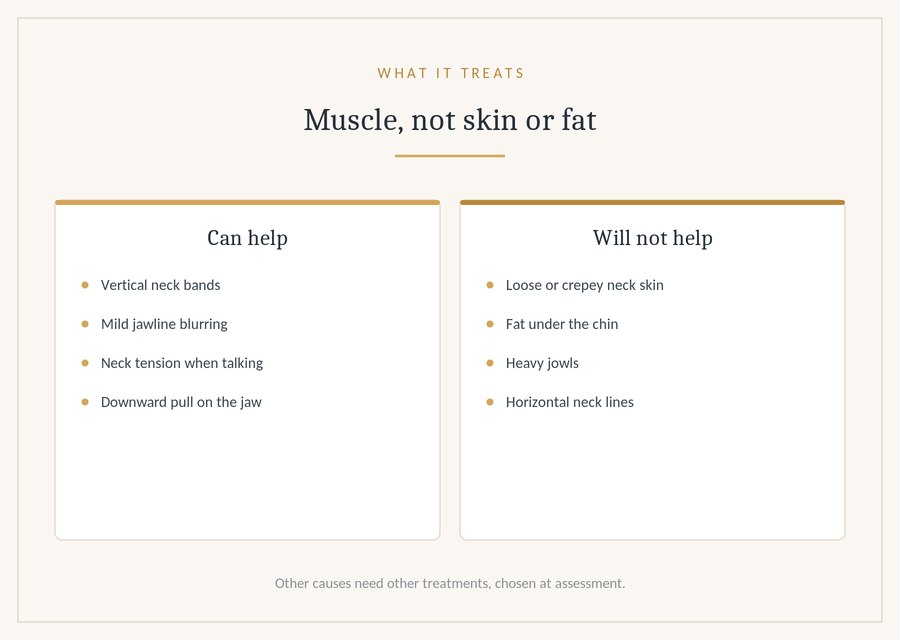
The treatment tends to suit people with visible platysmal bands, either at rest or when tensing, and a mild softening of the jawline, who still have reasonable skin elasticity. It is often considered by people in their thirties to fifties who notice that their neck looks tense in photographs or when talking. A simple test is to look in a mirror while tensing the neck: if strong cords appear and the jawline blurs, the muscle is contributing.
When other treatments are more appropriate
A Nefertiti lift will not correct significant loose skin, heavy jowls, fat under the chin or horizontal neck lines. Fat under the chin may respond better to fat-dissolving injections. Loss of definition from bone and volume changes along the jaw may be better addressed with jawline filler, and crepey skin or horizontal lines with skin quality treatments. Marked laxity of the neck is a surgical question, and an honest assessment should say so.
Combining approaches
Many necks have more than one cause, so a plan may combine treatments in stages. For example, toxin may be used to relax the bands, with skin boosters for the texture of the neck skin or a small amount of filler along the jaw. Our article on caring for the neck describes the main options.
How Should I Prepare?
Preparation is simple. Tell the physician about any medicines and supplements, because blood thinners, aspirin, fish oil and some herbal supplements can increase bruising, and do not stop a prescribed medicine without advice from the doctor who prescribed it. Avoid alcohol the day before if you bruise easily. Arrive without heavy make-up or creams on the neck and jawline, and allow time for the assessment, since the decision about whether to treat and how much to use depends on it. If you have an important event, plan treatment at least two weeks beforehand so that the full effect has developed and any bruising has faded.
What Happens During the Treatment?
The assessment
The physician looks at your neck and lower face at rest and while you tense the neck, grimace and smile. The strength and position of the bands, the jawline, the skin quality, any fat under the chin and the corners of the mouth are all assessed. Your medical history is reviewed, including any difficulty swallowing, neuromuscular conditions, medicines and previous treatments.
The injections
You are usually asked to tense your neck so the bands can be marked. Small amounts of toxin are injected along the lower border of the jaw and into the bands with a fine needle, keeping the injections superficial so that the deeper muscles of the neck are not affected. The treatment takes around fifteen to thirty minutes, and most people describe a brief sting. Dr Soheila works with Botox (Allergan), Dysport and Nabota, and the product and dose are chosen at the consultation.
How much toxin is used
Doses vary with the number and strength of the bands. In October 2024, the US FDA approved Botox Cosmetic for moderate to severe platysma bands, the first approval of a toxin for this use, with doses of 26, 31 or 36 units depending on severity. These are Botox units, and other products are dosed in their own units, which cannot be converted directly.
Aftercare
You are usually advised not to massage the area, to avoid strenuous exercise and lying flat for the rest of the day, and to avoid alcohol for a day. Small bumps at the injection points usually settle within an hour, and bruising, if it occurs, fades over several days.
When Will I See Results, and How Long Do They Last?
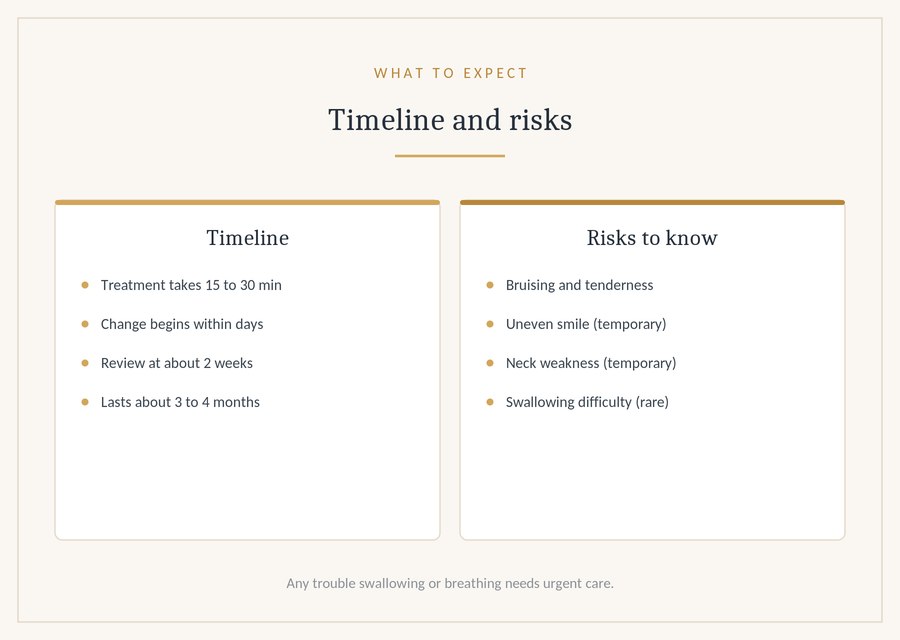
The effect usually begins within a few days and is judged at around two weeks, when a review is often arranged. The change is subtle: neck bands look softer, particularly when you speak or tense, and the jawline can look a little cleaner because the muscle pulls down on it less. The face should still look and move like your own.
Results typically last around three to four months, similar to anti-wrinkle injections elsewhere, after which the muscle gradually regains its strength. Treatment can be repeated if you wish to maintain the effect, usually no more often than every three months. Our article on how long botulinum toxin lasts explains the factors that affect duration.
Can the Treatment Be Repeated Over the Long Term?
Yes, many people repeat it every few months, but the plan should be reviewed at each visit rather than repeated automatically. The dose may be reduced if the bands respond well, and the gap between treatments may lengthen for some people. Very frequent top-ups and high doses are avoided, because they raise the chance of side effects and, rarely, of the body forming antibodies that make toxin less effective.
Over time the neck also changes for reasons the muscle treatment cannot address, such as skin thinning and sun damage, which are common in a sunny climate like Dubai’s. Daily sun protection on the neck and a review of skin quality treatments are sensible parts of a longer-term plan.
What Are the Risks of a Nefertiti Lift?
Common and expected effects
Redness, small bumps, tenderness and bruising at the injection sites are common. Some people notice a mild ache or a feeling of tightness in the neck for a few days.
Effects on nearby muscles
Because the platysma blends with the muscles that move the mouth, toxin that affects them can cause an uneven smile or difficulty moving the lower lip, which is temporary but can last several weeks. Toxin that reaches the deeper muscles of the neck can cause temporary neck weakness, difficulty lifting the head from a pillow, a change in the voice or difficulty swallowing. These effects are more likely with higher doses or deeper injection, which is why careful, superficial placement and conservative dosing matter.
Rare serious effects
All botulinum toxin products carry a warning that, rarely, the effect can spread and cause generalised weakness or problems with swallowing or breathing. Any difficulty swallowing, breathing or speaking after treatment needs urgent medical attention. Allergic reactions are also possible.
Who Should Avoid a Nefertiti Lift?
Treatment is postponed during pregnancy and breastfeeding and when there is infection or inflammation at the injection sites. It is avoided in people who are allergic to botulinum toxin or any ingredient of the product, and in people with neuromuscular conditions such as myasthenia gravis or Lambert-Eaton syndrome. People who already have any difficulty swallowing, weakness of the neck, breathing problems, or who take medicines that affect nerve and muscle function, such as certain antibiotics, need careful assessment and are often advised against it. People with marked skin laxity or fat under the chin are unlikely to see a worthwhile change. A licensed physician must confirm suitability in person.
Nefertiti Lift or Other Lower-Face Treatments?
The Nefertiti lift is one of several toxin treatments for the lower face, and they are often confused. Masseter injections slim the angle of the jaw by relaxing the chewing muscle, which is a different aim, and our guide to masseter injections explains it. Toxin to the muscles at the corners of the mouth can soften a downturned mouth, and toxin to the chin can smooth dimpling. These may be combined with neck treatment in a single plan, but each area adds to the total dose, so the plan should be clear about what is being treated and why. The page on Nefertiti neck lift and lower-face treatment describes how these areas are approached.
Choosing Who Treats You
Neck injections need a good understanding of the anatomy of the lower face and neck, so choose a licensed physician whose DHA licence you can verify on the DHA Sheryan portal and who performs lower-face toxin treatments regularly. Ask whether your neck will be assessed at rest and in movement, which product and dose are planned, and whether another treatment would suit your concern better.
A sound plan also includes written aftercare, a review at around two weeks and clear advice on what to do if you notice difficulty swallowing or neck weakness. At dr-soheila.com, treatments are planned and performed by Dr Soheila Eskandari, a DHA-licensed general practitioner with aesthetic privileges with 20 years of experience in aesthetic medicine.
The Short Version
A Nefertiti lift uses botulinum toxin along the jawline and in the vertical bands of the platysma muscle to reduce its downward pull. In suitable people it softens neck bands and can make the jawline look slightly more defined. It suits visible bands and mild loss of definition with reasonable skin elasticity, not loose skin, heavy jowls or fat under the chin.
The effect is judged at around two weeks and typically lasts three to four months. Bruising and tenderness are common, and an uneven smile, neck weakness or difficulty swallowing can occur, which is why careful dosing matters. Pregnancy, breastfeeding, neuromuscular conditions and existing swallowing problems are reasons to avoid treatment, and a licensed physician must assess suitability in person.
Questions Worth Asking
Is the platysma muscle the main cause of my neck or jawline concern? The answer should explain what is muscle, what is skin and what is fat or bone.
Which product and dose do you plan, and where? You should know the product, the units and whether other lower-face areas are included.
What would you suggest if this is not the right treatment for me? A good assessment considers alternatives rather than defaulting to toxin.
What should I do if I notice difficulty swallowing or neck weakness? You should be told what to watch for and how to reach the clinic quickly.
Frequently Asked Questions
What is a Nefertiti lift?
It is a botulinum toxin treatment injected along the jawline and into the vertical neck bands to relax the platysma muscle, softening the bands and reducing the downward pull on the lower face.
Does a Nefertiti lift actually lift the face?
Not in the surgical sense; it relaxes a muscle that pulls down, which can make the jawline look slightly more defined, but it does not tighten skin or reposition tissue.
Who is a good candidate for a Nefertiti lift?
People with visible neck bands and mild loss of jawline definition who still have reasonable skin elasticity tend to benefit most.
Can a Nefertiti lift treat a double chin or loose neck skin?
No, fat under the chin and loose skin do not respond to toxin; fat-dissolving injections, skin treatments or surgery may be considered instead.
How many units are used for a Nefertiti lift?
It depends on the bands and the product; the US FDA approved Botox Cosmetic for platysma bands in 2024 at doses of 26, 31 or 36 units, and other products use their own units.
How long does a Nefertiti lift last?
The effect is judged at around two weeks and typically lasts about three to four months before the muscle gradually regains strength.
Does a Nefertiti lift hurt?
Most people feel a brief sting with each small injection, and the treatment takes around fifteen to thirty minutes.
What are the side effects of a Nefertiti lift?
Bruising, tenderness and mild neck ache are common; an uneven smile, neck weakness, voice change or difficulty swallowing can occur, and breathing or swallowing problems need urgent care.
Who should avoid a Nefertiti lift?
People who are pregnant or breastfeeding, have a neuromuscular condition, existing swallowing or breathing problems, infection at the site or allergy to botulinum toxin should not have it.
What does a Nefertiti lift cost in Dubai?
Market rates generally depend on the units used; many clinics charge around AED 30 to AED 50 per Botox unit, so a neck and jawline session often comes to roughly AED 800 to AED 2,000, and you should ask for a written quote.
This article is general information about aesthetic and dermatological treatments and is not medical advice, a diagnosis, or a treatment recommendation for any individual. Outcomes vary between patients and no result is guaranteed. Prescription medications and injectable products carry risks and contraindications that must be assessed by a licensed physician during a personal consultation. Dr Soheila Eskandari is licensed by the Dubai Health Authority. Prices quoted are general market ranges for information only and are not an offer.


 English
 Arabic