
Skin Boosters in Dubai Compared: NCTF, Sunekos, Jalupro, Revitacare, Profhilo, Suisselle
Skin Boosters in Dubai Compared: NCTF, Sunekos, Jalupro, Revitacare, Profhilo, Suisselle
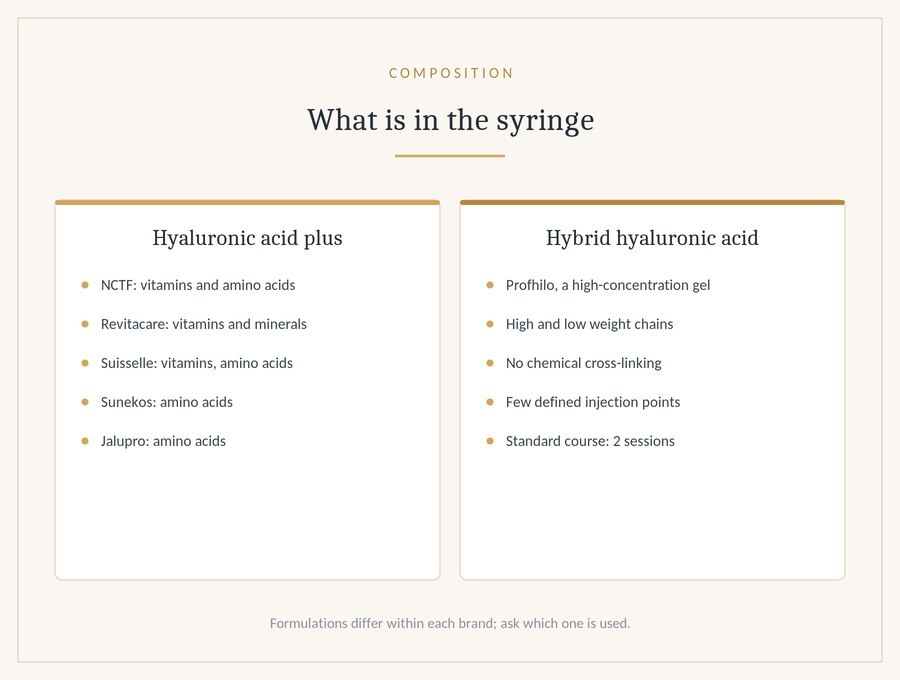
A skin booster in Dubai is a small-volume injection of hyaluronic acid, sometimes combined with other ingredients, placed in the skin to improve hydration, texture and elasticity, and the main brands differ in what the syringe contains. NCTF, Revitacare and Suisselle combine hyaluronic acid with vitamins and amino acids, Sunekos and Jalupro combine it with amino acids, and Profhilo is a high-concentration hybrid hyaluronic acid, but none of them lifts sagging skin or restores lost volume.
This guide compares NCTF, Sunekos, Jalupro, Revitacare, Profhilo and Suisselle, the skin boosters Dr Soheila works with. It covers what each contains, the concerns it is usually chosen for, how many sessions a course involves, what none of them can do, the risks, who should avoid them and what they cost. Details differ between formulations within a brand, so the schedules below are typical patterns rather than fixed rules, and suitability must be confirmed in person by a licensed physician.
What Is a Skin Booster, and How Is It Different From a Filler?
A skin booster is placed in the skin itself, as many tiny droplets or a few small deposits, to improve its quality. The base is usually hyaluronic acid that is not chemically cross-linked, so it spreads through the tissue, binds water and is gradually absorbed by the body. Some products add vitamins, minerals or amino acids, and Profhilo uses a hybrid of long and short hyaluronic acid chains at a high concentration.
A filler is designed differently. Its cross-linked gel is placed to add structure, for example to support a cheek or shape a lip, whereas a skin booster targets dryness, dullness, fine crepey lines and a mild loss of elasticity. These products are generally regulated as medical devices rather than medicines, registration differs between countries, and the published studies are mostly small and short, with few direct comparisons between brands. Polynucleotide products are built on a different ingredient and are covered in our guide to polynucleotide skin boosters; this article stays with the six hyaluronic acid-based products below.
How Do NCTF, Sunekos, Jalupro, Revitacare, Profhilo and Suisselle Differ?
Dr Soheila works with all six. Each is described below in the same order: what it contains, what it is usually chosen for and how a course is typically planned.
NCTF: hyaluronic acid with a vitamin and amino acid complex
NCTF stands for New Cellular Treatment Factor and is most often used as NCTF 135 HA. It combines non-cross-linked hyaluronic acid with a complex of vitamins, minerals, amino acids, coenzymes, nucleic acids and antioxidants, which its maker describes as 59 components. It is given as many small superficial injections and is usually chosen for dull, dehydrated skin, early fine lines and the papery texture that can appear around the eyes and on the neck. A course of three to four sessions two to four weeks apart, followed by maintenance every three to six months, is a commonly described schedule. Studies are mostly small, and controlled comparisons against hyaluronic acid alone are limited, so the added benefit of the complex is not yet clearly demonstrated. Our guide to NCTF in Dubai goes into the evidence.
Sunekos: an amino acid formulation with hyaluronic acid
Sunekos combines a mixture of amino acids, the building blocks the skin uses to make collagen and elastin, with hyaluronic acid; the 200 formulation uses low-molecular-weight hyaluronic acid. It is often chosen for thin, crepey or tired skin, including the delicate skin around the eyes, where the aim is better texture and elasticity rather than volume. Clinic schedules commonly describe three to four sessions one to two weeks apart, with maintenance sometimes planned every six to nine months. Published studies are limited and mostly small, as with most products in this group.
Jalupro: hyaluronic acid with amino acids
Jalupro combines hyaluronic acid with a mixture of amino acids. It is sold in several formulations, including Classic, HMW and Super Hydro, so the type and concentration of hyaluronic acid depend on the one chosen. It is usually selected for hydration, fine lines and general skin texture. Published clinic and supplier schedules range from two to four sessions, spaced from ten days to a month apart, so the plan depends on the formulation and on your physician. Our guide to Jalupro in Dubai has more detail.
Revitacare: a hyaluronic acid base with vitamins, minerals and amino acids
Revitacare is a French laboratory whose injectable skin-booster range is built on hyaluronic acid, with multi-ingredient formulations that add vitamins, minerals and amino acids. The exact blend and the hyaluronic acid content vary between formulations, so the product name matters. It is usually chosen for general skin quality, meaning dryness, dullness and early fine lines. The number of sessions and the interval depend on the formulation, and the schedule should follow the manufacturer’s instructions for the exact product, which your physician can show you.
Profhilo: a high-concentration hybrid hyaluronic acid
Profhilo, made by IBSA, contains 64 mg of hyaluronic acid in a 2 ml syringe, formed into hybrid complexes of high- and low-molecular-weight chains without chemical cross-linking agents. Rather than many superficial droplets, it is placed at a small number of defined points and is designed to spread through the tissue. It is usually chosen for dry skin that has started to lose firmness, with mild laxity on the face and neck, and its maker describes the effect as bioremodelling. The standard course is two sessions four weeks apart, with a maintenance session often planned after about six months. Our comparison of Profhilo and other skin boosters explains the difference, and the Profhilo treatment page gives an overview.
Suisselle: hyaluronic acid with amino acids and vitamins
Suisselle is a Swiss range whose skin boosters are described as a blend of non-cross-linked hyaluronic acid, amino acids and vitamins, and it comes in formulations named for their aim, such as Glow and Lift. It is usually chosen for dull, dehydrated skin and an early loss of firmness, where the goal is texture and radiance rather than shape. The schedule depends on the formulation, so ask for the course planned for the exact product. As with every product in this group, a name that includes the word lift does not mean that sagging tissue is repositioned.
Which Skin Booster in Dubai Suits Which Concern?
By composition, the six fall into three groups. NCTF, Revitacare and Suisselle pair hyaluronic acid with vitamins and amino acids, and NCTF and Revitacare also list minerals. Sunekos and Jalupro pair hyaluronic acid with amino acids alone. Profhilo contains hyaluronic acid only, as a hybrid, high-concentration gel.
By concern, the usual patterns are as follows. For dryness and dull skin, NCTF, Jalupro, Revitacare and Suisselle are commonly chosen. For fine crepey lines and thin skin, including under the eyes, Sunekos, NCTF and Jalupro are commonly used, with depth and technique selected carefully in that area. For an early loss of firmness and mild laxity, Profhilo is commonly chosen. These are patterns of use rather than rankings, and the right product depends on your skin, your history and the assessment.
By course, Profhilo has the shortest standard schedule, at two sessions four weeks apart. Sunekos, Jalupro and NCTF courses commonly run to between two and four sessions, about one to two weeks apart for Sunekos, ten days to a month for Jalupro and two to four weeks for NCTF, followed by maintenance every few months. Revitacare and Suisselle schedules depend on the formulation. Across all six, improved hydration may be noticeable within a week or two of a session, while changes in texture and elasticity build across the course, so the result is judged four to six weeks after the last session.
What Can Skin Boosters Not Do?
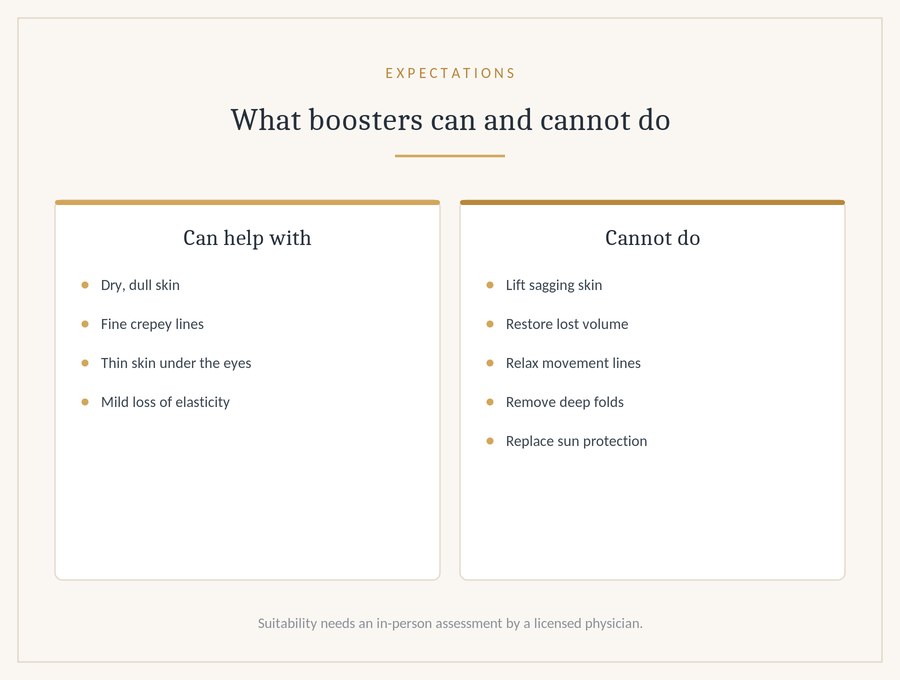
Skin boosters improve the quality of the skin, not its structure. They cannot lift sagging skin, because they do not reposition tissue or tighten loose skin the way energy-based devices, threads or surgery are designed to. They cannot restore lost volume in hollow cheeks, temples or tear troughs, which needs a filler or a collagen biostimulator, and they cannot relax the muscle movements behind frown lines and crow’s feet, which is the role of botulinum toxin. Our comparison of skin boosters and anti-wrinkle injections explains how the two differ.
Expectations for the skin under the eyes need particular care. A booster can soften fine crepey lines and dryness in thin skin there, but it does not correct dark circles caused by pigment, shadowing or hollowing, so the cause should be identified before anything is injected. Sun protection also remains essential, because ultraviolet exposure works against any gain in hydration and elasticity, and in Dubai’s strong sun and air-conditioned interiors a daily broad-spectrum sunscreen and a moisturiser are part of the plan.
What Are the Risks and Side Effects?
Common effects are small raised bumps at the injection points, redness, tenderness, swelling and bruising. Bumps from many tiny superficial injections usually settle within a day, whereas the small deposits used for Profhilo can leave soft lumps that take a few days to settle, and bruising is more likely around the eyes, where the skin is thin. Make-up, vigorous exercise, heat and alcohol are usually avoided for the first day, as your physician advises.
Less common effects include infection, allergic or delayed inflammatory reactions, lumps that persist and flare-ups of cold sores in people prone to them. Blockage of a blood vessel is considered much less likely with superficial micro-injections than with filler, but it cannot be ruled out, and severe or increasing pain, white or dusky skin or any change in vision needs urgent medical attention. Because contents differ between brands, ask for the product name, formulation and batch number to be recorded in your notes.
Who Should Avoid Skin Boosters?
Treatment is usually postponed or avoided during pregnancy and breastfeeding, because safety has not been established in those groups, and when there is infection, an acne flare, eczema or other inflammation in the area to be treated. It is not suitable for anyone with a known allergy to hyaluronic acid or to any component of the formulation, including its amino acids or vitamins, or with a history of severe allergic reactions. Extra caution applies with bleeding disorders, blood-thinning medicines and supplements, autoimmune conditions, a tendency to keloid or hypertrophic scarring and frequent cold sores. Never stop a prescribed medicine without the prescriber’s advice, and expect a licensed physician to assess suitability in person.
Choosing Who Treats You
When you compare skin boosters in Dubai, start with the practitioner rather than the product name. Choose a licensed physician whose DHA licence you can verify on the DHA Sheryan portal, and ask about their experience with the specific product, for example how often they treat the skin under the eyes or run a Profhilo course. A proper assessment before injecting should cover your skin, medical history and medicines, what the product can and cannot do, and the alternatives.
A sound plan names the product and formulation, the number of sessions and the interval, includes written aftercare and a review a few weeks after the last session, and gives you a clear way to reach the clinic if something worries you. The page on skin booster treatments gives an overview of the products. At dr-soheila.com, treatments are planned and performed by Dr Soheila Eskandari, a DHA-licensed general practitioner with aesthetic privileges with 20 years of experience in aesthetic medicine.
The Short Version
Skin boosters are hyaluronic acid injections, with or without added vitamins, minerals or amino acids, that improve hydration, texture and elasticity. NCTF, Revitacare and Suisselle pair hyaluronic acid with vitamins and amino acids, Sunekos and Jalupro with amino acids, and Profhilo is a high-concentration hybrid hyaluronic acid with a standard course of two sessions four weeks apart. Sunekos, Jalupro and NCTF courses commonly involve two to four sessions, with maintenance every few months.
None of them lifts sagging skin, restores lost volume or relaxes movement lines, and the evidence behind each brand is mostly small studies, so the realistic aim is a gradual, natural-looking improvement in skin quality. Bumps, bruising and swelling are common, rarer reactions can occur, and treatment is avoided in pregnancy, breastfeeding, active infection and known allergy. A licensed physician must assess suitability in person, and the product, formulation and course should be agreed before you are injected.
Questions Worth Asking
Which exact product and formulation will you use? A brand name is not enough, because each range has several formulations with different contents.
Is my concern skin quality, volume or sagging? Boosters address skin quality; volume and sagging usually need a different treatment.
How many sessions are planned, and when will we judge the result? Expect a short course and a review about four to six weeks after the last session.
What happens if I develop a lump, a reaction or a warning sign? A clear plan for review and urgent contact should exist before you are injected.
Frequently Asked Questions
What is a skin booster and how does it work?
A skin booster is a small-volume injection of hyaluronic acid, sometimes with vitamins, minerals or amino acids, that binds water in the skin and improves hydration and texture; unlike a filler, it does not add shape.
What is the difference between NCTF, Sunekos, Jalupro, Revitacare, Profhilo and Suisselle?
NCTF, Revitacare and Suisselle combine hyaluronic acid with vitamins and amino acids, Sunekos and Jalupro with amino acids, and Profhilo is a high-concentration hybrid hyaluronic acid placed at a few points; formulations within a brand also differ.
Which skin boosters are usually chosen for fine crepey lines?
NCTF, Sunekos and Jalupro are commonly used for fine crepey lines and dry, thin skin, depending on your skin and the area; none of them removes deep or movement-related wrinkles.
Can skin boosters be used under the eyes?
Yes, some can be used there to soften fine crepey lines and dryness in thin skin, but they do not correct hollows or dark circles caused by shadowing or pigment, and bruising is more likely.
Is Profhilo a skin booster?
Profhilo is usually grouped with skin boosters, although its maker calls it bioremodelling; it contains only hyaluronic acid, at a high concentration, placed at a few points, whereas NCTF, Sunekos and Jalupro add other ingredients and are usually given as many small injections.
How many sessions do skin boosters usually need, and how long do they last?
Courses typically run from two sessions for Profhilo to three or four for NCTF and Sunekos, followed by maintenance every few months; effects fade gradually, no duration can be promised, and repeat sessions are planned from how your skin looks.
Can a skin booster lift sagging skin or restore volume?
No; boosters improve hydration, texture and elasticity but do not reposition tissue or replace lost volume, which need other treatments such as fillers, collagen biostimulators, energy-based devices or threads, chosen after assessment.
What are the risks and side effects of skin boosters?
Bumps, redness, swelling, tenderness and bruising are common; infection, allergic or delayed inflammatory reactions, lasting lumps and cold-sore flare-ups can occur, and blockage of a blood vessel is rare but needs urgent medical attention.
Who should avoid skin boosters?
Treatment is usually postponed in pregnancy, breastfeeding, infection or inflammation in the area and known allergy to a component, and needs extra care with bleeding disorders, blood thinners, autoimmune conditions and keloid scarring.
What does a skin booster cost in Dubai?
Market rates generally run from around AED 900 to AED 3,000 per session, depending on the product, the area treated and the clinic; because most courses involve two to four sessions, ask for the total in writing and for what it includes.
This article is general information about aesthetic and dermatological treatments and is not medical advice, a diagnosis, or a treatment recommendation for any individual. Outcomes vary between patients and no result is guaranteed. Prescription medications and injectable products carry risks and contraindications that must be assessed by a licensed physician during a personal consultation. Dr Soheila Eskandari is licensed by the Dubai Health Authority. Prices quoted are general market ranges for information only and are not an offer.


 English
 Arabic