
Gummy Smile Botox in Dubai: How It Works and Who It Suits
Gummy Smile Botox in Dubai: How It Works and Who It Suits
Gummy smile Botox relaxes the small muscles that lift the upper lip, so the lip rises less when you smile and less gum shows. It suits a gummy smile caused mainly by overactive lip-elevator muscles; it does not correct one that comes from the jaw, the gums or the teeth, which need a dentist, periodontist or orthodontist instead. The effect usually becomes clear within one to two weeks and wears off gradually over the following months.
A gummy smile is common and is usually a cosmetic concern rather than a medical problem, but many people feel self-conscious about it. This guide explains the causes and why the cause decides the treatment, the muscles involved, typical units, onset and duration, risks, who should avoid treatment, the follow-up review and what it costs in Dubai.
What Is a Gummy Smile?
A gummy smile, known clinically as excessive gingival display, shows a wide band of gum above the upper front teeth. Studies do not agree on an exact cut-off: some call more than 2 mm of visible gum excessive, others use more than 3 to 4 mm, and 1 to 2 mm is generally regarded as normal. Estimates of how common it is range from roughly 10 to 29 per cent of people.
The gum may show mainly at the front of the smile, towards the back, in both places or on one side only, and doctors use this pattern to decide which muscles to target.
What Causes a Gummy Smile, and Why Does the Cause Matter?
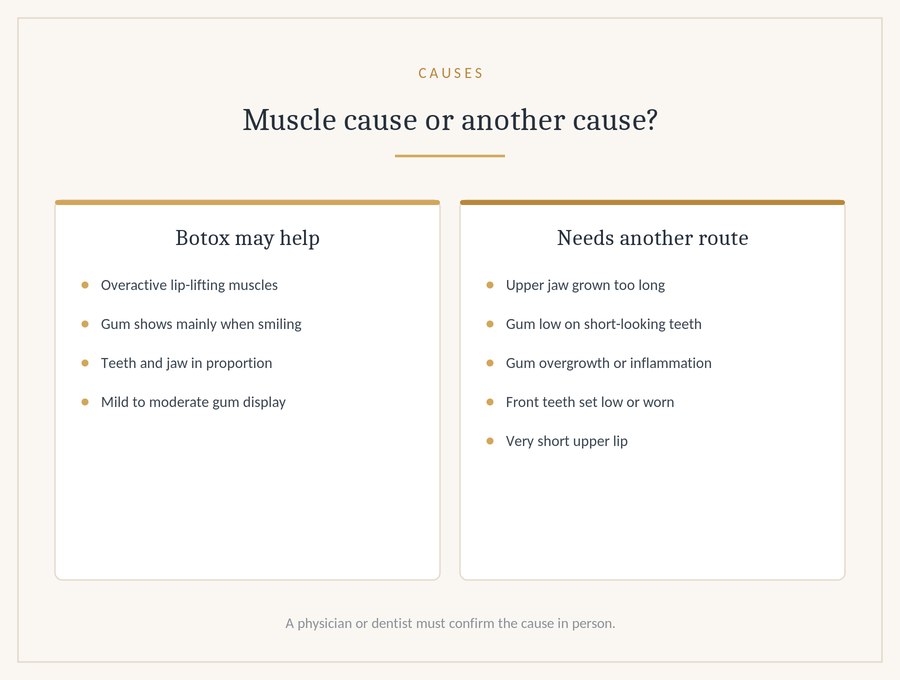
Two people can show the same amount of gum for different reasons, and the reason decides which treatment can work. Botox acts only on muscle, so if the cause lies in the jaw, gums or teeth, relaxing the lip will not correct it, and more than one cause can be present at once. The assessment looks at your smile at rest and at full width, your upper lip length, teeth and bite, and sometimes includes a dental opinion or X-ray.
Overactive upper-lip elevator muscles
When the muscles that lift the upper lip pull too strongly or too far, the lip rises high above the teeth and exposes the gum, even though the teeth, gums and jaw are in proportion. This is the cause for which Botox is mainly used, and the gum typically shows chiefly when you smile.
A short upper lip
A short lip does not cover the teeth and gum fully, so an ordinary smile shows more gum. Relaxing the elevator muscles may reduce the lift, but Botox does not lengthen the lip, so the change can be smaller and less predictable. Surgical lip repositioning is another option, and lip length is measured before any injection.
Vertical maxillary excess
The upper jaw has grown too long in height. The face often looks long, the lips may not close easily, and gum can show at rest. This is a skeletal cause that an orthodontist or maxillofacial surgeon assesses, and treatment may involve orthodontic care, jaw surgery or both. Botox does not change the jaw.
Altered passive eruption and gum overgrowth
In altered passive eruption, the gum has not drawn back to its usual level as the teeth came through, so the teeth look short and square. Gum overgrowth can follow inflammation or certain medicines. A periodontist assesses these, and treatments such as reshaping the gum line work on the gum itself. Botox does not change the proportion of tooth to gum.
Dental causes
The upper front teeth and the bone holding them can sit too low, which is called dentoalveolar extrusion, or the front teeth can be tilted or worn short. Orthodontic and restorative dental treatment address these, so a dentist is the right first contact.
The causes often overlap. Botox can be the main treatment when the cause is muscular, a supporting treatment alongside other care, or a temporary measure while a surgical plan is made.
How Does Botox Reduce a Gummy Smile?
Botulinum toxin type A blocks the nerve signal that tells a muscle to contract. Botox is a brand name for onabotulinumtoxinA, one of several such products. Injected in very small amounts into the muscles that lift the upper lip, it reduces how far they pull, so the lip rises less on smiling. The muscles are weakened rather than switched off, and the effect wears off.
Which muscles are involved?
Three muscles do most of the lifting. The levator labii superioris alaeque nasi runs from the bone beside the nose to the wing of the nostril and the upper lip. The levator labii superioris runs from below the rim of the eye socket to the upper lip, and the zygomaticus minor runs from the cheekbone to the upper lip. The injection is placed on each side at the centre of the triangle these muscles form, a spot called the Yonsei point in the literature.
The zygomaticus major, which pulls the corner of the mouth up and out, lies close by and should keep working so the smile stays wide and even. Some physicians use one point per side and others two, with a second point further out for gum that shows towards the back of the smile.
Is it a licensed use?
Treating a gummy smile is generally described as an off-label use of botulinum toxin, so you should be told this before you decide. The evidence comes from small studies and reviews, and reviewers have asked for larger randomised trials with longer follow-up. One pooled analysis concluded that Botox is mainly an option when the excess display is up to about 4 mm.
Who Does Gummy Smile Botox Suit?
Botox is most likely to suit someone whose gum shows mainly because the upper lip rises too far, whose teeth, gums and bite are in proportion, and whose excess display is mild to moderate. It also suits people who accept that a reversible treatment must be repeated to keep the effect.
It is less suitable when the main cause is skeletal, gum-related or dental, when a large amount of gum shows, or when the upper lip is unusually short or long. Then a dentist, periodontist, orthodontist or surgeon should lead, and Botox may play a smaller supporting role, for example alongside orthodontic treatment.
Botox lowers the lift of the lip, so the smile may feel slightly different, and you should agree with the physician what you want to keep.
What Happens at the Appointment?
The consultation covers your medical history, including medicines, pregnancy or breastfeeding and any dental or orthodontic treatment. The physician watches your smile at rest and in a full smile, notes how much gum shows and where, and checks your upper lip length, teeth and bite. If the cause looks dental or skeletal, you should be referred before any injection.
If Botox is suitable, the points are marked while you smile and a very small amount is placed at each with a fine needle. Most people describe a brief sting, and you can usually return to normal activities straight away. If this will be your first treatment, our first-time Botox guide explains what to expect.
Units, Onset and How Long It Lasts
How many units are used?
Doses are small. Published studies mostly use about 2 to 5 units of onabotulinumtoxinA per side, so roughly 4 to 10 units in total. The dose depends on how much gum shows, the pattern of the smile and the size of the muscles, and men often need more than women. Units are not interchangeable between brands. Starting cautiously and adjusting at the review is the same principle as in our guide to baby Botox, and it matters here because too much toxin makes the smile look heavy.
When will I see a result?
The effect usually becomes noticeable between one and two weeks after the injection, and studies found a clear reduction in gum display at two weeks.
How long does it last?
Duration is less well documented for this area than for the forehead or frown lines. Reviews report that the effect holds for at least eight weeks and that gum display may begin to return from about three to four months, with four to six months quoted in some reviews. One pooled analysis found display back at its starting level by about 24 weeks. Follow-up in many studies was short, so these are estimates. Repeat treatment is usually planned once the previous effect has worn off, which also lowers the chance of antibodies forming against the toxin.
Risks and Side Effects
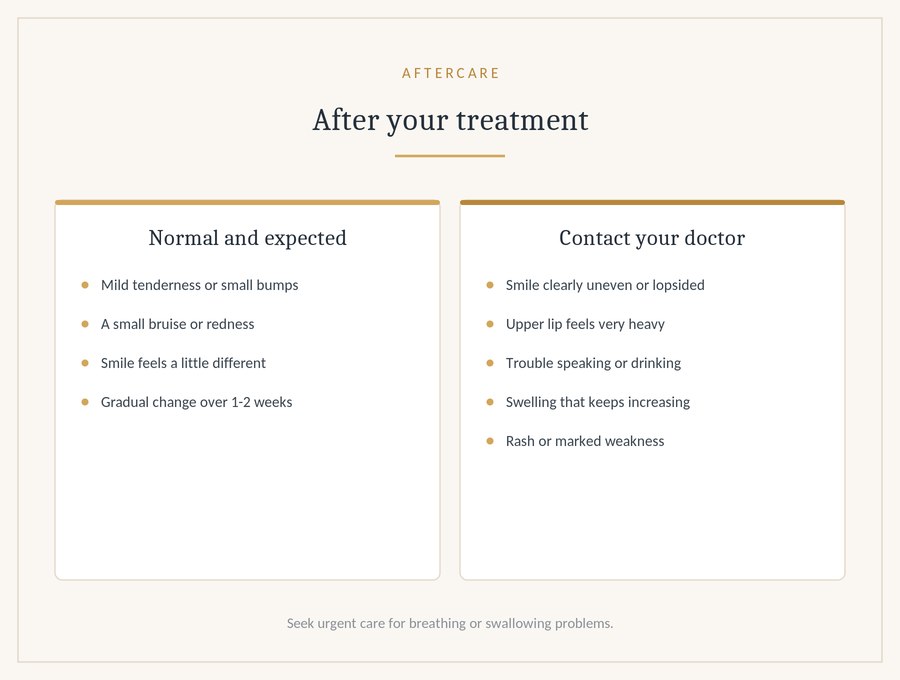
Most side effects are mild and short-lived. Tenderness, redness, swelling and small bruises at the injection points are the most commonly reported and usually settle within days. Reviews describe complications as uncommon, although most studies are small.
The risks specific to this treatment come from the toxin affecting more muscle than intended. The smile can look uneven if one side is weaker, or heavy and flat if too much of the lip-lifting muscle is relaxed. The upper lip can look longer at rest and, with an overdose, can droop enough to cover the teeth when you smile. Some people notice temporary difficulty with lip movements used in speaking, drinking or chewing. These effects are temporary but can last several weeks.
Less commonly, an allergic reaction or infection can occur. Anyone with difficulty swallowing or breathing, marked weakness or a spreading rash should seek urgent medical care, and any smile change that worries you should be reported to the clinic.
Who Should Avoid Gummy Smile Botox?
Treatment is usually postponed during pregnancy and breastfeeding, when there is infection or a skin condition at the injection sites, and when there is a known allergy to botulinum toxin. It is avoided in neuromuscular conditions such as myasthenia gravis. Some medicines, including certain antibiotics, ciclosporin and calcium channel blockers, can interact with botulinum toxin, so tell the physician about everything you take. Blood-thinning medicines increase bruising and should be discussed, but never stopped without the prescribing doctor’s advice.
Extra care is needed if your work depends on precise lip movement, as for singers and wind-instrument players, or if your upper lip is already long.
Aftercare and the Follow-Up Review
For the first few hours, stay upright, avoid rubbing or pressing the treated area, and avoid heavy exercise, saunas and very hot environments for the rest of the day. Make-up can usually be applied gently after a few hours. Your physician’s own instructions take priority.
A review at around two weeks is part of the treatment, because that is when the full effect can be judged. The physician watches your smile at rest and in motion, compares both sides and decides whether a small adjustment is needed.
Gummy Smile Botox and Other Upper-Lip Treatments
A lip flip is a different treatment: very small doses in the ring-shaped muscle around the mouth roll the upper lip outwards slightly, and it is not a treatment for a gummy smile. Our guide to the lip flip explains how it works. If your concern is the fullness or shape of your lips rather than the gum, our comparison of lip flip and lip filler explains the difference.
Choosing Who Treats You
Botulinum toxin is a prescription medicine, so the person injecting should be a licensed physician whose DHA licence you can verify on the DHA Sheryan portal. Ask about their experience with gummy smile treatment in particular, whether they assess your lip length, teeth and bite before injecting, and whether they refer you to a dentist when the cause is not muscular.
A sound plan includes the product name and dose, an explanation that the use is off-label, a review at around two weeks, written aftercare and a way to reach the clinic if something concerns you. The page on Botox and anti-wrinkle treatments gives a general overview. At dr-soheila.com, treatments are planned and performed by Dr Soheila Eskandari, a DHA-licensed general practitioner with aesthetic privileges with 20 years of experience in aesthetic medicine.
The Short Version
A gummy smile has several possible causes, and Botox helps mainly when overactive muscles that lift the upper lip are responsible. A few units on each side relax those muscles, the effect becomes clear within one to two weeks and wears off over several months. The use is off-label and the evidence comes from small studies.
Side effects are usually mild, but an uneven or heavy smile, a longer-looking upper lip and temporary difficulty with some lip movements can occur. A short upper lip, or a jaw, gum or dental cause, often needs a dentist, periodontist, orthodontist or surgeon. Treatment is avoided in pregnancy, breastfeeding and certain neuromuscular conditions, and a licensed physician must confirm suitability in person.
Questions Worth Asking
What is causing my gummy smile? The answer should cover your lip, gums, teeth and jaw, not only your muscles.
How many units will you use, and where? Expect a small dose, a named product and a plan to adjust at the review.
What are the alternatives? You should hear about dental and surgical options and be told the use is off-label.
What happens at my two-week review? Both sides should be checked in motion, with a small adjustment if needed.
Frequently Asked Questions
What is a gummy smile?
A gummy smile, or excessive gingival display, shows a wide band of gum above the upper front teeth; studies set the cut-off between 2 mm and 4 mm of visible gum, and 1 to 2 mm is regarded as normal.
How does Botox reduce a gummy smile?
It relaxes the levator labii superioris alaeque nasi, levator labii superioris and zygomaticus minor, so the upper lip rises less when you smile and less gum shows.
Does Botox work for every cause of a gummy smile?
No, it helps mainly when overactive lip-elevator muscles are the cause, and a jaw, gum or dental cause usually needs a dentist, periodontist, orthodontist or surgeon.
How many units are used for a gummy smile?
Published studies mostly use about 2 to 5 units of onabotulinumtoxinA per side, and the physician adjusts the dose to your smile pattern and muscle size.
How soon will I see results?
The effect usually becomes noticeable between one and two weeks after the injection, and the smile is reviewed at around two weeks.
How long does gummy smile Botox last?
Studies suggest the effect holds for at least eight weeks and fades over roughly three to six months, although follow-up is short and individual results differ.
Can gummy smile Botox make my smile look uneven or heavy?
Yes, if one side is weaker or too much muscle is relaxed, the smile can look uneven or flat and the upper lip longer; these effects are temporary, and a review allows small adjustments.
Who should not have Botox for a gummy smile?
It is usually avoided in pregnancy, breastfeeding, known allergy, infection at the injection sites and neuromuscular conditions such as myasthenia gravis; a dental or skeletal cause needs a dentist or specialist first.
Is Botox for a gummy smile an off-label use?
Treating a gummy smile is generally described as an off-label use of botulinum toxin, so your physician should explain this and the limits of the evidence before you decide.
What does gummy smile Botox cost in Dubai?
Market rates generally run from around AED 500 to AED 1,500 for a Botox treatment area or package in Dubai, with per-unit pricing often quoted at about AED 30 to AED 60, and a gummy smile needs only a few units, so the total depends on how the clinic prices it; our Botox price guide explains what a fair quote includes.
This article is general information about aesthetic and dermatological treatments and is not medical advice, a diagnosis, or a treatment recommendation for any individual. Outcomes vary between patients and no result is guaranteed. Prescription medications and injectable products carry risks and contraindications that must be assessed by a licensed physician during a personal consultation. Dr Soheila Eskandari is licensed by the Dubai Health Authority. Prices quoted are general market ranges for information only and are not an offer.


 English
 Arabic