
Skin Boosters vs Botox in Dubai: Which Fine Lines Each One Treats
Skin Boosters vs Botox in Dubai: Which Fine Lines Each One Treats
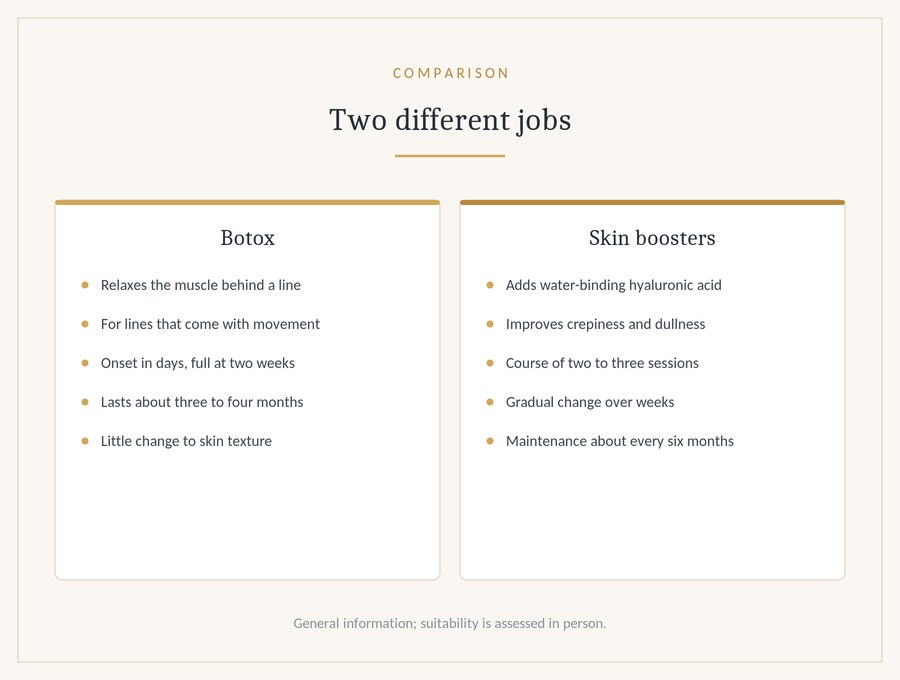
Skin boosters and Botox are not two versions of the same treatment, so the question is rarely which one is better. Botox relaxes the muscle that folds the skin into an expression line, while skin boosters improve the quality of the skin itself: its hydration, texture and fine crêpey lines. Lines that appear when you frown, raise your brows or smile usually respond to Botox; fine lines that are visible with the face completely still usually reflect skin quality, which is where skin boosters help.
Many faces in Dubai show a mix of both, which is why the two are often discussed together and sometimes combined. This guide explains what each treatment does, which lines respond to which, how a physician tells them apart, how many sessions are involved, how long results last, the side effects and risks, who should avoid each treatment, and what neither of them can achieve.
What Each Treatment Actually Does
Botox: relaxing the muscle that folds the skin
Botox is a brand name for botulinum toxin type A, a purified prescription medicine. Injected in very small doses into a specific facial muscle, it blocks the nerve signal that tells the muscle to contract. The muscle relaxes, the skin above it is folded less often, and the expression line it creates softens. The skin itself is not changed: its thickness, hydration and texture stay as they were. What changes is how much the skin is creased by movement.
This is why Botox works well on the forehead, between the brows and at the outer corners of the eyes, where strong muscles create lines every time you express emotion. It is not designed to improve dryness, dullness, fine texture or the papery creases that come from thinning skin.
Skin boosters: improving the skin the line sits in
Skin boosters are injectable gels based on hyaluronic acid, a sugar molecule found naturally in the skin that binds water. Unlike dermal fillers, which are designed to add volume and shape, skin boosters are thin, spread through the skin in many small injections and aim to improve hydration, elasticity and surface quality. Some products are combined with amino acids or other ingredients, and related treatments such as polynucleotides work on skin repair rather than hydration.
Over a course of sessions, skin that looked dry, crêpey or tired can look smoother and more even, and the fine lines that come from poor skin quality can soften. Skin boosters do not stop a muscle from moving, so they make little difference to a frown line that deepens every time you frown. If you want to understand how they compare with other options, our guides to Profhilo and other skin boosters and mesotherapy versus skin boosters go into the products themselves.
Which Lines Respond to Which?
Lines that come with expression
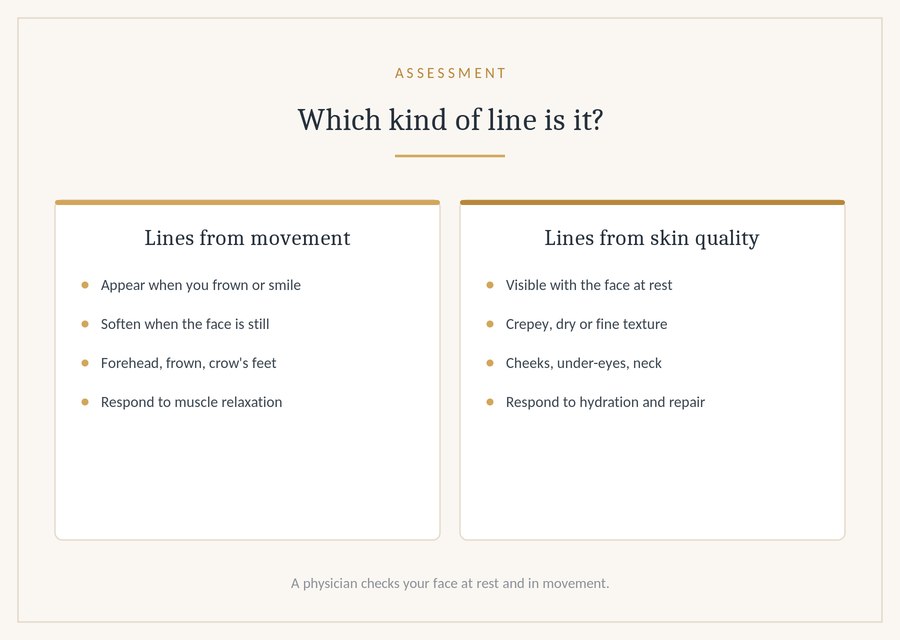
Dynamic lines are created by muscle movement. They appear when you frown, squint or lift your eyebrows and fade, at least partly, when the face is relaxed. Horizontal forehead lines, the vertical “11” lines between the brows and crow’s feet at the outer eyes are the classic examples. These are the lines Botox is designed for, because reducing the movement reduces the folding. Skin boosters may improve the texture around them, but they do not change the movement that creates them.
Fine lines visible at rest
Static fine lines are present even when the face is still. On the cheeks, under the eyes, around the mouth and on the neck, these are often signs of skin quality: reduced hydration, thinner skin, sun damage and the gradual loss of collagen and elastin that comes with age. They often look crêpey rather than deep, and they may be more obvious when the skin is dry. This is where skin boosters are usually considered, because improving the skin itself is the aim.
When a line has both causes
Many lines are mixed. A forehead line that started as movement can become etched into the skin over years, so that it remains visible at rest. In this case Botox reduces the movement that keeps deepening the line, while treatments that improve the skin, such as skin boosters or microneedling, may help the part of the line that has become fixed. Neither treatment alone fully addresses a mixed line, which is why assessment matters more than the choice of product.
How a Physician Decides What You Need
A useful consultation starts by looking at your face both still and in movement. The physician asks you to frown, raise your brows and smile, and watches where the lines form and how deep they become. Then the face is examined at rest, often in good light, to see which lines remain. The skin itself is assessed for hydration, texture, sun damage, pigmentation and thickness.
Your history matters too. The physician will ask about previous treatments, medicines, skin conditions, allergies and pregnancy or breastfeeding, and about what bothers you most when you look in the mirror. Lifestyle factors common in Dubai, such as strong sun exposure, long hours in air conditioning and squinting outdoors, can affect both muscle activity and skin quality, and they shape the advice given. A good outcome of this assessment may be a recommendation for one treatment only, for a combination, or for neither, if the concern would be better addressed by skincare, sun protection or a different procedure.
Sessions, Onset and How Long Each Lasts
Botox timeline
Botox is usually a single short appointment. The injections take only a few minutes. The first effect is often noticed within two to five days, the full effect is usually clear at around two weeks, and the result typically lasts about three to four months before movement gradually returns. Many physicians plan a review at around two weeks to check the result and make small adjustments if needed. Repeat treatment is planned when movement returns, not on a fixed calendar.
Skin booster timeline
Skin boosters are usually given as a course. Depending on the product, the typical plan is two or three sessions spaced two to four weeks apart. The change is gradual: hydration often improves within weeks, while texture and fine lines continue to improve for some time after the course. Results commonly last around six months, and maintenance sessions are then considered, often every six months or so, depending on the product, the skin and the person’s goals.
So the two treatments run on different rhythms. Botox gives a relatively quick and specific change that wears off over a few months, while skin boosters build gradually over a course and are maintained less often.
Can You Combine Them, and in What Order?
Combining the two is common because they address different causes. A typical sequence is to treat the expression lines with Botox first and to plan skin boosters afterwards, once the effect of Botox can be judged at around two weeks. In other plans, a skin booster course is already under way and Botox is added for the forehead or frown lines. What matters is that the plan is coherent: each treatment has a clear purpose, the order makes sense for your face, and the timing avoids treating the same area twice in quick succession without reason.
Some physicians treat different areas on the same day, for example Botox on the forehead and a skin booster on the cheeks. Others prefer to space treatments of the same area by about two weeks so that any swelling or bruising settles and each result can be seen clearly. Your physician should explain why they suggest one approach over another. If a plan includes many treatments at once, it is reasonable to ask which one addresses your main concern and whether all of them are needed. For a wider view of how muscle relaxation and volume treatments differ, our guide to Botox versus fillers explains the logic area by area.
Downtime, Side Effects and Risks
Botox
Downtime is usually minimal. Small raised marks at the injection points settle within about half an hour, and mild redness or tenderness is common. Bruising can occur, especially around the eyes. Some people have a headache for a day or two. Less commonly, the effect spreads to a nearby muscle, which can cause a heavy brow, a drooping eyelid or an uneven smile. These effects are temporary but can last several weeks, which is why careful dosing and placement matter. Allergic reactions are rare.
Skin boosters
Because skin boosters are placed through many small injections, small bumps are expected immediately afterwards and usually settle within a day or two. Redness, swelling, tenderness and bruising are common for a few days. Less commonly, small lumps can persist and may need review. As with any hyaluronic acid injection, infection is possible, and very rarely the product can block a blood vessel; this is uncommon with superficial skin boosters but is the reason treatment should be carried out by a physician who knows facial anatomy and can act quickly. Cold sores can be triggered in people who are prone to them, and preventive medicine is sometimes discussed beforehand.
For both treatments, anyone who has unusual pain, skin colour changes, increasing swelling, fever, vision changes, difficulty swallowing or breathing, or marked weakness after treatment should contact the clinic urgently or seek emergency care.
Who Should Avoid Them?
Both treatments are usually postponed during pregnancy and breastfeeding, when there is an active skin infection, acne flare or cold sore at the treatment site, and when there is a known allergy to any ingredient. Botox is avoided in people with certain neuromuscular conditions such as myasthenia gravis, and some medicines, including certain antibiotics, can interact with it. Skin boosters need care in people with active autoimmune disease, a history of severe allergic reactions or a tendency to form raised scars.
Blood-thinning medicines and supplements increase the chance of bruising and should be discussed, but they should never be stopped without the advice of the doctor who prescribed them. Anyone with an important event coming up should allow at least two weeks after either treatment so that any bruising or swelling has settled.
What Neither Treatment Will Do
It helps to know the limits. Neither Botox nor skin boosters replace lost volume in the cheeks or temples, lift sagging skin along the jaw, or fill deep folds such as the nasolabial folds. Those concerns are usually assessed for fillers, biostimulators or other approaches. Neither treatment removes pigmentation or broken capillaries, and neither replaces daily sun protection, which remains one of the most effective ways to protect skin quality in a sunny climate. Deep lines that have been etched for many years may soften with treatment but rarely disappear completely. Being clear about this at the start avoids disappointment and unnecessary treatment.
Choosing Who Treats You
Both Botox and skin boosters are medical treatments, so the person injecting should be a licensed physician whose DHA licence you can verify on the DHA Sheryan portal. Ask about their experience with these specific treatments, whether they examine your face at rest and in movement before suggesting anything, and whether they explain the product, the dose or volume, and the risks before you consent.
A sound plan includes a review, written aftercare and a clear way to reach the clinic if something concerns you. Be cautious about packages that bundle several treatments before anyone has assessed your skin. The page on Botox and anti-wrinkle treatments gives an overview of the areas treated. At dr-soheila.com, treatments are planned and performed by Dr Soheila Eskandari, a DHA-licensed general practitioner with aesthetic privileges with 20 years of experience in aesthetic medicine.
The Short Version
Botox and skin boosters treat different causes of fine lines. Botox relaxes the muscle that creases the skin, so it suits lines that appear with expression, starts working within days and lasts about three to four months. Skin boosters improve hydration and skin quality, so they suit fine crêpey lines visible at rest, work gradually over a course of two or three sessions and are maintained about every six months.
Many people have both kinds of line and benefit from a combined, well-timed plan, while others need only one treatment. Both carry side effects and risks, both are avoided in pregnancy and breastfeeding, and suitability should be confirmed in person by a licensed physician.
Questions Worth Asking
Which of my lines come from movement and which from skin quality? The answer should be specific to your face, not a general description.
Why this treatment, or this combination, for my main concern? Each part of the plan should have a clear purpose.
How many sessions, and when will we review the result? You should know the full course and the timing before you start.
What are the risks for me, and how would they be managed? This should include rare risks, not only bruising and swelling.
Frequently Asked Questions
Can skin boosters replace Botox?
No. Skin boosters improve hydration and skin quality, while Botox relaxes the muscle that creates expression lines, so they treat different causes and one cannot replace the other.
Can I have skin boosters and Botox on the same day?
Different areas are sometimes treated on the same day, while the same area is often spaced by about two weeks; your physician will advise based on your face and the products used.
Which comes first, Botox or skin boosters?
Botox is often given first, with skin boosters planned once its effect can be judged at around two weeks, but the order depends on your main concern and your physician’s plan.
How long do skin boosters last compared with Botox?
Botox typically lasts about three to four months, while skin booster results commonly last around six months after a course, with maintenance sessions after that.
Do skin boosters help forehead lines?
They can improve fine texture on the forehead, but lines that appear when you raise your brows come from muscle movement, which is what Botox addresses.
Which is better for fine lines under the eyes?
Fine crêpey lines under the eyes usually reflect skin quality, so skin treatments are often considered first, while Botox in this area is used cautiously and only after careful assessment.
Is there any downtime?
Botox usually leaves small marks that settle within about half an hour, while skin boosters cause small bumps for a day or two and sometimes bruising for a few days.
Who should avoid skin boosters or Botox?
Both are usually avoided in pregnancy, breastfeeding, active skin infection and known allergy to an ingredient, and Botox is also avoided in certain neuromuscular conditions such as myasthenia gravis.
Is there a right age to start?
There is no fixed age; the decision depends on the lines and skin quality you actually have, and treatment purely for prevention should be discussed carefully with a physician.
What does it cost in Dubai?
Market rates generally run from around AED 800 to AED 1,500 per area for Botox and from around AED 1,200 to AED 2,500 per skin booster session, with a course of two to three sessions usually advised; see our Botox price guide for more detail.
This article is general information about aesthetic and dermatological treatments and is not medical advice, a diagnosis, or a treatment recommendation for any individual. Outcomes vary between patients and no result is guaranteed. Prescription medications and injectable products carry risks and contraindications that must be assessed by a licensed physician during a personal consultation. Dr Soheila Eskandari is licensed by the Dubai Health Authority. Prices quoted are general market ranges for information only and are not an offer.


 English
 Arabic