
Nose Filler in Dubai: What It Can Change, the Risks and What to Consider Instead
Nose Filler in Dubai: What It Can Change, the Risks and What to Consider Instead
Non-surgical rhinoplasty, commonly called nose filler, uses injectable filler to reshape the outline of the nose without an operation. What it can change is limited, and it carries a vascular risk that is uncommon but serious.
Dr Soheila Eskandari does not perform nose filler injections. The nose is one of the highest-risk areas for filler-related vascular complications, including rare cases of blindness, so she does not include it in her practice.
This article explains what nose filler can and cannot change, why the vascular risk is taken so seriously, which warning signs matter after any filler treatment and what surgery offers. It is written for readers in Dubai who are researching nose filler or considering it with another provider.
What Filler Can and Cannot Do to a Nose
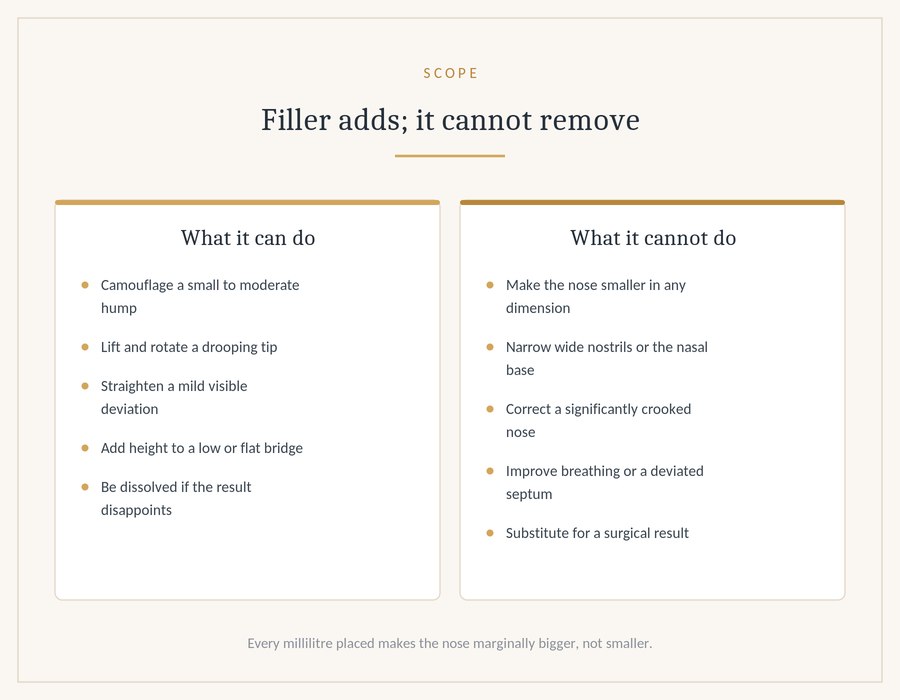
The key point to understand is that filler adds. It does not remove.
It can camouflage a dorsal hump. A small amount placed above and below a bump can create a straighter line in profile. The nose is fractionally larger afterwards, but it can read as straighter.
It can lift a drooping tip. Support at the base of the columella can rotate the tip upward, shortening the apparent length of the nose and opening the angle between nose and lip.
It can straighten a deviation that is visible from the front. Where one side is slightly concave, filling it can even the line. This applies to modest asymmetry, not to a significantly crooked nose.
It can define a flat or low bridge. Adding height and a defined line where the bridge is naturally low is a common use of nose filler.
It cannot make a nose smaller. Not the bridge, not the tip, not the nostrils. Every millilitre placed makes the nose marginally bigger, so reduction is the opposite of what filler does.
It cannot narrow wide nostrils or change the width of the nasal base. Those are surgical changes.
It cannot improve breathing. A deviated septum is an internal structural problem, and filler placed on the outside does not affect airflow.
Which Noses Respond Better, and Which Do Not
Where nose filler is offered, people tend to be satisfied when they have a small to moderate dorsal hump, a low bridge, a slightly drooping tip or mild asymmetry, and want a straighter line rather than a smaller nose.
They tend to be disappointed when they want a smaller nose, have a large hump where camouflage would add noticeable bulk, or have had previous rhinoplasty surgery. Thick sebaceous skin also limits how much definition shows through, while thin skin makes any irregularity more visible. These are general patterns, not an assessment of any individual nose.
Previous Surgery Changes the Risk
An operated nose has altered blood supply and scar tissue, which raise the risk of vascular complications and make the anatomy less predictable. Many experienced injectors decline to treat post-surgical noses. Anyone who has had rhinoplasty should disclose that history before filler is discussed, and a practitioner who does not ask is not assessing properly.
The Vascular Risk, Stated Directly
The nose is supplied by arteries that connect to the ophthalmic circulation, the blood supply to the eye. If filler is injected into or compresses one of those vessels, the possible consequences include skin necrosis and, rarely, visual loss. The nose and the glabella, the area between the eyebrows, are recognised as high-risk sites for it.
The frequency is low. The severity, when it happens, is high, and vision loss is not reliably reversible even with immediate treatment. That combination is why Dr Soheila does not include nose filler in her practice, and why anyone who chooses it elsewhere should look closely at the precautions described below.
What Reduces the Risk
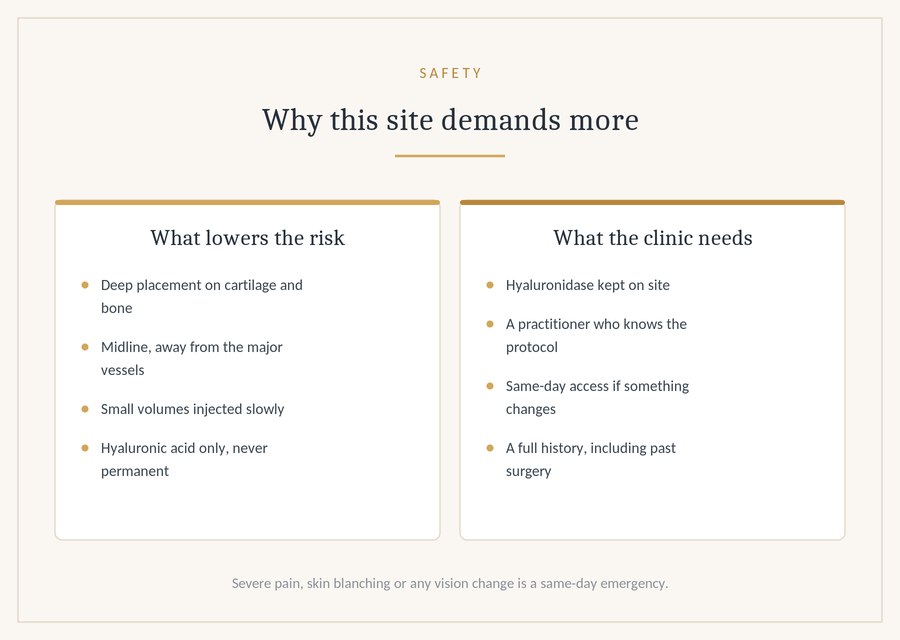
Practitioners who offer nose filler need detailed knowledge of the vascular anatomy of the region. They aim for deep placement on the cartilage and bone, in the midline where the major vessels are not, with small volumes injected slowly at low pressure, and use either aspiration or a cannula depending on their protocol. They use hyaluronic acid only, because a filler that cannot be dissolved is a considerably worse proposition if something goes wrong, and they keep hyaluronidase on site. None of these measures removes the risk; they are intended to reduce it.
The Warning Signs
These apply after any filler treatment. Severe pain out of proportion to the procedure, and blanching, greyness or mottling of the skin over the nose or between the eyes, are reasons to contact the injecting clinic immediately, on the same day. Any change in vision, including double vision or pain around the eye, is an emergency, and urgent medical care should be sought without waiting for a call back. Delay reduces the chance that treatment will help. A dull ache and mild swelling are common; sudden severe pain is not.
What a Nose Filler Procedure Involves
At clinics that offer it, topical anaesthetic is applied, and many products contain lidocaine. The injection takes ten to twenty minutes, and the change is visible immediately, which is part of the appeal and part of the risk: an immediate result makes it tempting to add more.
Volumes are usually small, commonly 0.5 to 1 ml in total, and a practitioner proposing significantly more should be able to explain why. The final shape is judged at around two weeks, and a review then is the usual time to consider a small adjustment.
How Long Nose Filler Lasts
Filler in the nose commonly lasts twelve to eighteen months, and sometimes longer, because the area barely moves. As elsewhere, low movement means slow breakdown. Duration varies between products and individuals, and no timescale can be promised.
Non-Surgical Versus Surgical
These are not competing options for the same goal. They change different things.
What filler offers. A non-surgical change to the line of the nose, reversible when hyaluronic acid is used: a straighter profile, a lifted tip or a defined bridge, with the nose becoming marginally larger. It carries the vascular risk described above.
What surgery offers. Rhinoplasty works on the bone and cartilage rather than adding to the surface, so it can make a nose smaller, narrow the nostrils, straighten a significantly crooked nose and, combined with septal surgery, improve breathing. It is a larger undertaking, with anaesthesia, a recovery period and changes that are difficult to reverse, and a surgeon should explain these trade-offs, including the possibility of revision.
Repeated attempts to approximate a surgical result with injections leave a nose that is heavier and harder to operate on later. There is also a legitimate third answer: a nose within the normal range, on a face that suits it, may not need changing at all.
What Happens Over Repeated Treatments
A nose treated repeatedly without assessment accumulates product, and the pattern is predictable. Each session adds a little, and because filler in this area lasts a long time, new product sits on top of the old. Over several years the bridge becomes broader, the line softens and the nose reads as larger from the front, even though each session looked reasonable.
A nose carrying years of filler is also a harder surgical proposition, and many surgeons ask for the product to be dissolved and the tissue allowed to settle before operating. For anyone who has nose filler, the way to avoid this is to have the nose assessed before each top-up rather than treated on a calendar.
Dissolving Is an Option, Not a Failure
Because hyaluronic acid can be broken down with hyaluronidase, a result that has gone in the wrong direction can usually be corrected. The enzyme is itself a medical treatment with its own considerations, not a casual step.
What to Consider Instead
The right alternative depends on what the underlying concern is. Three routes are worth discussing.
A Rhinoplasty Consultation for Nose Shape
If the concern is the shape, size, width or function of the nose, a rhinoplasty consultation with a plastic surgeon or a facial plastic surgeon is the appropriate route. A surgeon can examine the bone, cartilage and skin, explain what can and cannot be changed, and discuss recovery, risks and revision. A consultation does not commit anyone to surgery.
Chin Filler When the Real Issue Is Profile Balance
Sometimes the nose is not the main issue. A recessed chin can make the nose look more prominent in profile, because the eye reads the nose, lips and chin together. Where the real concern is profile balance, chin filler can change how the nose reads from the side, without any injection into the nose. Whether it is appropriate depends on an in-person assessment, and the article on chin versus jawline filler explains how the two areas differ.
If You Already Have Nose Filler and Have Concerns
Anyone who already has nose filler and has concerns should see the clinic that injected it, or another physician, promptly. Pain, a change in skin colour or any change in vision is urgent and should not wait.
Hyaluronic acid filler can be dissolved with an enzyme called hyaluronidase, and the article on dissolving filler explains how this works. Whether dissolving is appropriate, and when, is a decision for a licensed physician after examining the nose.
If You Are Considering Nose Filler Elsewhere
Anyone who decides to go ahead with nose filler despite the risks should expect a provider to meet the following safety criteria. None of them removes the risk, and none replaces a surgical opinion when the real goal is a smaller nose.
A licensed physician. The injector should be a licensed physician whose DHA licence can be verified on the DHA Sheryan portal, with specific training in facial vascular anatomy and experience in nasal injecting. Treatment by anyone else, or in a non-medical setting, is a reason to decline.
Hyaluronic acid only. Hyaluronic acid can be dissolved if there is a problem. Fillers that cannot be dissolved, including long-lasting and non-resorbable products, should never be used in the nose.
Hyaluronidase on site. The enzyme that dissolves hyaluronic acid should be in the room and in date, with a practitioner who can explain when and how it would be used.
An emergency protocol. The clinic should have a clear protocol for suspected vascular occlusion, including who is called, what is given and how quickly, a route to urgent ophthalmic and hospital care, and a way to be reached out of hours.
Questions Worth Asking
What exactly will change, and what will not? A specific answer about profile line and tip position is a good sign. A vague promise of a better nose is not.
Does previous nasal surgery change your assessment? If the practitioner did not ask, raise it yourself.
What product are you using, and do you keep hyaluronidase on site? The answers should be hyaluronic acid and yes.
How much are you planning to use? Small volumes indicate a considered plan.
The Short Version
Non-surgical rhinoplasty adds volume to camouflage a hump, lift a tip, straighten a mild deviation or define a low bridge. It cannot make a nose smaller, narrow the nostrils or help breathing. Results commonly last twelve to eighteen months.
The nose is also a high-risk area for filler-related vascular complications, which is why Dr Soheila Eskandari does not perform nose filler injections. For concerns about nose shape, a rhinoplasty consultation with a plastic surgeon or facial plastic surgeon is the appropriate starting point.
Frequently Asked Questions
Does Dr Soheila offer nose filler?
No. Dr Soheila Eskandari does not perform nose filler injections. The nose is one of the highest-risk areas for filler-related vascular complications, including rare cases of blindness, so she does not include it in her practice. Options worth discussing instead are a rhinoplasty consultation with a plastic surgeon or facial plastic surgeon for nose shape, and chin filler when the real issue is profile balance.
Can filler make my nose smaller?
No. Filler adds volume, so the nose is marginally larger afterwards. It can change the line, because camouflaging a hump or lifting a tip can make a nose read as straighter, but genuine reduction needs a surgical opinion.
How risky is nose filler?
The arteries in the nose connect to the circulation supplying the eye, which makes the nose a high-risk area for filler-related vascular complications. Serious complications are uncommon but include skin necrosis and, rarely, visual loss. Precautions reduce the risk but do not remove it.
How long does nose filler last?
Commonly twelve to eighteen months and sometimes longer, because the nose moves very little and breaks the product down slowly. That longevity means product can accumulate over repeated treatments.
How much filler is used in a nose?
Where nose filler is performed, noses are commonly treated with 0.5 to 1 ml in total. Small volumes placed precisely produce the change, while larger volumes mainly make the nose bigger.
Does nose filler hurt?
Topical anaesthetic is usually applied and many products contain lidocaine, so people generally describe pressure rather than sharp pain. Significant pain during or after the procedure is not expected and should be reported to the injecting clinic immediately.
What is the downtime after nose filler?
Mild swelling for a few days is usual and bruising is possible. Many people return to normal activity the next day, but the final shape should not be judged before about two weeks.
Can nose filler be done after a rhinoplasty?
It is sometimes done by practitioners who offer it, but the risk profile is different. Surgery alters the blood supply and leaves scar tissue, which makes the anatomy less predictable, and some practitioners decline to treat operated noses. Anyone unhappy with a surgical result should start by speaking to their surgeon.
Is nose filler reversible?
Yes, when hyaluronic acid is used: it can be dissolved with hyaluronidase, although the response varies. Fillers that cannot be dissolved are a poor choice in the nose for exactly this reason.
Will nose filler fix a deviated septum or help my breathing?
No. A deviated septum is an internal structural issue and filler placed externally does not change airflow. An ENT or surgical assessment is the appropriate route for breathing concerns.
This article is general information about aesthetic and dermatological treatments and is not medical advice, a diagnosis, or a treatment recommendation for any individual. Outcomes vary between patients and no result is guaranteed. Prescription medications and injectable products carry risks and contraindications that must be assessed by a licensed physician during a personal consultation. Dr Soheila Eskandari is licensed by the Dubai Health Authority.


 English
 Arabic