
Dermal Filler Prices in Dubai: What Affects the Cost, by Area and Product
Dermal Filler Prices in Dubai: What Affects the Cost, by Area and Product
Dermal filler prices in Dubai are usually quoted per syringe, and market rates for hyaluronic acid filler in DHA-licensed clinics generally run from around AED 1,500 to AED 3,500 per syringe depending on the product, the area and the injector. The total cost depends mainly on how many syringes your plan needs, which can range from half a syringe for subtle lips to several syringes for a full jawline. A low headline price says little until you know the product, the volume and what is included.
This guide explains how filler is priced, typical market ranges by area, how many syringes different areas usually need, what drives the cost up or down, how to read offers and packages, what longer-term costs look like, and the questions that help you compare quotes fairly. Prices here are general market ranges for information only, and a personal plan must be confirmed in person by a licensed physician.
How Is Dermal Filler Priced in Dubai?
Per syringe or per millilitre
Most hyaluronic acid fillers come in syringes of about one millilitre, and clinics usually price them per syringe. Some products come in smaller syringes, and some clinics price per millilitre or offer half-syringe options for small corrections. Because each syringe is single use and sterile, an opened syringe cannot normally be stored for a later appointment, which is why the plan should match the volume you need.
Per area or per plan
Some clinics quote per area, for example a lip treatment or a chin treatment, with the number of syringes built in. Others build a full-face plan across several areas. Area pricing is easy to compare only when you know how many syringes and which product the price includes.
What Are the Market Ranges by Area?
The figures below are general Dubai market ranges seen in DHA-licensed clinics. They vary by product line, injector experience and clinic, and they are not a quote.
| Area | Typical volume | Market range per syringe |
|---|---|---|
| Lips | 0.5 to 1 ml | AED 1,500 to AED 3,000 |
| Under-eyes | About 1 ml in total | AED 1,500 to AED 3,500 |
| Cheeks | 1 to 2 ml | AED 1,800 to AED 3,500 |
| Chin | 1 to 2 ml | AED 1,800 to AED 3,500 |
| Jawline | 2 to 4 ml | AED 1,800 to AED 3,500 |
| Smile lines | 1 to 2 ml | AED 1,800 to AED 3,500 |
| Temples | 1 to 2 ml | AED 1,800 to AED 3,500 |
| Radiesse (calcium hydroxylapatite) | 1 to 3 syringes | AED 2,000 to AED 4,500 |
Lip filler sits at the lower end because the product is soft and the volume is small. Structural areas such as the cheeks, chin and jawline use firmer products and often more volume, which raises the total. Radiesse and other biostimulators are priced differently because the product, the technique and the longevity differ.
Why Do Prices Differ Between Areas?
Three things change between areas: the product, the volume and the level of risk and skill involved. The under-eye area, for example, often uses a small volume, but it demands a soft product, a precise technique and careful assessment, because thin skin shows lumps and swelling easily and the area sits close to important blood vessels. The jawline uses a firmer product and more volume. Lips sit in between, with a soft product and a small volume but a high demand for symmetry and natural movement. A clinic’s price per syringe may therefore differ between areas even when the brand is the same, and the total cost differs because the volume differs.
How Many Syringes Do Different Areas Need?
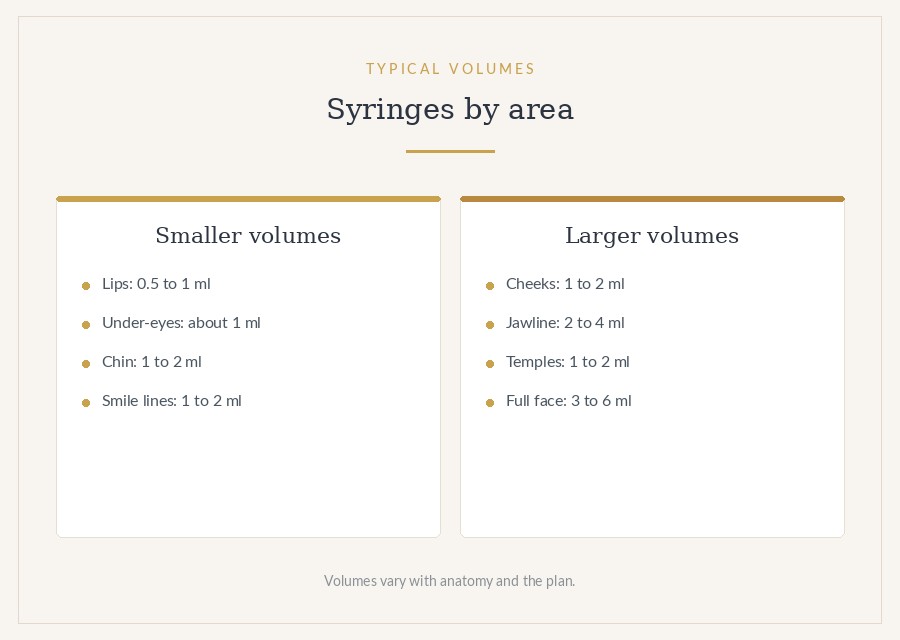
Most first-time lip treatments use half a syringe to one syringe. Under-eye treatment usually uses about one syringe split between both sides. The cheeks commonly need one to two syringes in total, the chin one to two, and the jawline two to four, depending on bone structure, skin thickness and the starting point. A full-face plan that restores structure in several areas might use three to six syringes, often spread over two appointments.
What Drives the Cost Up or Down?
The product
Fillers differ in firmness, flexibility, longevity and the technology used to make them. Established brands with strong safety data and specific products for each area generally cost more than older or less studied products. Genuine products are supplied through authorised distributors with batch labels that should be recorded in your file.
The injector
Filler injection is a medical procedure. A licensed physician with long experience in facial anatomy usually charges more than a newly trained injector, and that experience matters most when it comes to placement, natural results and recognising complications early.
The setting and what is included
The price may or may not include the consultation, numbing cream, a review appointment, small top-ups at the review and access to the clinic if a problem arises. A clinic that includes these may look more expensive on paper but cost less overall.
Why Can a Very Low Price Be a Warning Sign?
Prices far below the market range can mean that the product is not what it appears to be, that the volume is smaller than expected, that the injector is not licensed for the procedure, or that treatment is offered outside a licensed medical setting. Counterfeit and unregistered fillers are a known problem worldwide and carry a higher risk of infection, lumps and reactions. In Dubai, injectables should be given by DHA-licensed practitioners in licensed facilities, and you are entitled to see the product box and batch label.
How Should I Read Filler Offers and Packages?
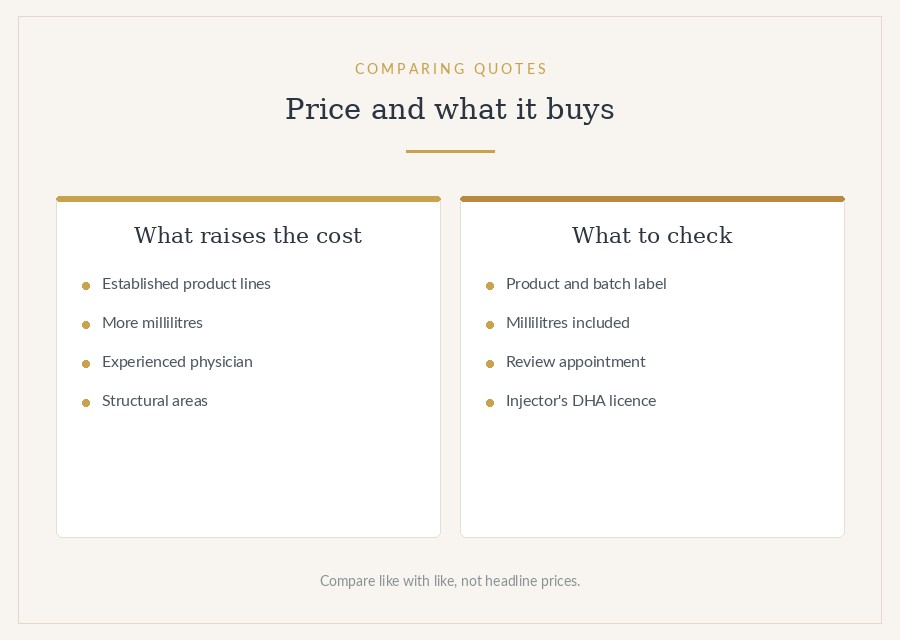
Offers can be genuine value, especially when they encourage a first consultation or a fixed-volume treatment. Before booking, check which product the offer uses, how many millilitres it includes, whether it applies to every area or only some, whether a review is included and whether extra syringes are charged at the standard rate. A package is useful only if the volume and areas match what you actually need; buying more filler than you need is not a saving.
What Does Filler Cost Over Time?
Hyaluronic acid filler is gradually broken down by the body. Lip filler often lasts around six to twelve months, under-eye filler can last a year or longer, and filler in the cheeks, chin and jawline often lasts twelve to eighteen months, sometimes more. When comparing products, consider the cost per year rather than the cost per syringe. A product that costs a little more but lasts longer in a particular area may cost less over time. The guide to how long fillers last explains longevity by area.
How Can I Plan a Filler Budget Over a Year?
It helps to think in phases rather than in single appointments. A first phase usually addresses the main concern, such as structure in the midface or definition in the lips, with a modest volume. A review two to four weeks later shows whether a small addition is needed. Maintenance then follows when the result starts to soften, rather than on a fixed date. For example, someone who has one syringe in the lips and one to two syringes in the cheeks in the first year may need only a small lip top-up and no cheek treatment in the second year, because structural areas tend to last longer.
Asking the doctor for a written plan that covers the first year, including the likely maintenance, makes budgeting easier and reduces the temptation to add areas on the day. It also makes it clear when filler is not the right answer, for example when a skin booster or a biostimulator would address skin quality better.
Is the Cheapest Product Fine for a First Treatment?
The product should match the area, not the budget. Lips need a soft, flexible gel that moves naturally; cheeks and jawline need firmer gels that hold their shape; the under-eye area needs a product that integrates smoothly into thin skin. Using a product designed for one area in another can lead to lumps, swelling or an unnatural look. A first treatment is the time to choose a well-studied product and a conservative volume, so that you can judge the result and build gradually if needed.
What Is the Cost of Getting It Wrong?
A result that is too full, uneven or placed in the wrong layer can mean dissolving, a waiting period while swelling settles and then re-treatment, which can cost more than the original procedure. Complications such as infection or a blocked blood vessel need urgent medical care. These situations are uncommon, but they explain why experience, licensing and access to the clinic after treatment are worth paying for, and why the quality of the first treatment matters more than the price of the first syringe.
What Does Dissolving Filler Cost?
Hyaluronic acid filler can be dissolved with an enzyme called hyaluronidase if the result is uneven, migrated or needs correction. Market rates for dissolving generally run from around AED 800 to AED 1,500 per session, depending on the area and the amount. In an emergency such as a suspected blocked blood vessel, dissolving is part of urgent medical care rather than an optional extra, which is another reason to choose a clinic that can manage complications.
Are There Other Costs to Consider?
Consultation fees vary between clinics, and some deduct them from the treatment cost. Cosmetic filler is not normally covered by health insurance. A few clinics charge separately for numbing cream, a follow-up visit or small top-ups, so it is worth asking about these in advance. If you are combining filler with Botox, skin boosters or biostimulators, ask for a written plan with the total cost and the order of treatments, so that you can budget over several months rather than deciding everything on the day.
How Do Filler Prices Compare With Other Treatments?
Botox is usually priced per area or per unit, with Dubai market rates generally around AED 800 to AED 1,500 per area. Skin boosters are priced per session, often as a course of two or three sessions. Biostimulators such as Sculptra are priced per vial and usually need more than one session. Because these treatments do different jobs, the cheapest option is rarely the right comparison; the question is which treatment addresses your concern. The guide to Botox prices in Dubai covers anti-wrinkle pricing in more detail.
How Can I Compare Quotes Fairly?
Ask each clinic for the same details: the product name and line, the number of millilitres, the areas, the injector’s name and licence, what the review includes and the total cost. Compare like with like. A quote of one syringe of a premium structural filler in the cheeks is not comparable with a quote of half a syringe of a softer product in the lips, even if both are described as a filler treatment.
Choosing Who Treats You
Price matters, but the injector’s training, licence and judgement matter more, because filler results and complications depend on anatomy and technique. Choose a licensed physician whose DHA licence you can verify on the DHA Sheryan portal, who shows you the product and batch label, explains the plan and the total cost before starting, and can manage complications if they occur.
The page on dermal fillers describes the treatments at the clinic, and current offers are listed on the offers page. At dr-soheila.com, treatments are planned and performed by Dr Soheila Eskandari, a DHA-licensed general practitioner with aesthetic privileges with 20 years of experience in aesthetic medicine.
The Short Version
In Dubai, hyaluronic acid filler is usually priced per syringe, with market rates in licensed clinics generally from around AED 1,500 to AED 3,500 per syringe. Lips sit at the lower end; structural areas such as the cheeks, chin and jawline use firmer products and more volume. Radiesse is generally around AED 2,000 to AED 4,500 per syringe.
The total depends mostly on the number of syringes. Compare quotes by product, volume, injector and what is included, consider cost per year rather than per syringe, and treat prices far below the market range with caution.
Questions Worth Asking
Which product will you use, and can I see the box and batch label? Genuine products come from authorised suppliers and should be recorded in your file.
How many millilitres do I need, and why? The plan should explain the volume for each area.
What does the price include? Ask about the consultation, numbing, the review, small top-ups and aftercare.
What happens if I need dissolving or have a complication? You should know the plan and any costs before treatment.
Frequently Asked Questions
How much does dermal filler cost in Dubai?
Market rates for hyaluronic acid filler in licensed clinics generally run from around AED 1,500 to AED 3,500 per syringe, depending on the product, area and injector.
How much does lip filler cost in Dubai?
Market rates generally run from around AED 1,500 to AED 3,000 per syringe, and many first treatments use half a syringe to one syringe.
How many syringes of filler do I need?
It depends on the area and your starting point: often half to one syringe for lips, about one for the under-eyes, one to two for the cheeks or chin and two to four for the jawline.
Why are some filler prices so low?
Very low prices can reflect a smaller volume, an unfamiliar product, an inexperienced injector or an unlicensed setting. Ask for the product, the volume and the injector’s licence.
Is filler priced per syringe or per area?
Most clinics price per syringe, and some quote per area. Always ask how many millilitres an area price includes.
How long does filler last?
Lip filler often lasts six to twelve months, and filler in the cheeks, chin and jawline often lasts twelve to eighteen months, depending on the product and the person.
Does insurance cover dermal filler?
Cosmetic filler is not normally covered by health insurance.
What does it cost to dissolve filler in Dubai?
Market rates generally run from around AED 800 to AED 1,500 per session, depending on the area and the amount to be dissolved.
Is Radiesse more expensive than hyaluronic acid filler?
Radiesse is generally around AED 2,000 to AED 4,500 per syringe. It is used for different purposes and often lasts longer, so cost per year is a fairer comparison.
How can I compare filler quotes?
Compare the product, the number of millilitres, the areas, the injector’s licence and what the price includes, rather than the headline number alone.
This article is general information about aesthetic and dermatological treatments and is not medical advice, a diagnosis, or a treatment recommendation for any individual. Outcomes vary between patients and no result is guaranteed. Prescription medications and injectable products carry risks and contraindications that must be assessed by a licensed physician during a personal consultation. Dr Soheila Eskandari is licensed by the Dubai Health Authority. Prices quoted are general market ranges for information only and are not an offer.


 English
 Arabic