
PRP vs Exosomes for Hair Loss in Dubai: Evidence, Regulation and Cost
PRP vs Exosomes for Hair Loss in Dubai: Evidence, Regulation and Cost
Exosomes arrived in hair clinics with more marketing than evidence, and PRP has been there long enough to have accumulated both. Patients asking which to choose are usually asking a question that has a more useful version: what is causing the hair loss, and is either of these the right category of treatment for it.
Both are injected into the scalp, both are described as regenerative, and both are frequently sold as courses. That is where the similarity ends — including in their regulatory position, which is the part most patients are never told about.
What Each One Is
PRP
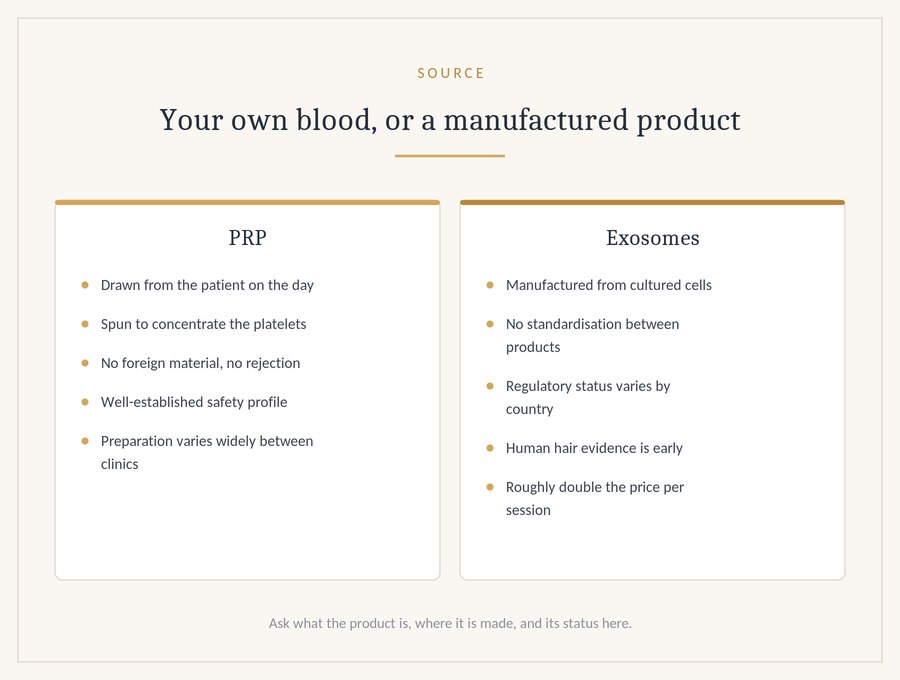
Platelet-rich plasma is made from the patient’s own blood. A sample is drawn, spun in a centrifuge to concentrate the platelets, and the resulting plasma is injected into the scalp. Platelets release growth factors, and the proposed mechanism is that these signal the hair follicle to stay in or return to its growth phase.
Because it is autologous — from your own body — there is no question of rejection or foreign material, and the safety profile is well established. What varies enormously is the preparation: the kit used, the spin protocol, the final platelet concentration and whether white cells are included. Two clinics offering PRP may be injecting meaningfully different products, and this variability is one reason published results differ.
Exosomes
Exosomes are small vesicles released by cells that carry signalling molecules between them. Products marketed for hair are typically derived from cultured stem cells, and the proposal is that the vesicles deliver signals that support follicle activity and reduce inflammation around it.
The biological reasoning is interesting and the laboratory work is real. The clinical evidence in human hair loss is early — small studies, short follow-up, and considerable variation between commercial preparations. There is no standardisation across products, so an “exosome treatment” in one clinic may not resemble one in another.
The Regulatory Point, Stated Plainly
This matters and it is usually omitted from the sales conversation.
PRP is prepared from the patient’s own blood at the point of care, which places it in a well-understood regulatory category in most jurisdictions. Exosome products are manufactured biological preparations derived from cultured cells, and their regulatory status differs by country. Several regulators have issued warnings about unapproved exosome products marketed for aesthetic and regenerative use.
The practical implication for a patient is straightforward: ask what the product is, where it is manufactured, and what its approval status is in the UAE. A clinic that can answer clearly is one worth listening to. A clinic that treats the question as an inconvenience is telling you something.
Neither Is a Treatment for the Wrong Diagnosis
This is the part that determines the outcome more than the choice between the two products.
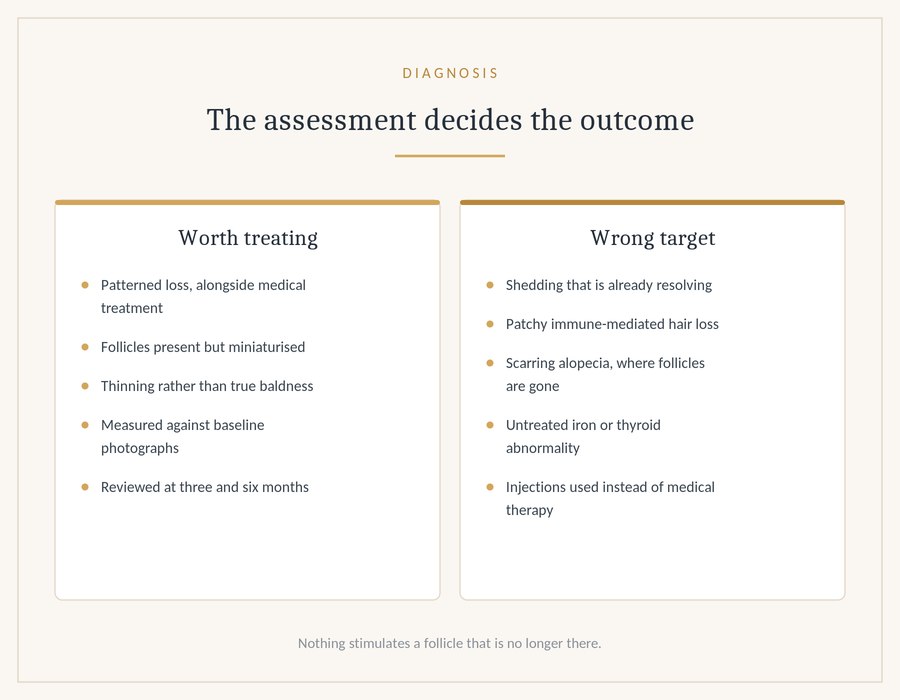
Androgenetic hair loss — the gradual patterned thinning that is by far the most common cause — has established treatments with substantial evidence behind them. PRP and exosomes are used as adjuncts to those, not replacements for them. Treating patterned loss with injections alone while ignoring the underlying process gives away the most effective part of the plan.
Telogen effluvium — diffuse shedding after illness, surgery, a nutritional deficiency, childbirth, thyroid disturbance or significant stress — usually recovers once the trigger is addressed. Injecting it is treating something that is already resolving, and the improvement will be attributed to the injection.
Alopecia areata — patchy immune-mediated loss — is an entirely different condition needing an entirely different approach, discussed in the guide to alopecia treatment in Dubai.
Scarring alopecias — where the follicle has been destroyed and replaced by scar tissue — will not respond to anything that stimulates a follicle, because there is no follicle to stimulate. Recognising this early prevents money being spent on a course that cannot work.
A proper assessment — history, examination, scalp inspection and appropriate blood tests — is therefore not a formality. It is the part that decides whether either treatment is worth having.
Comparing Them Directly
Evidence. PRP has considerably more published clinical work in androgenetic hair loss, including randomised studies, though the variability in preparation limits how firmly the results can be generalised. Exosome evidence in human hair loss is early and preliminary. Anyone presenting exosomes as better established is overstating what is known.
Source. PRP comes from the patient. Exosome products are manufactured externally. That difference drives both the safety discussion and the regulatory one.
The session. PRP requires a blood draw and processing, so the appointment is longer. Exosome treatment skips that step. Both involve multiple injections across the scalp, usually with topical anaesthetic, and both are described as uncomfortable rather than painful.
Course and maintenance. PRP is typically three to four sessions four weeks apart, then maintenance every three to six months. Exosome protocols vary by product and clinic, commonly three sessions, with maintenance intervals that are not well established because long-term data does not yet exist.
Cost. Market rates in Dubai generally run from around AED 1,200 to AED 2,500 per PRP session, and from around AED 2,500 to AED 5,000 per exosome session. Exosome treatment is the more expensive option and the less evidenced one, which is an uncomfortable combination that deserves to be said out loud.
What Realistic Improvement Looks Like
For either treatment, the honest description is reduced shedding, some increase in the calibre of existing hairs, and improved density in areas where follicles are miniaturised but still present.
What neither does is regrow hair in areas that are genuinely bald, where the follicle is gone. The distinction between thinning and bald is not always obvious to a patient looking in a mirror, and it is one of the specific things an examination establishes.
Photographs taken under standardised conditions at the start, and repeated at three and six months, are the only reliable way to judge whether a course has worked. Memory is a poor instrument for assessing hair density, in both directions.
The Short Version
PRP is made from your own blood and has considerably more clinical evidence in patterned hair loss. Exosomes are manufactured products with early evidence, no standardisation between preparations, an unsettled regulatory position and a higher price.
On current evidence PRP is the more defensible choice, and both are adjuncts to established treatment for androgenetic loss rather than substitutes for it. The diagnosis matters far more than the choice between them, and neither does anything for a follicle that is no longer there.
Questions Worth Asking
What is my diagnosis, and how did you reach it? Everything else follows from this.
What is the established treatment for my type of hair loss, and am I on it? If injections are being offered instead of that rather than alongside it, ask why.
For exosomes: what product, from where, and what is its approval status here? A clear answer is the minimum.
For PRP: what is your preparation protocol? Variability between kits and protocols is real, and a practitioner who knows theirs is paying attention.
How will we measure whether it worked? Standardised photographs at defined intervals, not an impression at the next appointment.
Where These Fit in a Complete Plan
Hair loss responds best to a layered approach, and injections are one layer among several.
Address the medical driver first. For patterned loss that means the treatments with the strongest evidence, used consistently. For shedding, it means identifying and correcting the trigger — iron status, thyroid function, a recent illness, a new medication, a period of significant physical stress.
Correct deficiencies, but do not over-supplement. Iron deficiency and thyroid disturbance are genuinely associated with hair loss and both are worth testing. Taking supplements without a deficiency does not help, and in the case of some vitamins taken in excess it can contribute to hair loss rather than treating it.
Then consider injections. Added to a working plan, they are a reasonable way to push further. Used instead of one, they are an expensive way to make slow progress.
Be patient with the timeline. The hair growth cycle means any treatment takes three to six months to show a measurable change. Judging at week six is judging nothing, and a clinic that promises visible results in a month is not describing how hair grows.
Combining the Two
Some clinics offer PRP and exosomes in the same session or alternating through a course. There is no strong evidence that this outperforms either one alone, and it roughly doubles the cost. That does not make it unreasonable, but it should be presented as a choice with an uncertain benefit rather than as a superior protocol.
Frequently Asked Questions
Which works better, PRP or exosomes?
On current published evidence PRP is better supported in androgenetic hair loss, with more clinical studies behind it. Exosome evidence in humans is early and the preparations are not standardised, so claims that they outperform PRP go beyond what is established.
Is PRP safe?
It is made from the patient’s own blood, so there is no concern about foreign material or rejection, and the safety profile is well established. Local soreness, swelling and occasional bruising are the usual effects, and infection risk is low with proper technique.
Are exosomes approved?
Regulatory status varies by country and several regulators have issued warnings about unapproved exosome products marketed for regenerative and aesthetic use. Ask the clinic what specific product they use, where it is manufactured and what its status is locally, and expect a clear answer.
How many sessions are needed?
PRP is typically three to four sessions four weeks apart, followed by maintenance every three to six months. Exosome protocols vary by product, commonly around three sessions, with maintenance intervals that are not yet well defined by long-term data.
Will either regrow hair where I am bald?
No. Both act on follicles that are still present but miniaturised. Where the follicle has been lost, there is nothing left to stimulate, and distinguishing thinning from true baldness is one of the specific purposes of an examination.
Do they replace medical treatment for pattern hair loss?
No — they are adjuncts. Androgenetic hair loss has treatments with substantially stronger evidence, and using injections instead of those rather than alongside them gives away the most effective part of the plan.
Does it hurt?
Both involve multiple injections across the scalp and are generally described as uncomfortable rather than painful. Topical anaesthetic is usually applied beforehand, and tenderness for a day afterwards is common.
When will I see a difference?
Three to six months, because that is how the hair growth cycle works. Reduced shedding is often noticed earlier. Standardised photographs at the start and at set intervals are the reliable way to judge, since memory is unreliable for hair density.
What tests should I have first?
A proper assessment usually includes history, scalp examination and blood tests covering iron status and thyroid function, with others depending on the presentation. Starting a course of injections without establishing the diagnosis risks treating the wrong condition entirely.
What do they cost in Dubai?
Market rates generally run from around AED 1,200 to AED 2,500 per PRP session and from around AED 2,500 to AED 5,000 per exosome session. Since both are sold as courses with maintenance, comparing the full course and annual cost is more informative than comparing single sessions.
This article is general information about aesthetic and dermatological treatments and is not medical advice, a diagnosis, or a treatment recommendation for any individual. Outcomes vary between patients and no result is guaranteed. Prescription medications and injectable products carry risks and contraindications that must be assessed by a licensed physician during a personal consultation. Dr Soheila Eskandari is licensed by the Dubai Health Authority. Prices quoted are general market ranges for information only and are not an offer.


 English
 Arabic