
Fat Dissolving Injections for a Double Chin: What They Can and Cannot Do
Fat Dissolving Injections for a Double Chin: What They Can and Cannot Do
Fat dissolving injections for a double chin are marketed as the non-surgical answer to submental fullness, and for the right patient they genuinely are. The difficulty is that the marketing rarely mentions the two things that determine whether you will be satisfied: how many sessions it actually takes, and how much swelling you should expect in between.
This guide covers how the treatment works, who it suits, what the recovery genuinely involves, the specific risks worth understanding, and what a full course costs.
How Fat Dissolving Injections Work
The active agent is deoxycholic acid, a molecule the body already produces as a bile acid to help break down dietary fat. In purified injectable form it is placed directly into the fat layer beneath the chin.
Deoxycholic acid disrupts the membrane of fat cells, causing them to break down. The resulting cellular debris and released lipids are cleared over the following weeks by the body’s normal inflammatory and lymphatic processes. Fat cells destroyed this way do not regenerate.
That last point is worth stating carefully. The destroyed cells are gone permanently, but the result is not immune to weight change. Fat cells remaining in the area can still enlarge, so significant weight gain can make the area look fuller again despite a successful course.
Why It Only Reaches One Layer
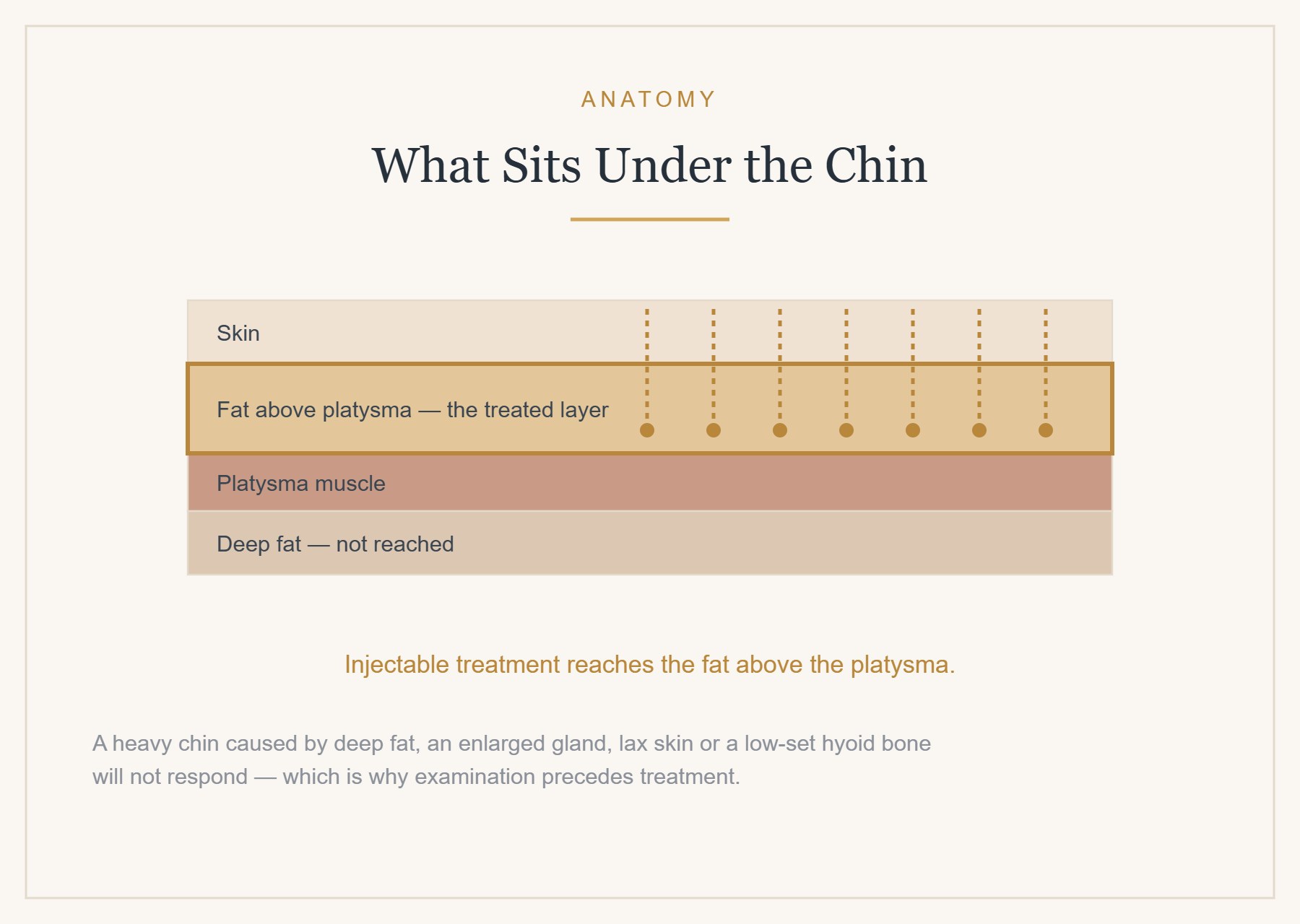
The area under the chin is not a single mass of fat. There is skin, a layer of fat above the platysma muscle, the platysma itself, and a deeper fat compartment below it. There are also the submandibular salivary glands, and the position of the hyoid bone in the neck.
Injectable treatment addresses the preplatysmal fat — the compartment above the muscle. This is the anatomical reason a proper assessment matters. A person whose fullness comes from a low-set hyoid, a prominent salivary gland, a lax platysma or deep fat below the muscle will not respond, regardless of how many sessions they have. Distinguishing these is a clinical examination, not something that can be judged from a photograph.
Who Is a Good Candidate
The ideal candidate has a moderate, discrete pad of fat under the chin, good skin elasticity, and stable weight.
Skin quality is the factor most often underweighted. Removing fat from beneath skin that has lost elasticity can leave the skin without support, making laxity more apparent than before. In a patient whose main problem is loose skin rather than fat, this treatment can make the appearance worse. Skin tightening, or a surgical opinion, is the more honest recommendation there.
Volume of fat matters. A large fat pad requires many sessions and a great deal of product. At some point the sensible comparison is submental liposuction, which addresses a large volume in a single procedure and usually costs less than an extended injectable course. A clinic willing to say that is giving you good advice, even though it declines the sale.
Stable weight matters. Someone actively losing weight may find the area improves on its own. Someone gaining will undermine the result.
Why the Chin Area Is Prone to Fat Accumulation
Patients frequently arrive frustrated that a double chin has persisted despite weight loss and exercise, and assume it reflects a lack of effort. Usually it does not.
Fat distribution is substantially genetic. Submental fullness runs in families and appears in people who are otherwise lean, because the number and behaviour of fat cells in a given area is largely determined independently of overall body composition. Targeted exercise does not reduce fat in a specific region — the physiology of fat mobilisation does not work that way — so the widely circulated jaw and neck exercises do not remove submental fat, whatever they may do for muscle tone.
Age contributes separately. Skin elasticity declines, the platysma muscle loses tone and can separate at the midline, and the same quantity of fat becomes more visible as the tissue supporting it weakens.
Posture and anatomy play a part too. A low-set hyoid bone or a naturally obtuse angle between chin and neck produces the appearance of a double chin with relatively little fat present. This is a skeletal characteristic, and no fat-reduction treatment changes it — which is precisely why examination matters before any injection is planned.
What the Course Actually Involves
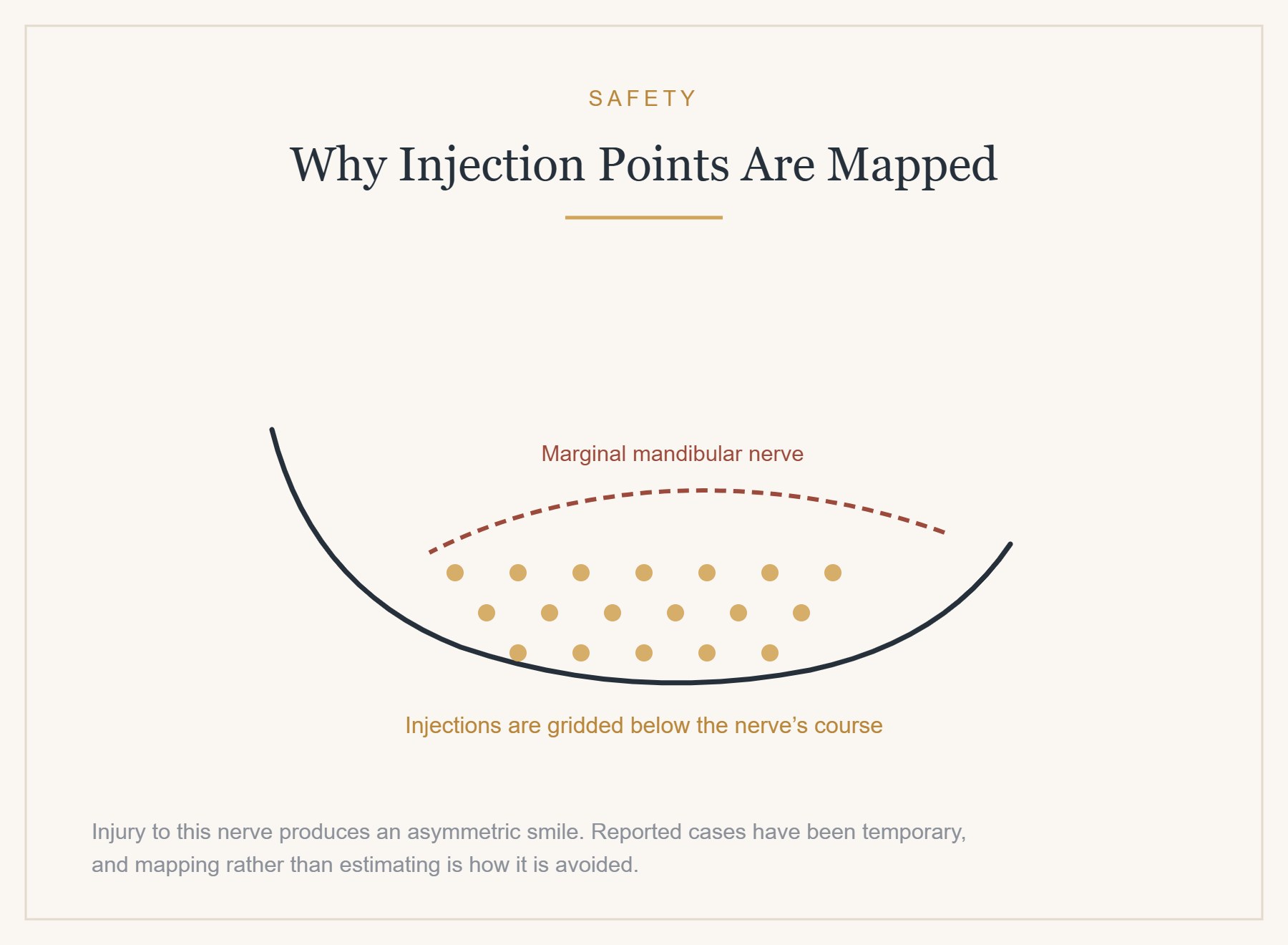
The area is marked with a grid, because injection points are mapped rather than estimated — the reason for this is anatomical and covered below. A number of small injections are placed across the treatment area, typically taking fifteen to twenty minutes.
Most patients require two to four sessions spaced at least four to six weeks apart, and the clinical trials permitted up to six. This is the expectation to hold on to. Before-and-after photographs are frequently taken after a completed course, not after one appointment, and patients who expect a single-session transformation are reliably disappointed.
The Swelling Is Substantial
This deserves emphasis, because it is where the gap between marketing and experience is widest.
Marked swelling under the chin begins within hours and is pronounced for several days. Many patients describe looking as though the treated area is temporarily larger, which is disconcerting if it has not been explained. Numbness in the area is common and can persist for weeks. Firm lumps under the skin are expected as the fat breaks down and can take a month or more to resolve. Bruising and tenderness are usual.
The swelling is not an unfortunate side effect — the inflammatory response is part of how the treatment works. But it means the treatment needs planning around social and professional commitments. Two weeks before a wedding is the wrong time.
The Risks Worth Understanding
Two specific complications distinguish this treatment from a routine injectable.
Marginal mandibular nerve injury. This branch of the facial nerve runs near the lower border of the mandible and supplies muscles that move the lower lip. Injury produces an asymmetric smile, with the lower lip failing to depress properly on the affected side. In reported cases it has been temporary, resolving over weeks to months, but it is visible and distressing while it lasts. Avoiding it is a matter of mapping the injection area to stay clear of the nerve’s course — which is precisely why the grid is drawn rather than the injections placed by eye.
Injection into the wrong plane. Deoxycholic acid disrupts cell membranes without discriminating by cell type. Placed too superficially, into the dermis rather than the fat, it can cause skin ulceration and scarring. Placed into muscle it causes unnecessary pain and inflammation. Correct depth is fundamental.
Other reported effects include difficulty swallowing, hair loss at the injection site in rare cases, and injection site pain that can be significant during the procedure itself.
Who Should Not Have It
It is avoided in pregnancy and breastfeeding, where there is infection at the treatment site, in patients with swallowing difficulties, in those with bleeding disorders or on anticoagulant medication, and where the fullness is caused by an enlarged submandibular gland or thyroid pathology rather than fat. That last category is the reason assessment precedes treatment: the appearance can be similar and the correct management is entirely different.
What Aftercare Actually Helps
Because swelling is the dominant feature of recovery, managing it well changes the experience considerably.
Cold compresses in the first forty-eight hours reduce discomfort, though they do not shorten the overall course of swelling. Sleeping with the head elevated for the first few nights helps lymphatic drainage. Strenuous exercise is usually avoided for a few days, since it increases blood flow to an already inflamed area.
A chin strap or compression garment is recommended by some practitioners. Evidence that it improves the final result is limited, but many patients find it more comfortable.
The firm lumps that develop as fat breaks down are expected and generally resolve without intervention. Aggressive massage in an attempt to speed this up is not helpful and can increase inflammation. What warrants a call to the clinic rather than patience is asymmetry of the smile, skin colour change with pain, difficulty swallowing, or fever.
How It Compares With the Alternatives
Submental liposuction removes a larger volume in one procedure under local anaesthetic, with a faster overall route to the final result, though it involves small incisions and a recovery period. For a substantial fat pad it is usually the more efficient choice.
Cryolipolysis and other device-based approaches offer another non-invasive route with a different side effect profile, generally less swelling but often more sessions.
Where skin laxity is the dominant issue rather than fat, none of these are the answer, and energy-based skin tightening or a surgical consultation is more appropriate. Patients whose concern is really the jawline rather than the neck may find the guide to jawline filler in Dubai more relevant, since the two problems are frequently confused.
Questions Worth Asking Before Booking
Because outcome depends so heavily on correct assessment, a few questions are genuinely informative.
What is causing my fullness? A practitioner who examines the area and explains whether it is preplatysmal fat, deep fat, skin laxity, gland or hyoid position is assessing. One who agrees to treat without distinguishing these is not.
How many sessions do you expect in my case, and what is the total cost? A per-session price without an estimate of sessions is not a price.
Would liposuction give me a better result? A clinic willing to answer honestly, including when the answer costs them the sale, is the one worth trusting.
What happens if I develop asymmetry of my smile? The answer should demonstrate familiarity with marginal mandibular nerve injury, its expected course, and how the clinic would manage and follow it up.
Costs in Dubai
Market pricing generally runs from roughly AED 1,500 to AED 3,000 per session, depending on the amount of product required. Since two to four sessions is typical, a complete course commonly totals between AED 4,000 and AED 10,000.
The course total is the figure that matters. A clinic quoting an attractive per-session price without indicating how many sessions your particular case is likely to need has not really given you a price.
The Short Version
Fat dissolving injections work, permanently remove the fat cells they destroy, and suit a specific patient: moderate submental fat, good skin elasticity, stable weight, and a willingness to accept several sessions with substantial swelling in between.
They do not tighten skin, do not help fullness caused by gland position or a low hyoid, and are not the efficient choice for a large fat pad. The decision that determines your result is made at assessment, before any needle is involved, which is why an examination that distinguishes the possible causes is worth more than any discount.
Frequently Asked Questions
How do fat dissolving injections work?
Deoxycholic acid disrupts the membrane of fat cells, and the resulting debris is cleared by the body over several weeks. Fat cells destroyed this way do not return, though remaining cells can still enlarge with weight gain.
How many sessions will I need?
Most people need two to four sessions spaced at least four to six weeks apart. Trials allowed up to six. A single session rarely produces the result shown in marketing photographs.
Is the result permanent?
The treated fat cells are permanently removed, but the outcome is not immune to weight gain. Significant weight increase enlarges the fat cells that remain and the area can look fuller again.
How much swelling should I expect?
Considerably more than most people anticipate. Marked swelling under the chin for several days is expected and is part of how the treatment works. Numbness, firmness and lumps that take weeks to settle are common. Plan around social commitments.
Will it tighten loose skin?
No. It removes fat, and removing fat from an area with poor skin elasticity can make laxity more apparent. Where skin quality is the main issue, skin tightening or a surgical opinion is more appropriate.
Is it safe?
It has an acceptable safety profile when injected by someone who maps the area properly. The specific concerns are marginal mandibular nerve injury causing temporary smile asymmetry, and injection into the wrong plane causing ulceration. Both are avoided by anatomical placement rather than luck.
Is it better than surgery?
It suits a moderate amount of fat with good skin quality. For a large fat pad or significant laxity, submental liposuction or a surgical approach gives a better result in one stage, and an honest assessment should say so.
Does it work for jowls or cheeks?
Use outside the submental area is off-label. Small volumes are used elsewhere by experienced injectors, but the evidence base and regulatory approval sit with the area under the chin.
Who should not have it?
It is avoided in pregnancy and breastfeeding, in the presence of infection at the site, in patients with swallowing difficulties, bleeding disorders or on anticoagulation, and where the fullness is caused by an enlarged salivary gland or thyroid rather than fat. Assessment before treatment is what distinguishes these.
What does it cost in Dubai?
Market pricing generally runs from roughly AED 1,500 to AED 3,000 per session, so a full course commonly totals between AED 4,000 and AED 10,000. Because multiple sessions are the norm, the course price is the number that matters.
This article is general information about aesthetic and dermatological treatments and is not medical advice, a diagnosis, or a treatment recommendation for any individual. Outcomes vary between patients and no result is guaranteed. Prescription medications carry risks and contraindications that must be assessed by a licensed physician during a personal consultation. Dr Soheila Eskandari is licensed by the Dubai Health Authority. Prices quoted are general market ranges for information only and are not an offer.


 English
 Arabic