
Masseter Botox in Dubai: Jaw Clenching and Jawline Slimming
Masseter Botox in Dubai: Jaw Clenching and Jawline Slimming
Masseter treatment is unusual in aesthetic medicine: it is one of the few injectable procedures that patients often seek for a medical reason and then keep for a cosmetic one. Someone arrives because they grind their teeth at night, wake with jaw ache and headaches, and have cracked a molar. Three months later they mention, almost in passing, that their face looks slimmer.
Both effects are real, they come from the same mechanism, and they arrive on very different timelines. Understanding which one you are actually after changes the dose, the expectation and how you judge whether it worked.
This guide, prepared with Dr. Soheila Eskandari at her Dubai clinic, covers how masseter treatment works, realistic timelines for each outcome, dosing, risks specific to this muscle, and what it costs locally.
The Masseter, and Why It Grows
The masseter is the thick, powerful muscle running from your cheekbone to the angle of your jaw. Clench your teeth and place your fingers just in front of your earlobe — the block of muscle that bulges is it. It is the primary muscle of chewing and, proportionally, among the strongest muscles in the body.
Like any muscle, it enlarges with use. Habitual clenching, night-time grinding, chewing gum, a naturally strong bite or simple genetics can all produce masseter hypertrophy — an enlarged muscle that widens the lower face and squares the jaw. This is why some people describe having a wide face that no amount of weight loss changes: the width is muscle, not fat.
Botulinum toxin injected into the muscle reduces its ability to contract forcefully. Two things follow. The clenching force drops, which addresses the pain and dental damage. And a muscle that is used less gradually atrophies — becomes smaller — which narrows the lower face over the following weeks.
Two Outcomes, Two Timelines
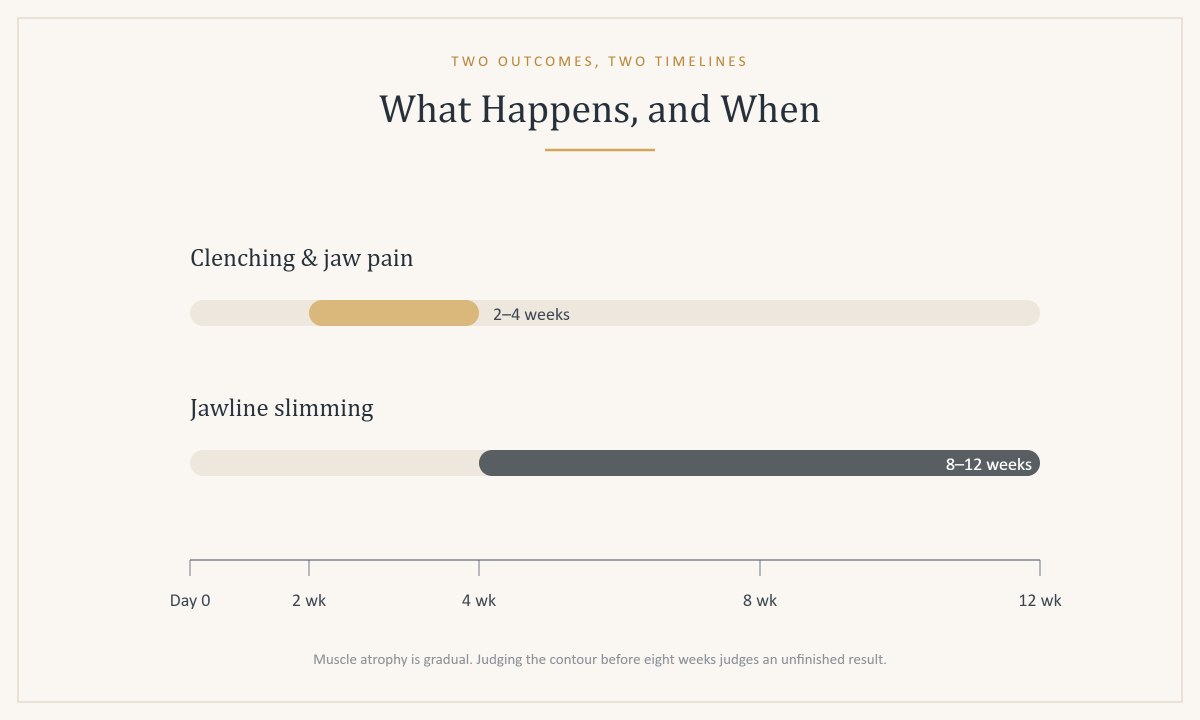
This is the part most patients are not told clearly, and it is the source of most disappointment at week two.
| Clenching & jaw pain relief | Jawline slimming | |
|---|---|---|
| Mechanism | Reduced contraction force | Muscle atrophy from reduced use |
| First noticeable | 2–3 weeks | 4–8 weeks |
| Full effect | Around 4 weeks | 8–12 weeks |
| Typical dosing | Higher — often 40–60 units total | Often 25–50 units total |
| Sessions needed | Usually one, then maintenance | Often 2–3 over 6–12 months for full effect |
The practical implication: if you are here for the jawline, do not judge it before eight weeks. Muscle atrophy is a slow biological process; the contour change is easiest to see at two to three months and is often clearest on photographs taken from the same angle rather than in the mirror.
Dosing above is a broad clinical guide, not a prescription. Actual dosing depends on measured muscle bulk, bite strength, gender and treatment history — which is why Dr. Soheila palpates and assesses the muscle under clench before quoting anything.
What the Evidence Supports
Being precise here matters. Studies using ultrasound and standardised photography show that botulinum toxin injection reduces masseter muscle thickness and measurable jaw width, with the most pronounced contour change at around two to three months. That part is well documented.
On bruxism, randomised trials and recent reviews report fewer sleep bruxism events and reduced myofascial pain after masseter injection — but the evidence base is still developing and results across studies are mixed. It is a reasonable, widely used treatment for jaw clenching and its consequences. It is not a cure for bruxism, and it does not address the underlying causes, which are frequently stress, sleep disorder or bite mechanics. A night guard, and in some cases a dental assessment, remains part of a complete plan rather than an alternative to it.
Who It Suits
- Night-time grinders and clenchers — particularly those waking with jaw ache, temple headaches or tooth sensitivity.
- Patients with genuine masseter hypertrophy who want a softer lower-face contour.
- Patients with jaw tension and facial pain where the muscle is palpably tight and tender.
- Patients who have cracked or worn teeth from clenching — where the dental cost of doing nothing is real.
Who It Does Not Suit
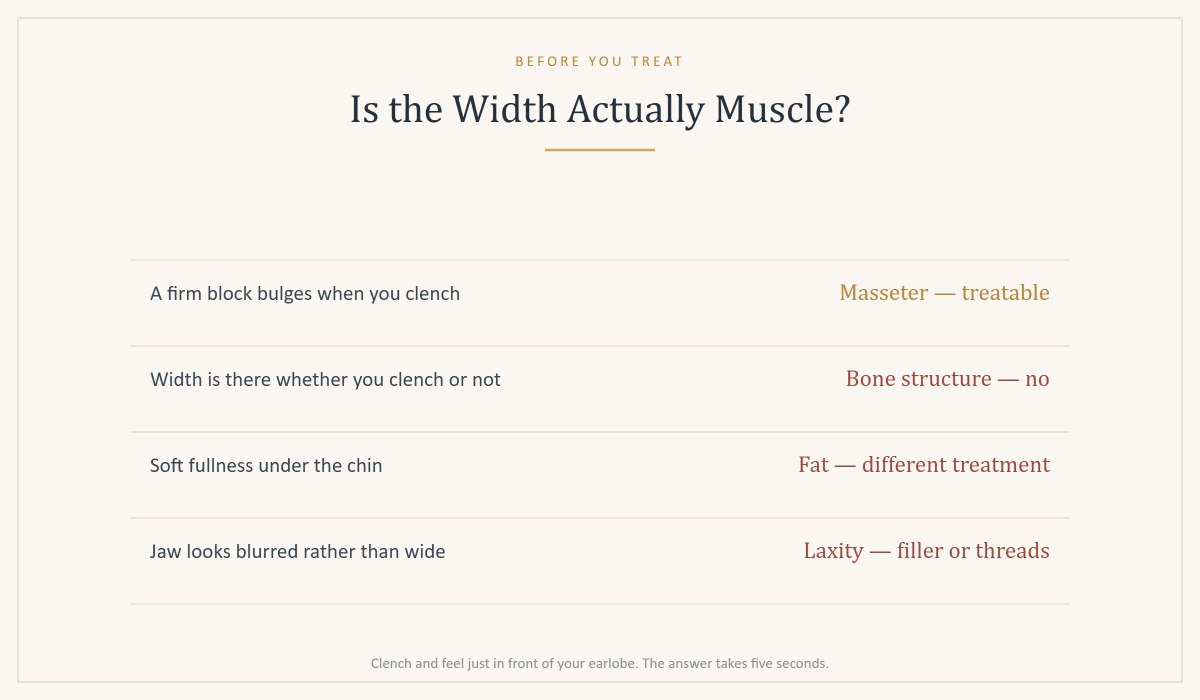
The most important assessment is whether the lower-face width is actually muscle. Several other things produce a similar appearance and none of them respond to this treatment:
- Bone structure. A wide mandibular angle is skeletal. No injectable changes bone.
- Buccal fat or submental fullness. A different problem with different solutions — see fat dissolving and double chin.
- Skin laxity along the jaw. Sagging is not width. That is a jawline filler, biostimulator or thread conversation.
- Very slim faces. Reducing masseter bulk in someone with little soft tissue can produce a gaunt or hollowed look, particularly over repeated treatment.
The clenching test settles it in seconds: if the muscle does not bulge noticeably when you bite down, the width is not coming from the masseter.
Risks Specific to This Muscle
All medical and aesthetic procedures carry potential risks alongside their potential benefits. The masseter has its own list, distinct from facial wrinkle treatment.
- Chewing fatigue. Common and temporary in the first two to three weeks, particularly with tough foods. Usually mild.
- Asymmetric smile. Uncommon, and caused by product diffusing forward into the risorius or zygomaticus muscles. Avoided by injecting within the muscle’s safe zone — behind an imaginary line dropped from the corner of the mouth — and at appropriate depth.
- Paradoxical bulging. Occasionally a portion of the muscle remains active and bulges outward on clenching. Correctable with small additional dosing at review.
- Hollowing with long-term high dosing. Repeated aggressive treatment over years can over-reduce the muscle and flatten the lower face. A reason for conservative maintenance rather than escalating doses.
- Bruising and temporary tenderness at the injection sites.
Treatment is not suitable during pregnancy or breastfeeding, over active infection, or in certain neuromuscular conditions. Botulinum toxin cannot be reversed — it wears off over three to four months — which is again why a conservative first dose and a review are the sensible approach.
The Appointment and the Weeks After
- Assessment. You will be asked to clench repeatedly while the muscle is palpated on both sides. Masseters are frequently asymmetric — most people chew preferentially on one side — and dosing is adjusted accordingly rather than split evenly.
- Treatment. Around ten minutes. Injections are placed within a defined safe zone in the lower portion of the muscle and at a depth that keeps product where it belongs. Discomfort is modest; the muscle is deep and the needle is fine.
- Same day. No visible change and no downtime. You can go straight back to work.
- Weeks 1–3. Clenching force drops. Some patients notice mild chewing fatigue with steak, hard bread or chewing gum. Jaw ache and morning headaches typically begin to ease in this window.
- Weeks 4–12. The contour change appears, slowly. Take a photograph at the same angle and lighting on day one and at week eight — the difference is far more obvious in comparison than in the daily mirror.
- Review. At four to six weeks, checking symmetry and whether any part of the muscle is still bulging on clench.
What to do alongside it
If grinding is the reason you are here, treat the injection as one part of the plan. A dentist-made night guard protects the teeth in a way no injectable can. Where clenching is stress-driven — which it usually is — the daytime habit matters too: most habitual clenchers are unaware they do it until they start noticing. And a dental assessment is worth having if there is existing wear, cracking or sensitivity, because that damage is permanent and worth stopping early.
The Wider Lower-Face Picture
Masseter treatment rarely sits alone. It is frequently one element of a lower-face plan:
- The Nefertiti neck lift releases the downward pull of the platysma on the jawline — a different muscle, complementary effect.
- Chin filler improves projection and can make a narrowed jaw read as more defined rather than simply smaller.
- Trapezius treatment is often relevant in the same patient, because habitual clenching and shoulder tension travel together.
See also bruxism and jawline slimming, and our guide to Botox versus fillers if you are unsure whether your concern is muscle or volume.
Cost in Dubai
Masseter treatment is not priced like facial wrinkle areas, because the unit requirement is several times higher. Where the Dubai market quotes botulinum toxin at roughly AED 30 to AED 60 per unit, a masseter treatment requiring 40 to 60 units total sits well above a standard single-area price.
Clinics quoting a flat “one area” price for masseter treatment are usually either using considerably fewer units than the indication requires, or have not assessed the muscle. Ask how many units are included and what happens at the review. Our guide to Botox pricing in Dubai covers what a fair quote should contain.
These are general market ranges observed across Dubai clinics, not a price list for this clinic. Dosing — and therefore cost — follows assessment of your actual muscle bulk.
Frequently Asked Questions
How long until my face looks slimmer?
Softening of the muscle begins within one to two weeks, but visible contour change generally takes four to eight weeks and is clearest at two to three months. Muscle atrophy is a gradual process and cannot be rushed.
Will it stop my teeth grinding completely?
It reduces the force of clenching, which is what causes the pain and dental damage. Evidence supports fewer bruxism events and less pain, though the data are still developing. It does not address the underlying cause, so a night guard and dental review often remain part of the plan.
How long does it last?
Typically four to six months — often longer than facial wrinkle treatment because of the higher dose. Patients treated repeatedly often find intervals lengthen as the muscle stays smaller.
Will my face look gaunt?
Not with appropriate dosing in an appropriately selected patient. The risk arises with aggressive repeated treatment, or in patients who had little muscle bulk to begin with. Assessment before treatment is what prevents it.
Can I eat normally afterwards?
Yes. Some patients notice mild chewing fatigue with tough foods for the first two to three weeks. It resolves as the muscle adapts.
Does it affect speaking or smiling?
Not when injected correctly within the muscle’s safe zone. An asymmetric smile is an uncommon complication of product spreading forward into neighbouring muscles, and it is temporary.
Is my wide jaw definitely muscle?
Clench your teeth and feel just in front of your earlobe. If a firm block of muscle bulges, masseter hypertrophy is likely contributing. If nothing bulges, the width is bone or soft tissue and this is not your treatment.
Do I still need my night guard?
Yes, in most cases. Reducing clenching force protects the teeth considerably, but a guard provides a physical barrier that an injectable cannot. The two work together rather than replacing one another.
Will my jaw go back to how it was if I stop?
Largely, yes. Muscle bulk returns over the months after treatment stops, particularly if the clenching habit continues. This is a maintenance treatment, not a permanent change.
Is it covered by insurance?
Cosmetic treatment is not generally covered. Some policies consider certain medical indications. Check directly with your insurer, as terms vary.
Jaw tension, teeth grinding, or a wider lower face?
Dr. Soheila Eskandari, DHA-licensed physician, will assess your masseter under clench, establish whether your lower-face width is muscle, bone or soft tissue, and give you a realistic timeline for the outcome you actually want.
Bruxism & jawline slimming · Book a consultation · WhatsApp +971 50 514 5129
Medically reviewed by Dr. Soheila Eskandari, DHA-licensed physician (Licence No. 00216960-005), Riviera Clinic, Umm Suqeim 1, Dubai. This article is general education and not medical advice. Unit ranges are broad clinical guides, not a prescription — dosing is determined at individual assessment. All medical and aesthetic procedures carry potential risks and benefits, which are discussed during consultation. Individual results vary and no outcome is guaranteed. Prices quoted are general Dubai market ranges observed at the time of writing and are not a quotation. Last updated August 2026.


 English
  Arabic