
Trapezius Botox in Dubai: Shoulder Line, Neck Tension and What It Costs You
Trapezius Botox in Dubai: Shoulder Line, Neck Tension and What It Costs You
Trapezius botulinum toxin arrived in aesthetic clinics as a shortcut to a longer-looking neck and stayed because a large proportion of the people who have it turn out to be treating something else entirely: years of shoulder and neck tension that no amount of stretching had resolved.
It is a legitimate and useful treatment. It is also the point at which injectable practice stops being purely cosmetic and starts weakening a muscle you use every day, which changes how carefully the decision should be made. This guide covers the anatomy, the two distinct reasons people have it, who it suits, the safety considerations that genuinely matter, and what it will not do.
What the Trapezius Does
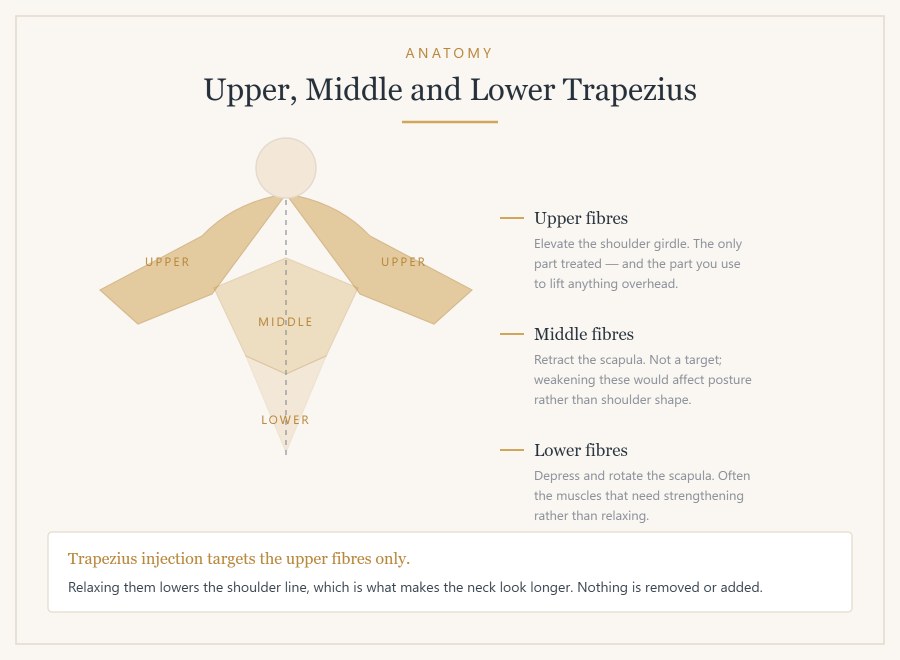
The trapezius is a large, flat, triangular muscle covering the back of the neck and the upper back. It has three functional parts. The upper (descending) fibres run from the base of the skull and cervical spine to the outer third of the clavicle and the acromion — these elevate the shoulder girdle and extend and rotate the neck. The middle fibres retract the scapula. The lower fibres depress and rotate it.
Trapezius injection targets the upper fibres only. These are the ones that create the visible slope from neck to shoulder, and the ones that become tight, bulky and painful in people who sit at desks, carry bags on one shoulder, hold tension in their shoulders, or train with heavy shrugs and deadlifts.
An important consequence of that anatomy: when the upper trapezius is hypertrophied or chronically contracted, the shoulder sits higher and the visible neck looks shorter. Relaxing it lowers the shoulder line and lengthens the apparent neck. That is the entire aesthetic mechanism — nothing is removed and nothing is added.
What Trap Tox Actually Is
Botulinum toxin type A is injected at multiple points along the upper trapezius on each side. It blocks acetylcholine release at the neuromuscular junction, so the treated fibres contract less forcefully. The muscle does not disappear; it works less hard, and with sustained reduced activity it loses some bulk over the months following treatment.
The Aesthetic Indication
Patients seeking the cosmetic version usually describe the same things: shoulders that look “up by my ears”, a neck that photographs short, a straight rather than sloped shoulder line, difficulty wearing off-the-shoulder or strapless clothing well, and — frequently — a trapezius that has grown noticeably since they started training.
The result is a softer slope from neck to shoulder and a longer-looking neck, developing over four to six weeks. Photographs taken before treatment are genuinely useful here, because the change is gradual enough that people forget their starting point.
The Functional Indication
Botulinum toxin has an established role in myofascial pain and in chronic migraine, where the trapezius is one of the standard injection sites in the approved protocol. Many patients who come for the aesthetic effect report, unprompted, that their shoulders feel looser, that the persistent ache at the base of the neck has eased, and that tension-type headaches have reduced in frequency.
For some patients this becomes the main reason to repeat the treatment. It is worth saying plainly at consultation which of the two effects you are primarily after, because it can influence dose and injection pattern.
Who Is a Good Candidate
The best candidates have genuine upper trapezius bulk or persistent hypertonicity that can be felt on examination. Ask the patient to shrug and the muscle stands out; palpate it at rest and it is firm rather than soft. Desk workers, drivers, people under sustained stress, people who carry a heavy bag on one side, and gym-goers whose training emphasises the upper traps all fall into this group.
Patients with chronic neck and shoulder tension who have already tried physiotherapy, stretching and postural work without lasting benefit are often the ones who get the most from it.
Muscle Bulk Versus Bone Structure
This is the assessment that determines whether the treatment will work at all, and it is frequently skipped.
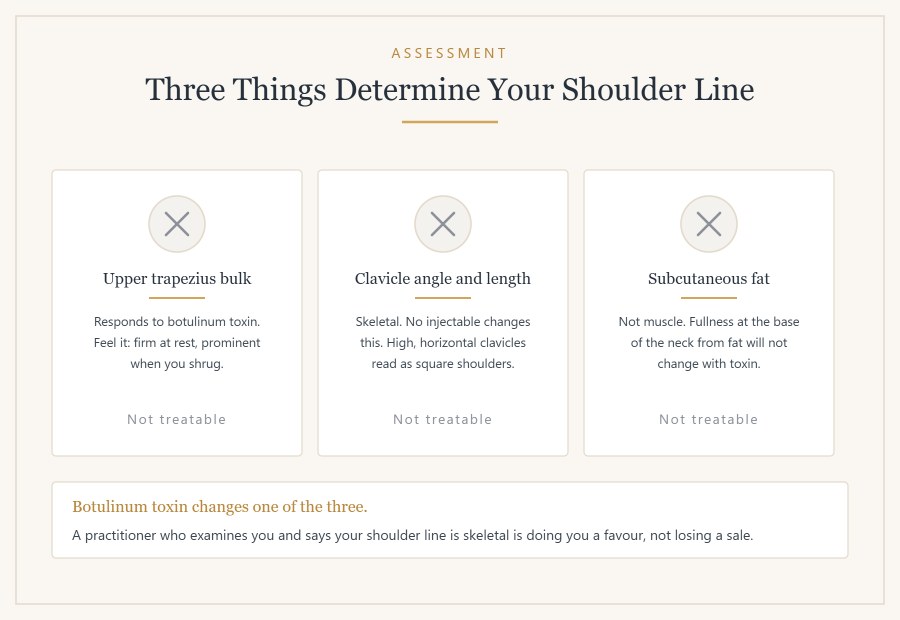
The shape of the neck-to-shoulder line is determined by three things: the bulk of the upper trapezius, the angle and length of the clavicle, and the amount of subcutaneous fat over the area. Botulinum toxin addresses one of those.
If your shoulders look square because your clavicles sit high and horizontal, relaxing the trapezius will change very little. If the fullness at the base of the neck is fat rather than muscle, the same applies. A practitioner who examines you, asks you to shrug, palpates the muscle and tells you honestly that your anatomy is skeletal rather than muscular is doing you a considerable favour — even though it means no treatment that day.
Who Should Think Carefully
The trapezius is a working muscle, and this is the meaningful difference between trap tox and forehead botox.
Athletes and people who lift. Overhead pressing, Olympic lifting, swimming, rowing, climbing and gymnastics all depend on upper trapezius function for scapular elevation and upward rotation. Weakening it will affect performance and can shift load onto the levator scapulae and rhomboids, which sometimes produces a new pain in a new place. Anyone whose sport or job depends on this muscle should have that conversation before treatment rather than after.
People with existing shoulder pathology. Rotator cuff problems, scapular dyskinesis and cervical radiculopathy can all be aggravated by reducing trapezius support. These need assessment first.
Neuromuscular disease. Myasthenia gravis, Lambert-Eaton syndrome and motor neurone disease are contraindications to botulinum toxin, as the effect on neuromuscular transmission can be exaggerated and unpredictable.
Pregnancy and breastfeeding, where safety data is inadequate.
Concurrent aminoglycoside antibiotics or other agents affecting neuromuscular transmission, which can potentiate the effect.
Active infection at the injection sites, and known hypersensitivity to any component of the product.
Dose and Technique — Why This Is Not Facial Botox
Facial treatments use small doses in small muscles. The trapezius is large, thick and strong, and doses reflect that: published and clinical protocols commonly use in the region of 40 to 100 units of onabotulinumtoxinA in total across both sides, distributed across several injection points per side, with the exact figure depending on muscle bulk, the indication and the product used. Unit equivalence differs between brands, so a number quoted for one toxin does not transfer directly to another.
Injections are placed into the muscle belly along the upper fibres. Depth and site discipline are the whole of the safety argument, which brings us to the part that is usually glossed over.
Safety: The Points That Actually Matter
Depth and the chest wall. Over the upper thoracic region the trapezius is a relatively thin sheet of muscle, and beneath it lie the ribs and the pleura. A needle placed too deeply, particularly medially and inferiorly, has the theoretical potential to reach the pleural space and cause a pneumothorax. This is rare and is avoided by injecting superficially into the muscle belly, using an appropriate needle length, angling away from the chest wall and pinching the muscle where the technique allows. It is the single strongest reason to have this treatment performed by someone who knows the anatomy of the region rather than someone who is comfortable with faces.
Excessive weakness. Overdosing produces genuine functional consequences — difficulty lifting the arm overhead, a heavy or unstable feeling in the neck, difficulty carrying bags. It resolves as the effect wears off, but that takes months. Conservative first dosing with review at four to six weeks and a top-up if needed is the sensible sequence; the reverse is not possible.
Compensatory pain. When the upper trapezius is weakened, adjacent muscles take up the work. Some patients develop a new ache in the levator scapulae or between the shoulder blades. This is usually manageable and often improves with physiotherapy, but it should be mentioned before treatment, not explained afterwards.
Asymmetry. Most people’s trapezius muscles are not symmetrical to begin with, particularly if they consistently carry a bag on one side. Injecting identical doses on both sides can make an existing asymmetry more obvious. Assessment should be side by side.
Common and expected effects are injection-site tenderness for a day or two, occasional bruising, and sometimes a mild headache in the first days.
Timeline and Duration
Onset is slower than in the face. Expect the first change at five to fourteen days, with the effect building to its peak at four to six weeks. The visible reduction in bulk lags behind the reduction in tension, because bulk reduces through disuse over weeks rather than through the block itself.
Duration is typically three to six months, and often at the longer end of that range compared with facial treatments — partly because of the higher dose, partly because the muscle is not in constant fine motion the way the facial muscles are. Repeated treatments in the same patient sometimes appear to last longer as the muscle bulk reduces.
An important framing: if the underlying cause is postural — a badly set-up desk, a heavy one-sided bag, unmanaged stress — the toxin creates a window of reduced tension rather than a solution. Patients who use that window for physiotherapy, workstation correction and targeted strengthening of the lower trapezius and deep neck flexors tend to need less treatment over time. Patients who do not are back in four months with the same shoulders.
What It Will Not Do
It will not narrow bone. It will not remove fat from the neck or shoulders. It will not correct a forward head posture or rounded shoulders, which are positional and muscular-imbalance problems requiring rehabilitation. It will not treat pain arising from the cervical spine, a disc, or a nerve root — those need diagnosis rather than injection. And it will not make the muscle permanently smaller; bulk returns as function returns.
The Nefertiti Lift, and Why It Comes Up in the Same Conversation
Patients researching trapezius injection frequently encounter the Nefertiti lift, and the two are often discussed together because both involve toxin in the neck region.
They are different treatments. The Nefertiti lift places small doses of botulinum toxin into the platysma — the broad sheet of muscle running from the chest across the jawline — and along the inferior jaw border. The platysma pulls downwards on the lower face; relaxing it allows the elevator muscles to act unopposed, which softens vertical neck bands and produces a modest improvement in jawline definition.
It is a subtle treatment with a real evidence base for platysmal banding, and it is often combined with masseter treatment for lower-face contouring. It is not a substitute for surgery in significant laxity, and dosing near the neck requires care, as excessive diffusion can affect swallowing.
Trapezius Botox Cost in Dubai
Figures below are general market ranges observed across DHA-licensed clinics in Dubai and are provided for orientation only. They are not an offer or a quotation, and pricing depends on the number of units required and the product used.
- Consultation and assessment: AED 300 – 700
- Trapezius botulinum toxin, per session: AED 1,800 – 4,500
- Per-unit pricing where used: AED 35 – 70 per unit
- Nefertiti lift: AED 1,500 – 3,500
- Masseter treatment (commonly combined): AED 1,500 – 3,000
Because dosing varies widely between patients, per-session prices are not directly comparable unless you know how many units are included. Ask for the product name, the number of units and the total price before agreeing. A low headline price with a low unit count is not a saving.
Questions Worth Asking Before You Book
Is my shoulder shape actually muscular, or is it skeletal? Which product, and how many units? What is the plan if it is not enough at four weeks? How will this affect my training, and should I change anything? What are the risks specific to injecting this area? Would physiotherapy address my problem as well or better?
Treating With Dr Soheila
Dr Soheila Eskandari is licensed by the Dubai Health Authority and practises at Riviera Clinic on Al Wasl Road, Umm Suqeim 1. Trapezius consultations include examination of the muscle at rest and on contraction to establish whether muscle bulk is genuinely the cause of the shoulder shape, discussion of training and occupational demands, and conservative first dosing with review rather than a maximal first treatment. You can read more about trapezius and Barbie botox, the Nefertiti neck lift and masseter botox for jawline slimming, or book an appointment.
Frequently Asked Questions
What is trap tox?
Botulinum toxin injected into the upper fibres of the trapezius muscle. Relaxing this muscle lowers the shoulder line and makes the neck look longer, and it also reduces the chronic tension and aching that many people carry in the neck and shoulders. It is sometimes marketed as Barbie botox or shoulder botox.
How many units are needed for trapezius botox?
Commonly in the region of 40 to 100 units of onabotulinumtoxinA in total across both sides, distributed across several points per side, with the exact dose depending on muscle bulk and indication. Unit equivalence differs between products, so figures do not transfer directly between brands.
How long does trapezius botox last?
Typically three to six months, often at the longer end of that range compared with facial treatments. The first change appears at five to fourteen days and the effect peaks at four to six weeks. Visible reduction in muscle bulk develops more slowly than the reduction in tension.
Will trap tox affect my ability to train?
It can. The upper trapezius contributes to scapular elevation and upward rotation, so overhead pressing, Olympic lifting, swimming and similar activities may feel different. Anyone whose sport or work depends on this muscle should discuss it before treatment, and conservative initial dosing is sensible.
Does it help neck and shoulder pain?
Frequently yes. Botulinum toxin has an established role in myofascial pain and the trapezius is one of the standard sites in the approved chronic migraine protocol. Many patients treated for cosmetic reasons report reduced aching and fewer tension-type headaches as a secondary benefit.
Is trapezius botox safe?
In experienced hands, yes. The specific technical concern is injection depth — the trapezius is a relatively thin sheet over the upper thoracic region, and a needle placed too deeply has the theoretical potential to reach the pleura. Superficial placement into the muscle belly with appropriate needle length avoids this, which is why practitioner familiarity with the anatomy of the region matters.
Will my shoulders look narrower?
The slope from neck to shoulder softens and the neck looks longer. Actual shoulder width is determined by the clavicles and the deltoids, neither of which is affected. If your shoulder shape is skeletal rather than muscular, this treatment will change very little.
Can I have it if I have neck pain from a disc problem?
Pain arising from the cervical spine or a nerve root needs diagnosis rather than muscle injection, and weakening the trapezius in that setting can be unhelpful. Cervical pathology should be assessed before elective treatment of this kind.
What is the difference between trap tox and a Nefertiti lift?
Trap tox treats the upper trapezius to lower the shoulder line and lengthen the neck. A Nefertiti lift treats the platysma and jawline border to reduce downward pull on the lower face, softening vertical neck bands and modestly improving jawline definition. Different muscles, different objectives.
What are the warning signs I should watch for after treatment?
Difficulty breathing, chest pain or sudden shortness of breath after treatment require urgent medical attention. Marked weakness affecting overhead activity, difficulty swallowing, or new pain in a different area should be reported to your clinic for review rather than left until the effect wears off.
This article is general information about aesthetic treatments and is not medical advice, a diagnosis, or a treatment recommendation for any individual. Outcomes vary between patients and no result is guaranteed. Botulinum toxin is a prescription medicine with risks and contraindications that must be assessed by a licensed physician during a personal consultation. Dr Soheila Eskandari is licensed by the Dubai Health Authority. Prices quoted are general market ranges for information only and are not an offer.


 English
 Arabic