
الميزوثيرابي مقابل معززات البشرة في دبي: مكونات كل منهما، والأدلة، والتكلفة
الميزوثيرابي مقابل معززات البشرة في دبي: مكونات كل منهما، والأدلة، والتكلفة
Mesotherapy vs skin boosters sounds like a choice between two treatments, but the terms describe different things and overlap in practice. Both involve many tiny injections into the skin, both aim at hydration and glow rather than a change in shape, and both are usually sold as a course. What differs is what goes into the syringe, how standardised it is and how much is known about it.
This is not a question of which is better. The more useful questions are what a particular product contains, what evidence supports it and what it can realistically change. This guide covers facial skin only.
Mesotherapy vs Skin Boosters: Why the Terms Overlap
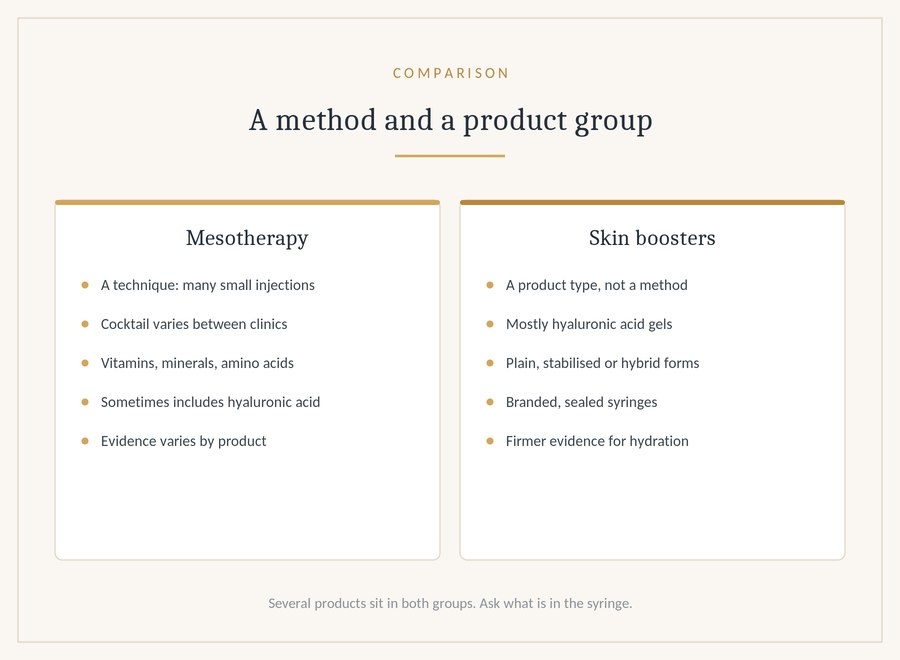
Mesotherapy is a technique. Developed in France in the 1950s, it means placing small amounts of a solution into or just beneath the skin through many shallow injections. In aesthetic practice the solution is called a cocktail, and its contents are chosen by the practitioner or set by the maker of a ready-made product.
A skin booster is a type of product. The term usually means an injectable hyaluronic acid gel designed to improve skin quality rather than add volume, placed in the dermis, the skin’s supporting layer. It is an umbrella term, not a regulated category.
The overlap comes from two directions. Boosters are injected using mesotherapy technique, and several products combine both ideas by pairing hyaluronic acid with amino acids, vitamins or antioxidants. NCTF و جالوبرو are examples. A clinic may list the same vial as mesotherapy on one page and as a skin booster on another, and published studies sometimes call hyaluronic acid injections mesotherapy.
Marketing adds to the blur. Names such as “glow injections” or “skin vitamins” say little about content, and a long ingredient list is a number, not evidence. A useful shorthand is that mesotherapy describes how a product is delivered, while skin booster describes roughly what it is meant to do.
What Each One Contains
Mesotherapy Cocktails
A facial cocktail may include vitamins, minerals, amino acids, antioxidants, coenzymes and, in some products, non-cross-linked hyaluronic acid. Some are ready-made products in a sealed vial; others are mixed in the clinic from separate ampoules. Some ingredients are authorised for other routes rather than for injection into the skin, so sourcing and formulation deserve attention.
There is no standard formula, so two clinics advertising “mesotherapy” may inject quite different things. Some cocktails target a single concern; pigmentation work, for example, relies on actives such as tranexamic acid, covered in the guide to الميزوثيرابي لعلاج التصبغات.
معززات البشرة
Plain boosters are built on hyaluronic acid, a molecule that occurs naturally in skin and holds water. Non-cross-linked products are thin, spread easily and break down more quickly. Lightly cross-linked, or stabilised, gels stay in the dermis longer. Hybrid products combine high and low molecular weight hyaluronic acid in a stabilised complex, are placed at fewer points and are designed to spread through the tissue, as explained in the guide to بروفيلو مقابل معززات البشرة. A further group adds amino acids, vitamins or antioxidants, which is where the overlap with mesotherapy is greatest.
A Separate Category: Polynucleotides
Polynucleotides are purified DNA fragments, usually from salmon or trout, injected to support skin repair. They are neither a classic booster nor a mesotherapy cocktail, though menus list them beside both, and their evidence rests mostly on small trials. The guide to معززات البشرة متعددة النوكليوتيدات covers them in detail.
How They Are Delivered
Both use fine needles to place product in the dermis after topical anaesthetic has been applied for twenty to thirty minutes. The product goes in as many tiny deposits, by hand or with a multi-needle device, and the injections take twenty to thirty minutes. Most people describe small pricks and some stinging, more so around the eyes. Hybrid products use a few defined points instead.
Depth matters: product placed too superficially can leave visible bumps or, with some gels, a bluish tinge known as the Tyndall effect. The starting material also differs. Boosters come as labelled, sealed syringes, while a mesotherapy cocktail may be mixed in the clinic, adding steps at which sterility or accuracy can fail.
What the Evidence Shows
Evidence for Mesotherapy
Evidence for facial mesotherapy cocktails is limited and varies with the product. A small early study of ten volunteers given a multivitamin and hyaluronic acid solution found no significant clinical difference in photographs at three and six months. A 2021 review updating earlier analyses found little new data and could not recommend mesotherapy for routine skin rejuvenation. The American Society of Plastic Surgeons notes that mesotherapy for skin rejuvenation is not approved by the US Food and Drug Administration and that proof of its efficacy is lacking.
That does not mean every product does nothing. Randomised trials of some hyaluronic acid based mesotherapy products report improved hydration and skin quality compared with controls, so evidence belongs to specific products rather than to the word “mesotherapy”. For vitamin and antioxidant cocktails the proof is thinner. Specialist societies publish consensus recommendations, but consensus is not controlled trial evidence.
Evidence for Skin Boosters
Boosters stand on firmer ground, mainly because standardised products can be tested one at a time. A 2025 systematic review and meta-analysis of local hyaluronic acid injection found improved hydration and radiance but no significant difference in elasticity, based on a small number of studies. In 2023 the US FDA approved one hyaluronic acid product for improving cheek skin smoothness, supported by a randomised, controlled trial with results assessed over six months.
Limits remain. Many studies are small and short, some are manufacturer-supported, and direct comparisons between brands are scarce. Evidence for hyaluronic acid with amino acids is growing but rests on smaller trials.
What Each Can and Cannot Improve
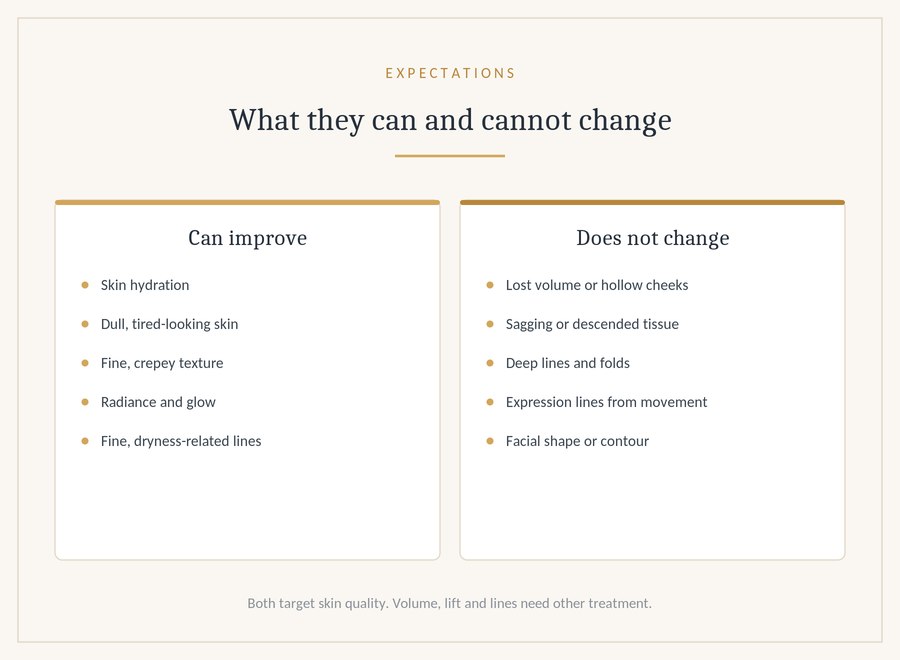
Both work on skin quality, meaning the surface and the layer just beneath it. Realistic gains include better hydration, more even light reflection that people describe as glow, and a softer, less crepey texture, including around the eyes, on the neck and on the hands. Fine, dryness-related lines may soften. Change builds gradually over a course, and the aim is skin that looks rested rather than a face that looks altered.
Neither lifts sagging tissue, replaces lost volume, fills deep lines or folds, or changes facial shape. Hollow cheeks need structural treatment and expression lines need a muscle-relaxing injection. Using a skin-quality treatment for a volume problem is a recognised reason for disappointment.
Sessions and Maintenance
Hyaluronic acid boosters are commonly given as an initial course of two to three sessions, two to four weeks apart, with maintenance about every four to six months. Hybrid products often need only two sessions. Mesotherapy courses commonly run to four to six sessions about two weeks apart, followed by occasional maintenance every few months.
Because evidence on duration is limited, mesotherapy schedules reflect practitioner protocol and your response more than established data. A single session may leave skin briefly more hydrated, but meaningful change is judged across the course, four to six weeks after the final session. Daily broad-spectrum sun protection matters in Dubai, where year-round UV exposure works against any gain.
كيف تبدو عملية التعافي
The first day or two. Small raised bumps appear at each injection point, with redness and tenderness, and usually settle within a few hours to a day or two. Pinpoint bruising is common, especially around the eyes, and can take up to a week to fade.
Aftercare. Makeup is usually avoided for twelve hours, and sauna, steam rooms and vigorous exercise for twenty-four to forty-eight hours. Most people look presentable the next day, but it is sensible to book at least a week before an important occasion in case of bruising.
Risks and Side Effects
Bumps, redness, swelling, tenderness and bruising are common and temporary. Less common problems depend as much on technique and sourcing as on the product.
Infection. Outbreaks of infection with atypical mycobacteria have been documented after mesotherapy, linked to inadequately cleaned equipment and unlicensed providers. They appear weeks later as persistent, tender red lumps and are often resistant to common antibiotics. Sterile technique, single-use needles and cartridges, and registered, properly sourced products are the main protection, since unlabelled products add risks of their own.
Allergic and inflammatory reactions. Any ingredient can provoke an immediate or delayed allergic reaction, and a cocktail with many components makes the cause harder to find. Delayed lumps or tender swellings can appear weeks or months after hyaluronic acid products, as after fillers. They are uncommon and need a doctor’s assessment, and hyaluronic acid can be dissolved with an enzyme if necessary.
Nodules and marks. Placement that is too superficial can leave visible nodules or a blue-grey tinge, and bruising or inflammation can occasionally leave dark marks, particularly in deeper skin tones.
Blocked blood vessels. This is rare with small superficial volumes but cannot be excluded. Increasing pain, skin that turns pale, dusky or mottled, or any change in vision needs same-day medical attention.
Who Should Avoid Them
Treatment is postponed in pregnancy and breastfeeding, because evidence for use at these times is lacking, and when there is active infection, a cold sore or inflamed skin such as an acne flare or eczema in the area. It is avoided with a known allergy to an ingredient. Bleeding disorders and blood-thinning medication increase bruising and need medical advice first. Keloid scarring, autoimmune conditions, a weakened immune system or previous reactions to injectables call for individual assessment. A licensed physician must review your history and examine your skin in person.
How to Choose
Start with the concern, not the label. Dull, dehydrated or crepey skin may suit either approach. Hollowness, sagging and deep lines need something else, and an honest assessment will say so.
Ask exactly what will be injected. You should hear the product name and see sealed packaging opened in front of you, with a batch number. The product should be registered for use in the UAE.
Ask what evidence exists for that product. A good answer refers to the product, not to mesotherapy in general. Be cautious of secret formulas.
Check the licence and the setting. Treatment should be carried out by a licensed physician in a licensed facility, and Dubai Health Authority registration can be verified online. Gloves, skin disinfection and single-use needles should be routine.
Ask for the plan, and be wary of pressure. Sessions, intervals, maintenance and total course cost should be explained in advance. Claims of detoxification, whitening, fat melting or an instant lift, and pressure to prepay for large packages, are reasons to pause.
تكلفة المعيشة في دبي
Market rates generally run from around AED 500 to AED 1,500 per session for facial mesotherapy, depending on the cocktail and the area, and from around AED 900 to AED 2,500 per session for hyaluronic acid skin boosters, with hybrid and premium products at the upper end or above it.
Both are sold as courses, so the course price is the figure to compare. A lower session price that needs more sessions is not necessarily cheaper. Very low prices deserve a question about what is being injected and where it came from.
النسخة المختصرة
Mesotherapy is a way of delivering small injections into the skin, while a skin booster is a type of product, usually hyaluronic acid, designed to improve skin quality. They overlap because boosters are injected with mesotherapy technique and many products combine both ideas. What matters is what is in the syringe, how standardised it is and how much evidence supports it.
Hyaluronic acid boosters have firmer evidence for hydration and skin quality, while evidence for many mesotherapy cocktails is limited and depends on the product. Neither lifts, restores volume or fills deep lines, both need a course, and both carry risks that depend on sterile technique and regulated products. A licensed physician must assess suitability in person.
أسئلة تستحق الطرح
What exactly is being injected, and is it registered for use in the UAE? You should hear product names and see sealed packaging with a batch number.
What evidence exists for this specific product? A clear answer refers to the product, not to mesotherapy in general.
How many sessions will I need, and what is the total course price? The plan should state sessions, intervals, maintenance and review.
Is my concern really one of skin quality? A practitioner willing to say that volume, lift or lines need another treatment is giving useful advice.
الأسئلة الشائعة
ما الفرق بين الميزوثيرابي ومعززات البشرة؟
Mesotherapy is a technique: many small injections of a solution into the skin. A skin booster is a type of product, usually hyaluronic acid, designed to improve skin quality. They overlap because boosters are injected with mesotherapy technique.
Which is better, mesotherapy or skin boosters?
Neither is better in general. Hyaluronic acid boosters have firmer evidence for hydration and skin quality, but the right choice depends on the product, the concern and a physician’s assessment.
How strong is the evidence for each?
For hyaluronic acid boosters, systematic reviews report improved hydration and radiance, though studies are often small. For mesotherapy cocktails, reviews describe the evidence as limited, although some hyaluronic acid based products have supportive trials.
كم عدد الجلسات التي سأحتاجها؟
Boosters are commonly given as two to three sessions, two to four weeks apart, then maintained every four to six months. Mesotherapy courses commonly run to four to six sessions about two weeks apart.
كم تدوم النتائج؟
Effects are gradual and temporary. Hyaluronic acid boosters are usually topped up every four to six months. For mesotherapy the duration is less well documented and depends on the cocktail, your skin and sun exposure.
Does it hurt, and is there downtime?
Most people describe small pricks and some stinging, eased by topical anaesthetic. Bumps and redness usually settle within a day or two, and pinpoint bruising can last up to a week.
Can either one lift the face or fill lines?
No. Both improve skin quality, meaning hydration, glow and fine texture. Lost volume, sagging and deep lines need structural treatments, and expression lines need muscle-relaxing injections.
What are the risks, and who should avoid them?
Risks include bumps, bruising, infection, allergic or delayed inflammatory reactions, nodules and, rarely, blocked blood vessels. Treatment is avoided in pregnancy, breastfeeding, active infection and known allergy. A licensed physician must assess suitability in person.
Are NCTF, Jalupro and polynucleotides mesotherapy or skin boosters?
NCTF and Jalupro combine hyaluronic acid with other ingredients and are described both ways. Polynucleotides are purified DNA fragments, a separate category that is also often listed as a skin booster.
كم تبلغ التكلفة في دبي؟
Market rates generally run from around AED 500 to AED 1,500 per session for facial mesotherapy and from around AED 900 to AED 2,500 per session for hyaluronic acid skin boosters, depending on product, area and clinic.
هذه المقالة معلومات عامة حول العلاجات التجميلية والجلدية، ولا تُعدّ نصيحة طبية أو تشخيصًا أو توصية علاجية لأي فرد. تختلف النتائج من مريض لآخر، ولا يوجد ضمان لأي نتيجة. تنطوي الأدوية الموصوفة والمنتجات القابلة للحقن على مخاطر وموانع استخدام يجب تقييمها من قبل طبيب مرخص خلال استشارة شخصية. الدكتورة سهيلة إسكندري مرخصة من قبل هيئة الصحة بدبي. الأسعار المذكورة هي نطاقات السوق العامة لأغراض المعلومات فقط، وليست عرضًا.


 Arabic
  English