
معززات البشرة متعددة النوكليوتيدات في دبي: شرح لمنتجات بلينست، ريجوران، وتواك
معززات البشرة متعددة النوكليوتيدات في دبي: شرح لمنتجات بلينست، ريجوران، وتواك
Polynucleotide injectables have moved from a niche Korean and Italian speciality to something offered on almost every clinic menu in Dubai, usually under one of three names — Plinest, Rejuran or TWAC — and usually with a description that does not distinguish them from any other skin booster.
They are worth understanding properly, because the mechanism is genuinely different from everything else in the injectable category, and that difference determines who they suit. This guide explains what polynucleotides are, how they work, how the main products differ, what they treat well, and what they cannot do.
What Polynucleotides Actually Are
Polynucleotides are fragments of DNA. Specifically, they are chains of nucleotides — the building blocks of DNA — extracted and highly purified from the gonadal tissue of salmon or trout, then deproteinised so that essentially no fish protein remains in the final product.
The use of fish DNA is not arbitrary. Salmonid DNA shares a high degree of structural homology with human DNA, and the purification process removes the protein components that would otherwise provoke an immune response. What is injected is a purified nucleic acid fraction, not fish tissue.
The abbreviation you will also see is PDRN — polydeoxyribonucleotide — which refers to shorter DNA fragments. PDRN has a substantial medical literature outside aesthetics, in wound healing, tissue repair and osteoarthritis, which is unusual for a treatment that arrived in cosmetic clinics through the skin-quality route.
How They Work
There are three mechanisms operating together, and understanding them explains why the effect is repair rather than volume.
The Adenosine A2A Receptor Pathway
PDRN acts as an agonist at the adenosine A2A receptor on fibroblasts and other cells. Activation of this receptor has two relevant consequences: it downregulates pro-inflammatory signalling, and it increases production of vascular endothelial growth factor, which promotes the formation of new microvasculature. Better perfusion of the dermis supports every subsequent repair process.
The same receptor activation stimulates fibroblast proliferation and increases synthesis of type I collagen — the structural collagen that gives skin its firmness.
The Salvage Pathway
As the injected fragments are gradually broken down, the resulting nucleosides and nucleotides become available to surrounding cells, which take them up and reuse them for their own DNA synthesis. Building nucleotides from scratch is metabolically expensive; recycling ready-made ones is not. In tissue that is trying to repair itself, that efficiency matters.
This is the mechanism most often described in marketing as “giving your skin its building blocks back”, and unusually for a marketing line it is a fair description of what is happening.
The Scaffold Effect
Longer polynucleotide chains behave as a viscoelastic hydrogel in the dermis. They bind water, provide a temporary three-dimensional matrix along which fibroblasts can organise, and scavenge free radicals. This is a physical effect rather than a receptor-mediated one, and it is the reason polynucleotide preparations produce a hydration and plumping response in the first days, before any collagen has been made.

PN Versus PDRN
The two terms are used almost interchangeably in clinic, which is unhelpful because they describe different fractions.
PDRN refers to lower molecular weight fragments. Its dominant action is receptor-mediated — anti-inflammatory, pro-angiogenic, pro-repair.
PN refers to longer, higher molecular weight chains. These retain the biological activity but add the biophysical scaffold and water-binding effect described above.
In practice most commercial products contain a distribution of chain lengths rather than a single fraction, and the differences between brands are as much about concentration, chain-length profile, viscosity and whether hyaluronic acid has been added as they are about the PN-versus-PDRN distinction.
The Products
بلينست
An Italian polynucleotide range derived from trout DNA, and one of the longer-established products in the category. The family includes a standard facial formulation, a version formulated for the periorbital area, a variant intended for a faster onset, and a combination product pairing polynucleotides with hyaluronic acid for patients who want a hydration component alongside the repair effect.
ريجوران
A Korean polynucleotide range derived from salmon DNA, and the product most responsible for the category’s popularity. The original formulation targets overall skin quality and texture; a lower-viscosity version exists for the delicate under-eye area, and a variant combined with hyaluronic acid provides more immediate hydration and a small amount of softening volume.
TWAC
A more recent salmon DNA polynucleotide product that has gained traction in this market, positioned similarly to the above and offered both as a facial treatment and for the periorbital area.
A reasonable summary: the choice between these is less consequential than the choice of whether polynucleotides are the right category at all, and less consequential than injector technique. Any clinic presenting one brand as transformatively superior to the others is overstating the difference.
What Polynucleotides Treat Well
Under-Eye Skin Quality
This is arguably the strongest indication and the one that has driven demand. Thin, crepey, dull under-eye skin with fine lines is poorly served by filler — adding volume to a texture problem tends to make it look worse, and the periorbital area is unforgiving of product placed superficially.
Polynucleotides address the tissue itself rather than the hollow: thickness, hydration, vascularity and fine-line quality. Where dark circles are partly a matter of thin skin allowing underlying vessels and muscle to show through, improving dermal thickness addresses one real component of the problem.
Atrophic Acne Scarring
The combination of fibroblast stimulation, collagen synthesis and improved microvasculature makes polynucleotides a reasonable adjunct in atrophic acne scarring, generally alongside microneedling or subcision rather than instead of them. Expect gradual softening of scar edges and improved surrounding skin quality rather than resolution of deep tethered scars, which need mechanical release.
Overall Skin Quality
Dullness, dehydration, early laxity, fine lines, redness and post-inflammatory changes all respond to varying degrees. The description patients most often give is that their skin looks healthier and behaves better — less reactive, less dry by mid-afternoon, better-tolerating of actives — rather than that it looks different.
The treatment is also used in the neck and décolleté and, increasingly, for scalp and hair quality, where the pro-angiogenic effect is the rationale.
What They Do Not Do
They do not add volume. A hollow temple, a flat cheek, a deficient chin or a tear trough hollow caused by structural volume loss will not be corrected by polynucleotides, and no number of sessions will change that.
They do not lift. Descended tissue is not repositioned by improving skin quality.
They do not remove pigment. Skin that looks brighter after a course usually looks brighter because it is better hydrated and better perfused, not because melanin has been reduced. Melasma and established hyperpigmentation need their own treatment.
They do not relax muscle. Dynamic lines from expression are a botulinum toxin question.
How They Compare
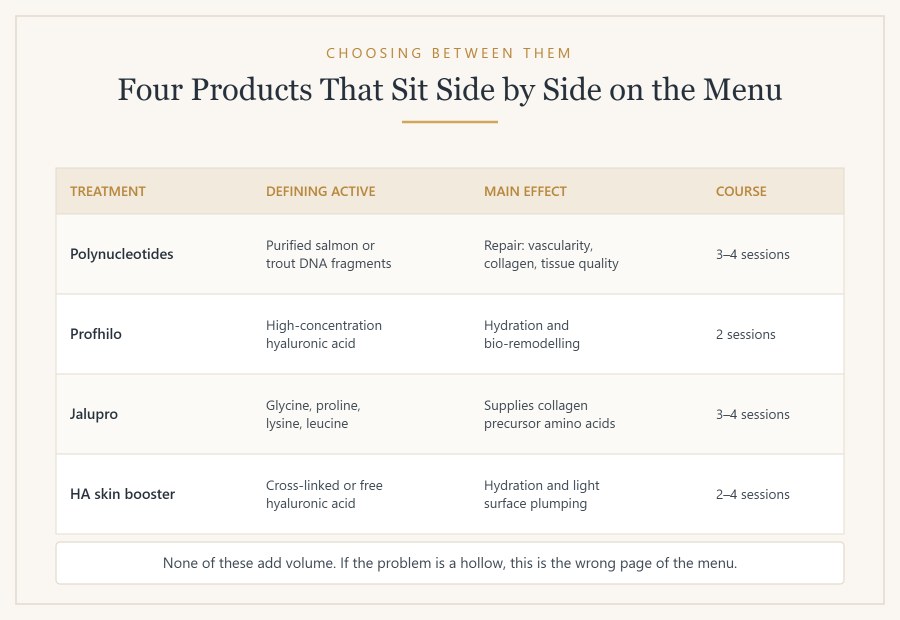
Versus Profhilo: Profhilo is pure high-concentration hyaluronic acid, delivered through a small number of defined points, working by slow release to hydrate and bio-remodel. Its strength is hydration and a modest firming effect over two sessions. Polynucleotides work by a repair pathway rather than by hydration alone, need three or four sessions, and are generally the better choice where the underlying problem is damaged or thin tissue rather than simply dry tissue.
Versus Jalupro: Jalupro’s defining actives are amino acids — the raw materials for collagen synthesis. Polynucleotides act through receptor signalling and nucleotide salvage. Both are biorevitalisation rather than volume, and in practice the choice often comes down to which mechanism suits the patient’s skin and what the clinic has experience with.
Versus hyaluronic acid skin boosters: Conventional skin boosters hydrate. Polynucleotides hydrate and additionally provoke a repair response. The difference shows up most clearly in damaged skin — scarring, thin periorbital skin, post-inflammatory change — and least clearly in young, healthy skin that is simply dehydrated.
The Session, and the First Forty-Eight Hours
Numbing cream is applied for twenty to thirty minutes. The product is then delivered as a series of small injections into the superficial dermis, usually in a grid pattern across the treatment area, or by linear threading. Treatment takes fifteen to thirty minutes for a face.
Immediately afterwards you will have visible small raised papules where the product sits — this is expected, not a complication. On the face they typically settle within a few hours to a day. Around the eyes they can persist a little longer and are more noticeable, which is worth planning around: this is not a treatment to have on the morning of an event.
Bruising is common in the periorbital area. Mild swelling and tenderness for a day or two are normal.
A standard course is three to four sessions spaced two to four weeks apart. Change becomes apparent from around the second session, with the full effect settling over the six to eight weeks after the last. Maintenance is usually every six to twelve months.
Who Should Not Have It
Pregnancy and breastfeeding, where safety data is inadequate. Active infection or inflammatory skin disease at the treatment site. Known hypersensitivity to any component. Autoimmune connective tissue disease is a relative contraindication requiring individual assessment.
Fish allergy deserves a specific mention. The products are highly purified and deproteinised, and the fraction injected is nucleic acid rather than fish protein, so the theoretical risk is low. Nevertheless a genuine fish or seafood allergy should always be declared at consultation so that it can be assessed properly rather than discovered afterwards.
Patients occasionally ask about the dietary or religious acceptability of a fish-derived product. Fish-derived materials are generally regarded as acceptable within halal guidance, but if this matters to you it is entirely reasonable to raise it directly at consultation and to ask for the product’s source and documentation.
Polynucleotide Treatment Cost in Dubai
Figures below are general market ranges observed across DHA-licensed clinics in Dubai and are provided for orientation only. They are not an offer or a quotation, and pricing depends on product, area and number of sessions.
- Face, single session: AED 1,200 – 2,500
- Under-eye only, single session: AED 900 – 1,800
- Course of three sessions, face: AED 3,000 – 6,500
- Course of four sessions, face: AED 4,000 – 8,500
- Neck or décolleté, single session: AED 1,200 – 2,500
Because the treatment is delivered as a course, the total programme price is the number to compare between clinics rather than the price of one session. Ask how many sessions are proposed, how many vials or syringes each session uses, and whether review appointments are included.
أسئلة تستحق طرحها قبل الحجز
Which product and which formulation, and why that one for my skin? How many sessions do you expect I will need, and what is the total cost? What specifically are we trying to improve, and how will we judge whether it worked? Will I have visible bumps, and for how long? Is a polynucleotide actually the right category for my concern, or would filler, toxin or a pigment treatment address it better?
العلاج مع الدكتورة سهيلة
Dr Soheila Eskandari is licensed by the Dubai Health Authority and practises at Riviera Clinic on Al Wasl Road, Umm Suqeim 1. Skin quality consultations begin by establishing what is actually wrong — volume, texture, pigment, laxity or a combination — before a product category is selected, because these are different problems with different answers. You can read more about polynucleotide and salmon DNA treatments, بلينست, ريجوران و TWAC، أو حجز موعد.
الأسئلة الشائعة
What are polynucleotides made from?
Purified DNA fragments extracted from the gonadal tissue of salmon or trout. The material is deproteinised during manufacture, so what is injected is a purified nucleic acid fraction rather than fish protein. Salmonid DNA is used because of its structural similarity to human DNA.
Are polynucleotides a filler?
No. They add essentially no volume and cannot correct hollowness. They work by stimulating repair — reducing inflammation, improving microvasculature and prompting fibroblasts to produce collagen — so the effect is on skin quality rather than shape.
كم عدد الجلسات التي أحتاجها؟
Typically three to four, spaced two to four weeks apart. Improvement usually becomes apparent from around the second session and continues for six to eight weeks after the last one. Maintenance is generally every six to twelve months.
What is the difference between Rejuran, Plinest and TWAC?
All three are polynucleotide products — Plinest from trout DNA, Rejuran and TWAC from salmon DNA. They differ in concentration, chain-length profile, viscosity and whether hyaluronic acid has been added. The practical differences between them are smaller than the difference between polynucleotides and other treatment categories.
Do polynucleotides help dark circles?
They can help one component of dark circles — thin, poor-quality skin that allows underlying vessels and muscle to show through. They do not correct a hollow tear trough casting a shadow, and they do not reduce pigment. Which type of dark circle you have determines whether this is the right treatment.
Will I have visible bumps afterwards?
Yes, immediately after treatment. Small raised papules where the product sits are expected and typically settle within a few hours to a day on the face, sometimes longer around the eyes. Bruising in the periorbital area is common. Plan the treatment at least a week before anything important.
Can I have polynucleotides if I am allergic to fish?
The products are highly purified and deproteinised, so the theoretical risk is low, but a genuine fish or seafood allergy must be declared at consultation so it can be assessed properly before treatment rather than discovered afterwards.
How do polynucleotides compare with Profhilo?
Profhilo is high-concentration hyaluronic acid and works primarily through hydration and bio-remodelling over two sessions. Polynucleotides work through a repair pathway involving receptor signalling and nucleotide recycling, over three to four sessions, and are generally better suited to damaged or thin tissue rather than simply dehydrated skin.
Are they safe during pregnancy?
They are not recommended in pregnancy or breastfeeding, as safety data in these groups is inadequate. Elective aesthetic injectables are generally deferred until after this period.
كم تبلغ تكلفة الدورة التدريبية في دبي؟
Market rates in DHA-licensed clinics generally run from AED 1,200 to AED 2,500 per facial session, with a course of three to four sessions typical — so roughly AED 3,000 to AED 8,500 for a full programme. Compare clinics on the total course price rather than the single-session figure.
هذه المقالة معلومات عامة حول العلاجات التجميلية، ولا تُعدّ نصيحة طبية، أو تشخيصًا، أو توصية علاجية لأي فرد. تختلف النتائج من مريض لآخر، ولا يوجد ضمان لأي نتيجة. جميع العلاجات بالحقن تنطوي على مخاطر يجب مناقشتها مع طبيب مرخص خلال استشارة شخصية. الدكتورة سهيلة إسكندري مرخصة من هيئة الصحة بدبي. الأسعار المذكورة هي نطاقات السوق العامة لأغراض المعلومات فقط، وليست عرضًا.


 Arabic
  English