
حشو معابد دبي: علاج تجاويف المعابد، المخاطر وما يمكن توقعه
حشو معابد دبي: علاج تجاويف المعابد، المخاطر وما يمكن توقعه
The temples are easy to overlook until they hollow. The shallow area between the outer eyebrow, the hairline and the cheekbone normally forms a smooth, gently curved surface. When it flattens and then sinks, the face can look tired, thinner or older than the person feels, most noticeably in side light and in photographs.
Filler can restore that volume, and hyaluronic acid has been studied in randomised trials for this area. The temple is also one of the more demanding places to inject, because of the arteries and veins that run through it. This guide to temple filler in Dubai explains why temples hollow, who suits treatment, how the options differ, and what the risks, recovery and cost look like.
Why Temples Hollow
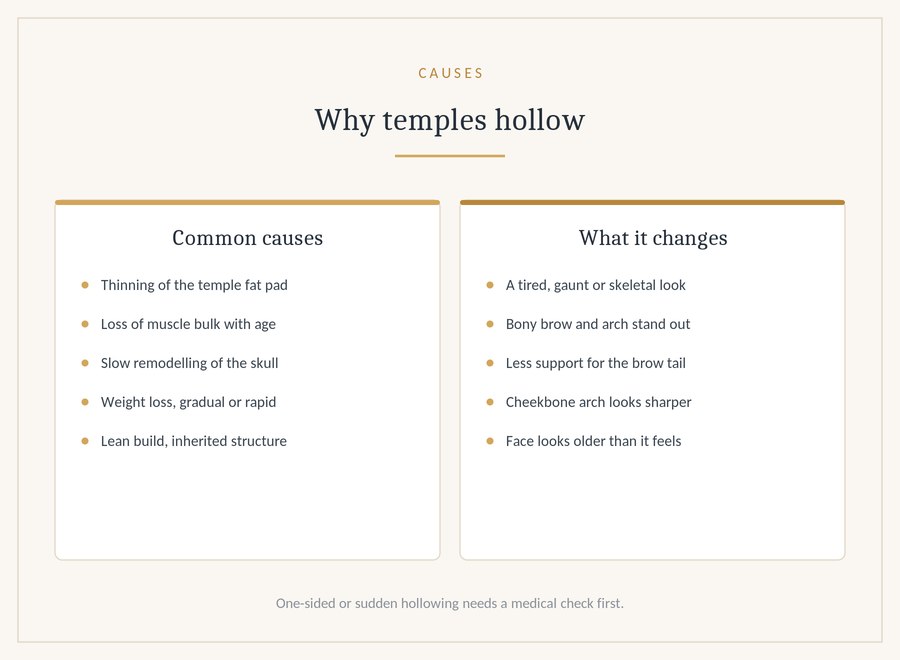
The temple is a shallow hollow in the skull, covered by the temporalis muscle, the large muscle that closes the jaw, with thin fat pads and skin over it. Hollowing appears when that padding thins or the structures beneath it shrink.
Ageing. The temple fat pad thins, the muscle loses some bulk, the skin becomes less elastic and the skull beneath remodels slowly, so the bony edges around the brow and cheekbone become easier to see.
Weight loss. Facial fat is lost along with body fat, and the temples are one of the places where this shows, whether weight is lost gradually or quickly.
A very lean or athletic build. People with little body fat have little facial padding to begin with, so hollows can appear at a younger age.
Genetics. A narrow or flat temple, or a prominent brow ridge and cheekbone arch, can look hollow at any age and often runs in families.
Other causes. Surgery, injury or radiotherapy can also cause hollowing. Hollowing on one side only, or that develops quickly, needs medical assessment first, because filler would only mask the cause.
How Hollow Temples Change the Face
The temple frames the upper face. When it is full, forehead, brow and cheekbone flow into one another. When it is hollow, the brow ridge and cheekbone arch stand out, the skin can look drawn, and the face takes on a gaunt or skeletal quality that people often read as tiredness.
The temple also supports the tail of the eyebrow. As volume is lost, the brow tail can sit lower and the outer upper eyelid can look more crowded. Restoring temple volume may give modest support to the brow tail, but it is not a brow lift and does not correct significant skin laxity.
Who Makes a Good Candidate
لمن يناسبه
Clear volume loss with otherwise good skin. A visible hollow is the problem filler is designed to address.
Hollowing after weight loss or in a lean build. The problem is a lack of padding, which is what filler replaces.
من لا يناسبه بشكل جيد
Marked skin laxity or a heavy upper lid. Volume cannot tighten loose skin, and other approaches may suit better.
Very severe hollowing. Large deficits may need staged treatment or a surgical option such as fat grafting.
Hollowing on one side or of recent onset. This needs medical assessment first.
Expectations filler cannot meet. Filler softens a hollow; it does not restore the temple of twenty years ago.
Choosing the Product
Two families of product are used in the temples, and the choice depends on how deep the hollowing is and how much reversibility matters.
حشوات حمض الهيالورونيك
Hyaluronic acid is the usual first choice. The gel must be firm enough to hold its shape over muscle and bone, a quality manufacturers measure as G prime, but not so firm that it feels hard or shows through thin skin. Products designed for volume are used, not softer lip or fine-line gels.
In a manufacturer-sponsored randomised trial, about 80 per cent of treated people improved by at least one grade on a temple hollowing scale after three months, against about 14 per cent of untreated controls. Roughly three in four still showed improvement at 13 months. A 2026 pooled analysis of six studies and 430 people found a similar response rate. Follow-up is about a year, so longer-term data are limited.
Collagen Biostimulators
Collagen biostimulators, such as poly-L-lactic acid and calcium hydroxylapatite, work differently. They prompt the body to lay down its own collagen over weeks to months, so the change builds gradually, and poly-L-lactic acid is usually given in two to three sessions. Recent studies report improvement lasting around a year, but the evidence is much smaller, and biostimulators cannot be dissolved. See the guide to المحفزات الحيوية للكولاجين.
How the Injection Is Done
Several planes and techniques are used, and experts do not fully agree on a single preferred approach.
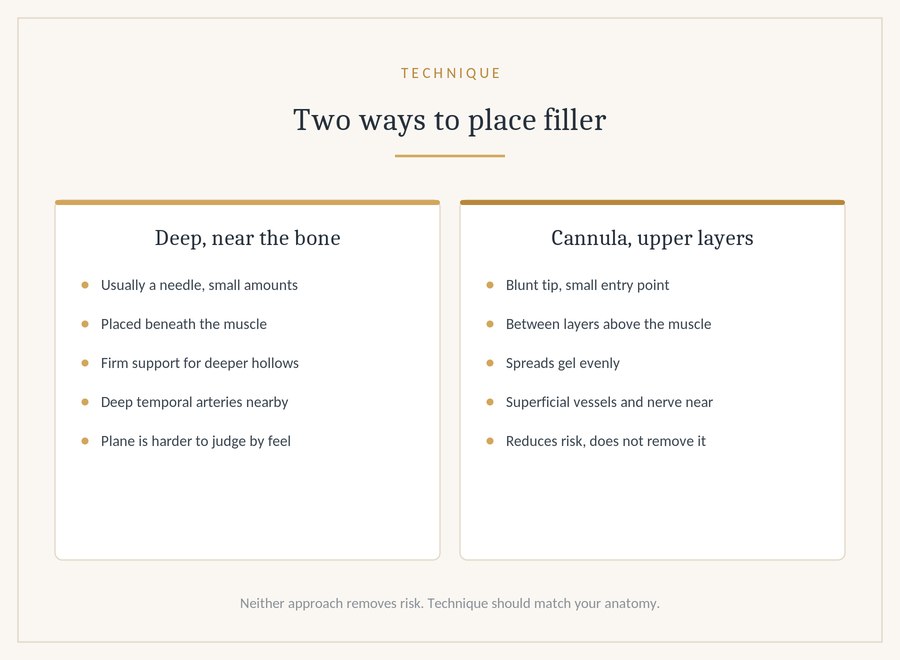
Deep injection near the bone. Small amounts of filler are placed beneath the temporalis muscle, against the bone, usually with a needle. This gives firm support for deeper hollows. But the deep temporal arteries run in and around the muscle, and because the muscle sits directly on the bone, the plane is harder to judge by feel than was once taught.
A cannula in a more superficial plane. A blunt-tipped cannula is passed through a small entry point into the layer between the fascial coverings above the muscle. The gel tends to spread evenly, and a blunt tip is generally thought less likely to pierce a vessel than a needle. But arteries, large veins and a facial nerve branch lie in or near these layers, so a cannula reduces risk without removing it.
Filler placed just under the skin tends to look lumpy, and filler within the muscle can shift and wear off sooner. Some injectors use ultrasound to map vessels, which helps but does not remove the risk. Evidence comparing techniques is mostly anatomical studies, case series and expert opinion, not head-to-head trials, so the injector should be able to explain why a plane was chosen for your face.
Why the Temple Is a High-Skill Area
The temple looks simple and is crowded underneath. The superficial temporal artery runs up the side of the head with branches towards the forehead and outer brow, and the deep temporal arteries run within the muscle. Large veins, one of them 5 to 10 mm across, lie in the fat pad, and a branch of the facial nerve that lifts the brow sits just beneath the upper fascia. Positions vary between people.
The main concern is vascular occlusion. If filler enters a vessel or presses on one, it can block blood flow to the tissue supplied, causing severe pain, pale or mottled skin and, in rare reported cases, tissue loss and hair loss. Some of these arteries also connect with the circulation of the eye. If filler enters one under pressure and travels backwards, it can reach the vessels supplying the retina and cause sudden loss of vision. Published reviews show that only a minority of people regain full sight. Visual loss is rare, but it is severe enough to shape every decision about technique.
Why Hyaluronidase Matters
Hyaluronidase is the enzyme used for مادة مالئة قابلة للذوبان, and it breaks down hyaluronic acid gel. If a vessel is affected, it is injected into the area as soon as possible, because the longer blood flow is blocked, the greater the tissue damage. A clinic treating the temples should keep it on site, know how to use it, and have a written emergency plan that includes a route to hospital eye care. It works at the injection site, but evidence that it restores vision is limited, so any change in sight calls for emergency hospital care. Biostimulators cannot be dissolved this way.
Warning Signs That Need Same-Day Care
Severe or increasing pain, pale, dusky or mottled skin, any change in vision, double vision, a drooping eyelid, a severe headache, or weakness or difficulty speaking need emergency care straight away, not a message to the clinic the next day. Visual and stroke-like symptoms usually begin during or within minutes of the injection; skin changes can take hours or days to appear.
كيف تبدو عملية التعافي
During the appointment. A numbing cream is often used, and many hyaluronic acid fillers contain a little local anaesthetic. Most people feel pressure and mild to moderate discomfort. Treatment usually takes around 20 to 30 minutes.
The first few days. Mild swelling, tenderness to the touch and discomfort when chewing are common, and some people have a headache or jaw ache. In the pivotal trial, jaw pain and headache were among the most frequently reported adverse events, and most reactions settled within a week. Bruising is possible. Soft foods, a raised head at night and avoiding heavy exercise, heat and alcohol for a day or so are commonly advised; your own doctor’s instructions take priority.
Around two weeks. Swelling has settled and the shape is clear. This is when the review takes place and any small adjustment is made.
Lumps, asymmetry and more visible veins are other possible effects, and infection or delayed inflammatory reactions are uncommon. Anything that persists should be reviewed.
How Long Results Last
Hyaluronic acid in the temple commonly lasts around 12 to 18 months, varying with the product, the volume, the depth of placement and the individual. Ageing continues, so maintenance treatments are often needed. Biostimulators build over weeks to months and have been followed for about a year in trials; how long they last in this area is less well documented. No duration can be promised.
Combining Temple and Cheek Filler
The temple, the cheekbone arch and the midface form one continuous contour, so a change in one is seen in the others. A hollow temple makes the cheekbone arch look sharper and the midface flatter, and a deflated cheek can make the temple look more sunken. Treating the temples alone can leave the face unbalanced. The guide to حشو الخدين covers the midface, and face contouring explains how temples, cheeks, jaw and chin are planned as a whole.
The areas are usually treated in a planned sequence, starting with the larger deficit and reviewing at two weeks. Hollows under the eyes often accompany temple and cheek loss but are assessed separately, as discussed in the guide to حشو تحت العين. Overfilling is a common error: a bulging temple looks as unnatural as a hollow one.
Who Should Avoid Temple Filler
Treatment is postponed in pregnancy and breastfeeding, during any infection or inflammation of the skin or scalp near the injection area, and in anyone with a known allergy to a product’s ingredients, including the lidocaine in many fillers. Caution is needed with autoimmune or inflammatory conditions, bleeding disorders and blood-thinning medication, which can increase bruising or reactions. Prescription medication should never be discontinued without medical advice. Previous surgery, injury, radiotherapy or filler in the area change the anatomy and need to be known.
Unexplained, one-sided or rapidly developing hollowing, or expectations filler cannot meet, may lead to advice against treatment or referral first. Suitability can only be judged by a licensed physician in a personal consultation, with a full medical history.
تكلفة المعيشة في دبي
Market rates generally run from around AED 1,800 to AED 7,000 for both temples with hyaluronic acid filler, depending on the product, the volume needed (commonly 1 to 2 ml per side) and the clinic. Collagen biostimulators are usually priced per vial or syringe, from around AED 1,800 to AED 4,500 each, and a temple course often needs more than one session.
A price far below this range, for an area with these risks, is a reason to ask which product is used and how complications are managed.
النسخة المختصرة
Temples hollow with age, weight loss, a lean build or inherited bone structure, which can make a face look tired or skeletal and leave the brow tail with less support. Hyaluronic acid filler is the usual choice, backed by randomised trials and dissolvable if needed. Collagen biostimulators are an alternative with a smaller evidence base and cannot be dissolved.
The temple is a high-skill area because arteries and large veins run through it, some connected to the circulation of the eye. Vascular occlusion and visual loss are rare but severe, so the injector’s knowledge of anatomy, choice of plane and readiness to deal with a complication, including hyaluronidase on site, matter more than the brand of filler.
أسئلة تستحق الطرح
Why this plane and technique for my face? The answer should refer to your anatomy and the depth of hollowing.
Which product is it, and is it approved for use in the UAE? You should be told the exact name and shown the packaging.
Is hyaluronidase kept on site, and what is the emergency plan? A clear, specific answer matters.
Do I need treatment here, or somewhere else first? Sometimes the cheeks, or no treatment at all, is the better answer.
الأسئلة الشائعة
What is temple filler?
An injectable treatment that adds volume to the hollow beside the outer eyebrow, most often with hyaluronic acid gel placed in deep or fascial layers with a needle or a blunt cannula.
What causes hollow temples?
Thinning of the temple fat pad, loss of muscle bulk and slow bone remodelling with age, plus weight loss, a lean or athletic build and inherited structure. Sudden or one-sided hollowing needs a medical check first.
Who is a good candidate for temple filler?
Someone with clear volume loss, reasonably good skin and realistic expectations. Marked skin laxity or a heavy upper lid may need other options, and anyone pregnant or breastfeeding should wait.
Which fillers are used for the temples?
Hyaluronic acid gels designed for volume are the usual choice. Collagen biostimulators are an alternative with a smaller evidence base. Hyaluronic acid can be dissolved with an enzyme; biostimulators cannot.
What are the risks of temple filler?
Swelling, tenderness, bruising, headache and jaw ache are common. Rare but serious risks include vascular occlusion, tissue damage and, very rarely, loss of vision, because temple arteries connect with the eye’s circulation. Skilled technique reduces these risks but cannot remove them.
What is recovery like?
Mild swelling, tenderness and discomfort when chewing are common for several days and usually settle within a week. The shape is judged at around two weeks. Severe pain, skin colour change or any visual change needs same-day emergency care.
كم تدوم فعالية حقن الفيلر في منطقة الصدغين؟
Hyaluronic acid commonly lasts around 12 to 18 months, varying with the product, volume and individual. Biostimulators build over several sessions and have been followed for about a year in trials. No duration can be promised.
Can temple filler be dissolved?
Hyaluronic acid filler can be dissolved with hyaluronidase, which is also the emergency treatment for a blocked vessel. Collagen biostimulators cannot be dissolved, so the choice of product matters.
Can I have temple and cheek filler together?
Yes, when both areas need it. The temple, cheekbone and midface form one contour, so they are often planned together, usually starting with the larger deficit and reviewing at around two weeks.
كم تبلغ التكلفة في دبي؟
Market rates generally run from around AED 1,800 to AED 7,000 for both temples with hyaluronic acid filler, depending on the product, the volume needed and the clinic.
هذه المقالة معلومات عامة حول العلاجات التجميلية والجلدية، ولا تُعدّ نصيحة طبية أو تشخيصًا أو توصية علاجية لأي فرد. تختلف النتائج من مريض لآخر، ولا يوجد ضمان لأي نتيجة. تنطوي الأدوية الموصوفة والمنتجات القابلة للحقن على مخاطر وموانع استخدام يجب تقييمها من قبل طبيب مرخص خلال استشارة شخصية. الدكتورة سهيلة إسكندري مرخصة من قبل هيئة الصحة بدبي. الأسعار المذكورة هي نطاقات السوق العامة لأغراض المعلومات فقط، وليست عرضًا.


 Arabic
  English