
Bridal Aesthetic Treatments in Dubai: A Timeline From Six Months to the Wedding Week
Bridal Aesthetic Treatments in Dubai: A Timeline From Six Months to the Wedding Week
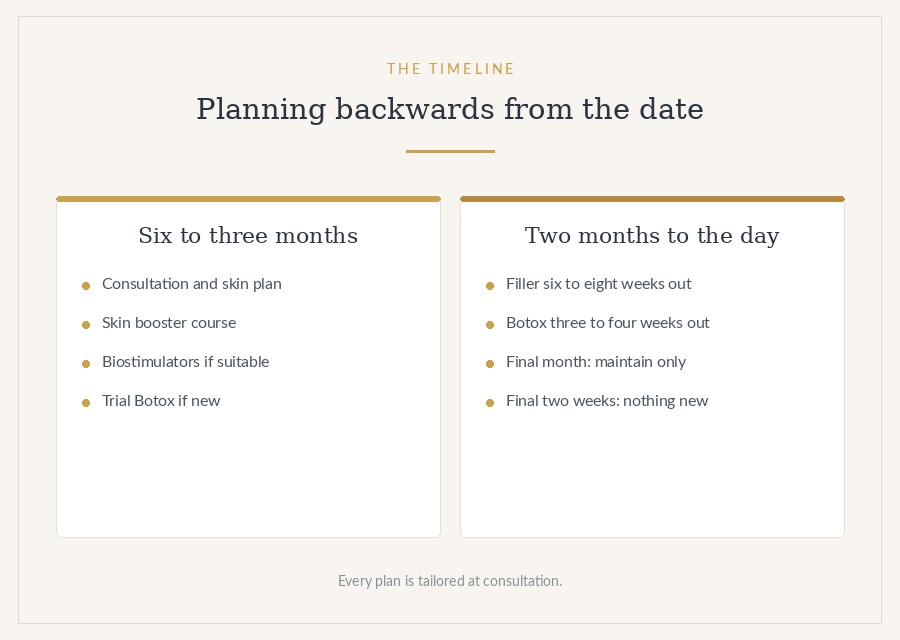
Bridal aesthetic treatments in Dubai are easiest to get right when they follow a timeline rather than a last-minute appointment. Skin-quality treatments such as skin boosters, PRP and microneedling need two to six months to show their full effect, filler is ideally placed at least six to eight weeks before the wedding so that swelling settles and any adjustment can be made, and Botox is usually given about three to four weeks before the day. In the final two weeks, nothing new should be tried.
This guide sets out a practical timeline from six months before the wedding to the wedding week, explains why each step sits where it does, covers skin, Botox, filler and biostimulators, and looks at bruising, photographs, grooms and family members, budgets and the mistakes to avoid. It also covers costs in Dubai. Every plan must be tailored and confirmed in person by a licensed physician.
Why Does Timing Matter So Much?
Aesthetic treatments do not show their final result on the day. Skin treatments work by encouraging the skin to repair and build collagen, which takes weeks to months. Filler can cause swelling and bruising for a week or two and sometimes needs a small adjustment once it has settled. Botox takes up to two weeks to reach its full effect. A first-time treatment also carries a small chance of an unexpected reaction, and the wedding week is the worst possible time to discover it. Planning backwards from the date gives every treatment the time it needs.
Six Months Before: Consultation and Skin Plan
The first consultation
Start with an assessment of your skin, facial structure and goals. Bring photographs you like of your own face and be clear about the look you want for the day: most people want to look like themselves on a good day rather than different. The doctor can then separate what needs a course of treatment from what can be done in a single session later.
Skin quality first
If dullness, dehydration, fine lines or uneven texture are the main concerns, skin boosters such as Profhilo or polynucleotides are usually given as a course of two or three sessions about four weeks apart, with results building over the following months. PRP facials and microneedling can help texture and mild acne scarring over a similar timeframe. Pigmentation and melasma need a longer, more cautious plan with daily sun protection, because strong treatments in a hot, sunny climate can make pigmentation worse if rushed.
Your daily routine
The months before the wedding are also the time to settle on a simple, consistent routine: a gentle cleanser, a moisturiser suited to your skin, a broad-spectrum sunscreen every day and, if the doctor agrees, one active ingredient introduced slowly. Changing products often, or adding several new ones at once, makes it hard to know what is helping and raises the chance of irritation. If you are planning dental treatment or teeth whitening, schedule it away from facial injections around the mouth.
Three to Four Months Before: Structure and Trials
If the face has lost some structure, collagen biostimulators such as Sculptra or Radiesse may be considered at this stage because their effect develops over two to three months. This is also the time for a first trial of Botox if you have never had it, so that you know how your face responds, how long it lasts and which dose gives the look you like. A trial removes the guesswork from the treatment you will have closer to the date.
Six to Eight Weeks Before: Filler, If Wanted
If you would like filler, for example a subtle lip enhancement, cheek support or a softer under-eye hollow, six to eight weeks before the wedding is a sensible window. It allows swelling and any bruising to settle completely, gives time for a review at two to four weeks, and leaves room to make a small adjustment or, rarely, to dissolve hyaluronic acid filler if the result is not right. A wedding is not the time for a dramatic change; a conservative volume usually photographs more naturally.
Three to Four Weeks Before: Botox
Botox for frown lines, forehead lines or crow’s feet is commonly given about three to four weeks before the wedding. The effect starts after a few days and is complete by around two weeks, so a review at two weeks still leaves a week or two for a small adjustment. Treating much earlier risks the effect beginning to soften by the day; treating within the final two weeks leaves no time to correct anything. A light dose that keeps some natural movement usually looks better in photographs and video than a completely still forehead.
The Final Month: Maintain, Do Not Experiment
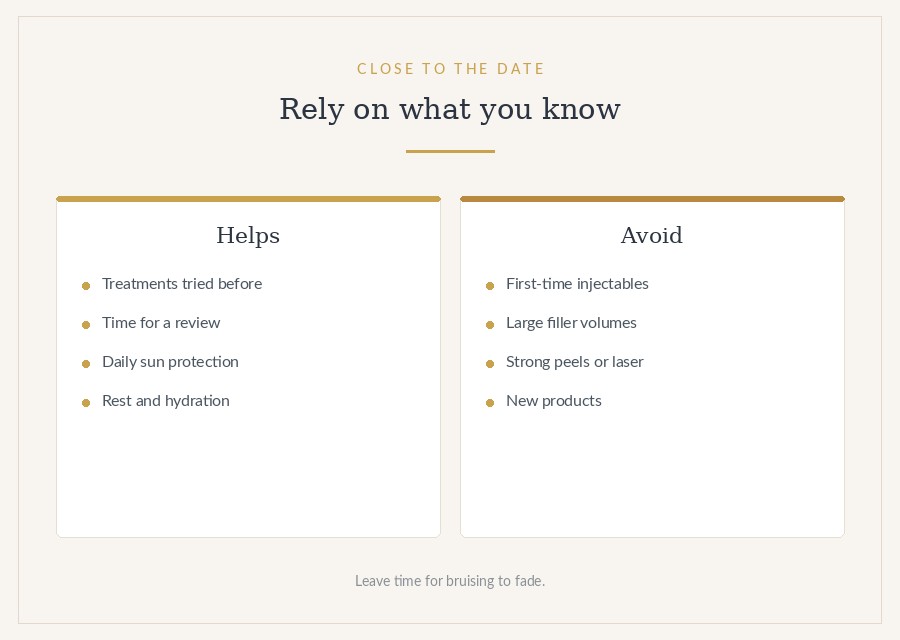
The final month is for maintenance: gentle facials you have had before, consistent skincare, hydration, sleep and sun protection. Avoid strong peels, new active ingredients, laser resurfacing and any treatment you have not tried before, because redness, peeling or a reaction can take longer to settle than expected. If you use retinoids or exfoliating acids, ask the doctor when to pause them before the wedding.
The Final Two Weeks and the Wedding Week
Nothing new should be tried in the final two weeks. Injectables of any kind, new facials, threading or waxing in new areas, and new skincare products should wait until after the wedding. If you take supplements that increase bruising, ask the doctor whether to pause them in the weeks before any injection. In the wedding week, focus on rest, hydration, gentle skincare and protecting the skin from strong sun.
How Can I Reduce the Risk of Bruising?
Bruising is the most common reason a treatment looks worse before it looks better. To reduce the risk, avoid alcohol for a day before and after injections, tell the doctor about all medicines and supplements, and avoid strenuous exercise and heat on the day of treatment. Most importantly, leave enough time: a bruise that appears six weeks before the wedding is a minor inconvenience, while one that appears three days before is a problem for the photographs.
What If the Wedding Is Less Than Two Months Away?
A shorter timeline is still workable, but the plan becomes simpler. With six to eight weeks, it is usually possible to start a skin booster course, have Botox about three to four weeks before the day and, if wanted, a conservative filler treatment straight away so that it has time to settle. With less than six weeks, the safer focus is skin care, hydration and, if you have had it before and know how you respond, Botox at least two weeks before the date. Treatments you have never tried are better saved for after the wedding.
What About the Lips?
Lips swell more than most areas after filler, sometimes noticeably for two or three days, and bruising can take a week or more to fade. For this reason, lip filler is ideally done at least six weeks before the wedding. If you have never had lip filler, a small volume is the sensible choice, because it can always be built up later. For people who mainly want a slightly fuller upper lip when smiling, a lip flip with a tiny dose of Botox is sometimes an alternative, timed like other Botox treatments.
Neck, Hands and Décolletage
Wedding dresses often show the neck, shoulders, chest and hands, which are also visible in close-up photographs of rings. Crepey skin on the neck and chest and thin skin on the back of the hands can be improved with skin boosters or diluted biostimulators, but these areas respond slowly, so they belong in the early part of the timeline, ideally four to six months before the date. Fine neck bands can sometimes be softened with Botox, timed with the facial treatment.
Underarm Sweating on the Day
Long ceremonies, heat and nerves can make underarm sweating more noticeable, especially in silk and light fabrics. Botox for excessive underarm sweating usually starts working within a week and lasts several months, so it can be given about two to four weeks before the wedding alongside facial treatment. It is a medical treatment that needs an assessment, so discuss it at the consultation if it is a concern.
What Looks Good in Wedding Photographs?
Photography and video tend to exaggerate shine, heavy volume and frozen expressions, while they flatter healthy, hydrated skin and natural movement. A plan that improves skin quality, adds subtle support where structure has been lost and softens only the lines that bother you usually looks better on camera than a plan built around volume. Good lighting and professional makeup do the rest, so there is no need to overdo injectables in an attempt to compensate.
What About Grooms and Family Members?
Grooms often ask about frown lines, forehead lines, under-eye tiredness and skin texture, and the same timeline applies: skin treatments first, Botox about three to four weeks before, nothing new in the final fortnight. Mothers of the bride and groom, and other family members in the photographs, often choose skin boosters and light Botox, sometimes with subtle filler. Planning family treatments together can make scheduling easier, but each person needs an individual assessment.
Which Treatments Should I Avoid Close to the Wedding?
Avoid trying a new injector, a new product or a new area within the final six weeks. Avoid large volumes of filler, especially in the lips, where swelling can be marked for the first few days. Avoid strong chemical peels and laser resurfacing in the final month, and be cautious with any trend that promises a dramatic change, because the risk of an unfamiliar result is highest when there is no time to correct it.
How Should I Budget for Bridal Treatments?
A plan built over several months spreads the cost and avoids rushed decisions. A typical plan might combine a skin booster course, a single Botox session and, if wanted, one syringe of filler, while others need only skin treatments. Ask for a written plan with the total cost and the dates of each step. Treatments that are not needed should not be added simply because the date is approaching.
What Happens After the Wedding?
After the wedding and any travel, it is a good moment to review what worked and plan maintenance at a calmer pace. Botox will usually start to soften around three to four months after treatment, and skin boosters often need a maintenance session every six to twelve months. Any treatment you postponed because it was too close to the date can now be considered properly, with time to see the result.
Choosing Who Treats You
Choose a licensed physician whose DHA licence you can verify on the DHA Sheryan portal and who is willing to plan the whole timeline with you rather than offering a single last-minute session. Ask how reviews are scheduled, how the clinic can be reached after treatment and how the plan changes if the date moves.
The guide to Profhilo explains one common skin booster, and the pages on anti-wrinkle treatment and dermal fillers describe the treatments at the clinic. At dr-soheila.com, treatments are planned and performed by Dr Soheila Eskandari, a DHA-licensed general practitioner with aesthetic privileges with 20 years of experience in aesthetic medicine.
The Short Version
Start about six months before the wedding with a consultation and a skin plan, because skin boosters, PRP and microneedling take months to show their full effect. Consider biostimulators and a trial of Botox three to four months out, filler six to eight weeks before and Botox three to four weeks before the day.
Use the final month for maintenance only and try nothing new in the final two weeks. Leave time for bruising and reviews, choose conservative volumes that photograph naturally, and work with a licensed physician who plans the whole timeline with you.
Questions Worth Asking
What would you treat first, and why? The answer should start with your main concern and the treatments that take longest.
When is the latest safe date for each treatment? Ask for a written timeline that works backwards from your wedding date.
Should I have a trial of Botox or filler first? A trial is especially useful if you have never had injectables.
What happens if I bruise or the result needs adjusting? The plan should leave time for a review and a correction.
Frequently Asked Questions
When should I start aesthetic treatments before my wedding?
Ideally about six months before, so that skin-quality treatments have time to work and there is room for trials and reviews.
How long before the wedding should I have Botox?
Botox is commonly given about three to four weeks before the wedding, so that the full effect has developed and a review is possible.
How long before the wedding should I have filler?
Six to eight weeks before is a sensible window, giving time for swelling to settle, a review and any adjustment.
Can I have filler a week before my wedding?
It is not advisable, because swelling and bruising may not settle in time and there is no room to correct the result.
Which skin treatments suit brides in Dubai?
Skin boosters, PRP facials and microneedling are common choices, usually as a course starting several months before the wedding.
Should I try Botox before my wedding if I have never had it?
A trial three to four months before the wedding shows how your face responds, so the final treatment can be planned with confidence.
How can I avoid bruising before my wedding?
Avoid alcohol around treatment, tell the doctor about all medicines and supplements, and schedule injections early enough for any bruise to fade.
Can grooms follow the same timeline?
Yes. The same principles apply: skin treatments first, Botox three to four weeks before and nothing new in the final two weeks.
What should I avoid in the final two weeks?
Avoid any new injectable, new product, strong peel, laser treatment or new facial, and focus on rest, hydration and sun protection.
What do bridal aesthetic treatments cost in Dubai?
Costs depend on the plan. Market rates for Botox generally run from around AED 800 to AED 1,500 per area and filler from around AED 1,500 to AED 3,500 per syringe; skin boosters are usually priced per session as a course.
This article is general information about aesthetic and dermatological treatments and is not medical advice, a diagnosis, or a treatment recommendation for any individual. Outcomes vary between patients and no result is guaranteed. Prescription medications and injectable products carry risks and contraindications that must be assessed by a licensed physician during a personal consultation. Dr Soheila Eskandari is licensed by the Dubai Health Authority. Prices quoted are general market ranges for information only and are not an offer.


 English
 Arabic