
Lip Filler in Dubai: Proportion, Product and Knowing When to Stop
Lip Filler in Dubai: Proportion, Product and Knowing When to Stop
Lip filler is the treatment where the gap between a good result and an obvious one is narrowest. The technical part — placing hyaluronic acid gel in the lip — is not difficult. Knowing how much, in which part of the lip, and when to stop is what separates lips that simply look like better versions of themselves from the recognisable overfilled appearance that brings patients in asking for dissolving.
This guide covers how proportion is assessed, why product choice matters, the vascular safety issues specific to this area, what migration actually is, and realistic longevity and cost.
Proportion Decides Whether It Looks Natural
The most common cause of an obviously treated lip is not excessive volume overall. It is volume placed in the wrong proportion.
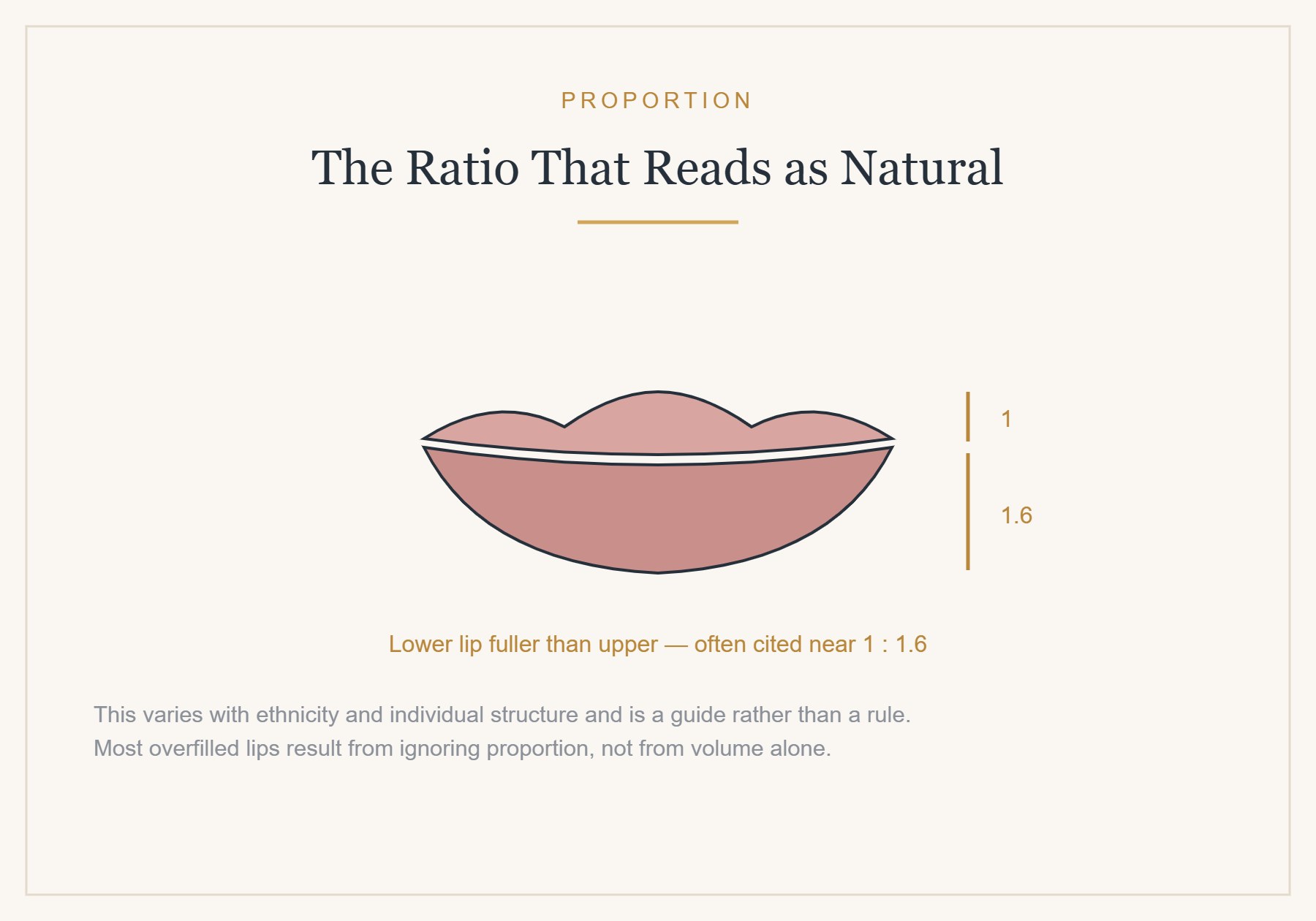
In most faces considered aesthetically balanced, the lower lip is somewhat fuller than the upper — a ratio in the region of one to 1.6 is often cited, though this varies with ethnicity and individual facial structure and should not be applied as a rule. When the upper lip is filled to match or exceed the lower, the result reads as artificial even when the total volume is modest.
Other elements matter as much as size. The vermilion border should stay defined without a visible shelf above it. The philtral columns — the two ridges running from the nose to the lip — should remain visible rather than being flattened by product pushed too high. The Cupid’s bow should retain its shape. The lip should project forward in profile rather than simply widening.
A lip assessed only from the front, and only for volume, is likely to end up looking treated.
Ethnic and Individual Variation
Aesthetic proportions differ across populations and any single ideal applied universally produces homogenised results. In a city as diverse as Dubai this matters practically: the objective is enhancement of an individual’s existing lip anatomy in proportion to their own face, not conversion toward a single template. A practitioner producing recognisably similar lips across very different faces is applying a formula rather than assessing.
Product Choice
Lips move constantly — speaking, eating, expressing — and they need a filler that moves with them. Firm, highly cohesive products designed to hold structure along a jawline feel unnatural in a lip and are more prone to visible lumps.
Products intended for lips are softer and more flexible, with lower resistance to deformation. They also break down faster, which is the trade-off, and the reason lip filler needs replacing sooner than filler placed elsewhere.
Permanent and semi-permanent fillers should not be used in lips. Complications from permanent material in a highly mobile, highly visible area are difficult to manage and cannot be reversed, and this is one of the clearer points of consensus in aesthetic medicine.
The Safety Considerations Specific to Lips
The lips have a rich blood supply from the superior and inferior labial arteries, which typically run within the lip substance itself — often posterior to the vermilion, close to the depth at which filler is placed.
Vascular occlusion, where filler enters or compresses an artery and interrupts blood supply, is uncommon but is the complication that matters. It presents as immediate blanching, disproportionate pain, and a mottled discolouration developing over hours. It is an emergency: prompt treatment with hyaluronidase to dissolve the obstructing filler determines whether the tissue recovers or is lost.
The safeguards are technique and preparedness — appropriate depth, aspiration before injection, small volumes injected slowly under low pressure, cannula use where indicated, and hyaluronidase held on site with a practitioner who recognises the presentation early. It is reasonable to ask a clinic directly whether hyaluronidase is available in the building.
Cold Sores
Injection can reactivate herpes simplex virus in anyone with a history of cold sores. Antiviral prophylaxis started before treatment is standard practice, so this belongs in the medical history rather than being mentioned afterwards.

Deciding Whether to Have It at All
A consultation that is doing its job spends time on motivation as well as anatomy.
Patients who do well generally want a specific, describable change — more definition, a little more fullness, correction of an asymmetry they have always noticed. Their reference point is their own face.
The pattern that tends to end badly is a reference image of someone else, particularly one drawn from social media. Lips in those images belong to a different face with different proportions, and are frequently the product of camera lens, angle, lighting and editing rather than injectable treatment. Reproducing them on a different face is not achievable, and pursuing it is how patients end up in a cycle of repeated treatment chasing a result that was never physically available.
There is also a straightforward question of timing. Lips swell substantially, and treatment two or three days before an important event is a poor decision. Two to three weeks beforehand allows swelling to settle and leaves room for a small adjustment if one is needed.
It is entirely reasonable to leave a consultation without treatment. A practitioner who is content for you to think it over is behaving appropriately; pressure to proceed immediately, or same-day promotional pricing that expires if you leave, is a reason to be cautious rather than an incentive.
Different Lips Need Different Approaches
“Lip filler” describes several distinct treatments that happen to use the same product.
Hydration and texture. A small amount of soft product placed within the body of the lip improves quality and reduces fine vertical lines without adding obvious volume. This suits patients who want their lips to look healthier rather than fuller.
Definition of the border. Careful placement along the vermilion border sharpens an outline that has softened with age. This is a precise technique — product placed slightly too high or too superficially here is a principal cause of the shelf appearance described above.
Volume. Placement within the lip body to increase fullness, respecting the upper-to-lower proportion.
Structural correction. Addressing asymmetry, a downturned mouth corner, or loss of philtral column definition. This is more technically demanding than straightforward augmentation and produces a disproportionate improvement when done well.
The Ageing Lip Is a Different Problem
Lip ageing is not simply volume loss. The upper lip lengthens, the vermilion rolls inward and shows less, the philtral columns flatten, and the corners of the mouth turn down. Vertical lines develop from a combination of muscle activity and sun exposure.
Filling such a lip with volume alone rarely looks right, because the underlying changes are structural. The better result usually comes from combining a small amount of well-placed filler with treatment of the surrounding area — and in some patients, from recognising that a surgical lip lift addresses upper lip lengthening in a way that no injectable does.
Migration: What It Is and Why It Happens
Filler migration describes product moving beyond the intended boundary, most visibly producing a raised shelf above the upper lip that becomes apparent in profile and when the lips are at rest.
It is associated with several avoidable factors: overfilling, so that product is pushed beyond the lip compartment; injecting too superficially; placing product above the vermilion border rather than within the lip; and repeat treatment before previous filler has fully resolved.
That last point deserves attention. Hyaluronic acid filler in lips often persists longer than the visible effect suggests. Topping up every six months for several years can accumulate product, and the gradual change means neither patient nor practitioner necessarily registers it. Periodic assessment of what is already present — occasionally with a deliberate gap in treatment — is part of doing this responsibly.
What Treatment Involves
Topical anaesthetic is applied for twenty to thirty minutes, and modern lip fillers contain lidocaine. A dental block is available for anxious patients, though it distorts the lip temporarily and removes the ability to check symmetry during the procedure, so it is a trade-off rather than an upgrade.
Injection takes fifteen to thirty minutes. Most patients start with a single syringe, which in careful hands produces definition and modest fullness rather than an obvious change.
Swelling and Timeline
Lips swell more than most areas. Significant swelling for two to three days is normal, often worst on the morning after treatment, and lips can look considerably larger than the eventual result during the first week.
The final shape should be judged at two weeks. Requesting more product at the one-week mark, while swelling is still resolving, is a reliable route to overfilling — and this is the single most useful piece of aftercare advice in lip treatment.
Aftercare and What to Avoid
Ice in the first twenty-four hours reduces swelling and discomfort. Sleeping with the head slightly elevated on the first night helps. Vigorous exercise, alcohol, saunas and steam rooms are usually avoided for a day or two, as all increase swelling and bruising.
Firm massage of the lips is not advised unless specifically instructed, since it can displace product before it has settled. Dental treatment is usually deferred for around two weeks, as the mouth retractors used in dentistry apply significant pressure to freshly treated lips.
What should prompt an immediate call rather than waiting: blanching or a white appearance of the lip or surrounding skin, pain that is severe or increasing rather than settling, or a mottled, dusky discolouration. These are the signs of vascular compromise, and time matters. Any clinic performing lip filler should give you a number to call outside appointment hours and should be able to see you promptly.
Longevity
Six to twelve months is typical. The lips’ constant movement and good blood supply accelerate breakdown, and the softer products used there are less durable by design.
Patients whose main concern is a thin-looking upper lip with adequate volume may be better served by a different approach — a small amount of botulinum toxin to relax the upper lip and increase visible vermilion, discussed further in the guide to the lip flip — since it addresses lip position rather than volume.
Costs in Dubai
Market pricing generally runs from roughly AED 1,500 to AED 3,000 per syringe, depending on product and injector.
Unusually low pricing deserves scrutiny. The wholesale cost of a genuine, well-sourced product sets a floor, and the price should also cover assessment, the injector’s training, and the clinic’s ability to manage a vascular emergency. Deeply discounted lip filler, particularly at non-clinical venues or promotional events, is where the serious complications in this field disproportionately arise.
The Short Version
A good lip result depends on proportion, appropriate product, correct depth and restraint, rather than on volume. Most patients need less than they expect, and the final assessment belongs at two weeks rather than at one.
The safety considerations are specific and worth taking seriously: the labial arteries run close to the injection plane, vascular occlusion is the complication that matters, and hyaluronidase must be on site with someone who recognises the presentation. Those requirements, not the price per syringe, are what should decide where you have this treatment.
Frequently Asked Questions
How long does lip filler last?
Typically six to twelve months. Lips move constantly and are well vascularised, so filler breaks down faster there than almost anywhere else in the face. Softer products designed for lips tend to sit at the shorter end of that range.
Will one syringe look obvious?
In most patients a single syringe placed well looks like better-defined, slightly fuller lips rather than an obvious change. Obvious results usually come from repeated treatment without allowing full resolution, or from ignoring proportion.
What is filler migration and why does it happen?
Migration is product spreading beyond the lip border, producing the shelf above the upper lip. It is associated with overfilling, injecting too superficially, placing product above the vermilion border and repeated treatment before previous filler has resolved.
Can lip filler be dissolved?
Yes, hyaluronidase dissolves hyaluronic acid filler, usually within days. It is worth knowing that dissolving is not perfectly precise and can affect the tissue’s own hyaluronic acid, so it is a correction rather than a simple undo.
What is the most serious risk?
Vascular occlusion, where filler enters or compresses a labial artery and interrupts blood supply. It is uncommon but it is an emergency, and it is why treatment should be with a practitioner who recognises it early and holds hyaluronidase on site.
How much swelling should I expect?
Significant swelling for two to three days, often most pronounced on the morning after. Lips can look considerably larger than the final result for the first week. Final shape should be judged at two weeks.
Does it hurt?
The lips are sensitive, but topical anaesthetic and lidocaine-containing products make it manageable. A dental block is an option for anxious patients, though it removes the ability to check symmetry during treatment.
Can I have lip filler if I get cold sores?
Yes, but tell your practitioner. Injection can reactivate herpes simplex, and antiviral prophylaxis started before treatment is standard for anyone with a history of cold sores.
Why do my lips look uneven afterwards?
Early asymmetry is usually uneven swelling and settles within two weeks. Genuine asymmetry persisting beyond that can be adjusted with a small correction. Most faces are naturally slightly asymmetric to begin with, and the aim is balance rather than mirror symmetry.
What does lip filler cost in Dubai?
Market pricing generally runs from roughly AED 1,500 to AED 3,000 per syringe depending on the product and the injector. Unusually low pricing is worth questioning, since product quality and the availability of emergency hyaluronidase are what the price should cover.
This article is general information about aesthetic and dermatological treatments and is not medical advice, a diagnosis, or a treatment recommendation for any individual. Outcomes vary between patients and no result is guaranteed. Prescription medications carry risks and contraindications that must be assessed by a licensed physician during a personal consultation. Dr Soheila Eskandari is licensed by the Dubai Health Authority. Prices quoted are general market ranges for information only and are not an offer.


 English
 Arabic