
Collagen Biostimulators in Dubai: Sculptra, Radiesse, AestheFill and Ellansé Compared
Collagen Biostimulators in Dubai: Sculptra, Radiesse, AestheFill and Ellansé Compared
The most common disappointment with collagen biostimulators is not that they fail. It is that patients are given the timeline of a filler and the mechanism of a biostimulator, and the two do not match. Someone leaves the clinic looking slightly fuller, returns four days later looking exactly as they did before, and concludes the treatment did not work — three months before it would have.
Biostimulators are a genuinely useful category and they behave nothing like hyaluronic acid filler. This guide explains what each of the main products is, how the mechanism dictates the timeline, who the category suits, and the one property that matters more than most patients are told: they are not reversible.
Filler Versus Biostimulator
A hyaluronic acid filler works by occupying space. The gel is injected, it sits where it is placed, and it holds tissue in a new position. The result is immediate, it is proportional to the volume injected, and — because hyaluronidase dissolves hyaluronic acid — it can be removed.
A collagen biostimulator works by provoking your own tissue to build. The injected particles are recognised as foreign, and the body mounts a controlled, low-grade wound-healing response around them. Fibroblasts are recruited and activated, and they lay down new collagen — predominantly type I — in the treated plane. Over the following weeks to months, the particles themselves are broken down and cleared. What remains is not the product. It is the collagen your body made in response to it.
That single difference explains almost everything else. The result is gradual rather than immediate. It is not proportional to the injected volume in any straightforward way. It improves for months after the last session. And it cannot be reversed, because there is nothing to dissolve — the change is your own tissue.
The Four Main Biostimulators
Poly-L-Lactic Acid — Sculptra and Lanluma
Poly-L-lactic acid, or PLLA, is the longest-established biostimulator in aesthetic use. It supplied as a freeze-dried powder that is reconstituted with sterile water, typically some hours before treatment, and injected as a suspension into the deep dermis or subcutaneous plane.
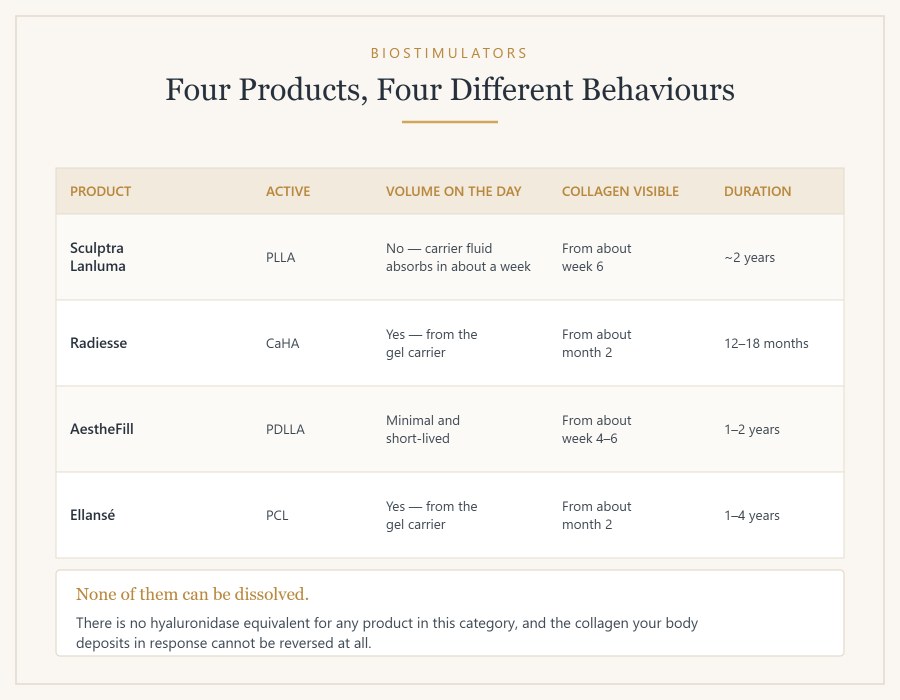
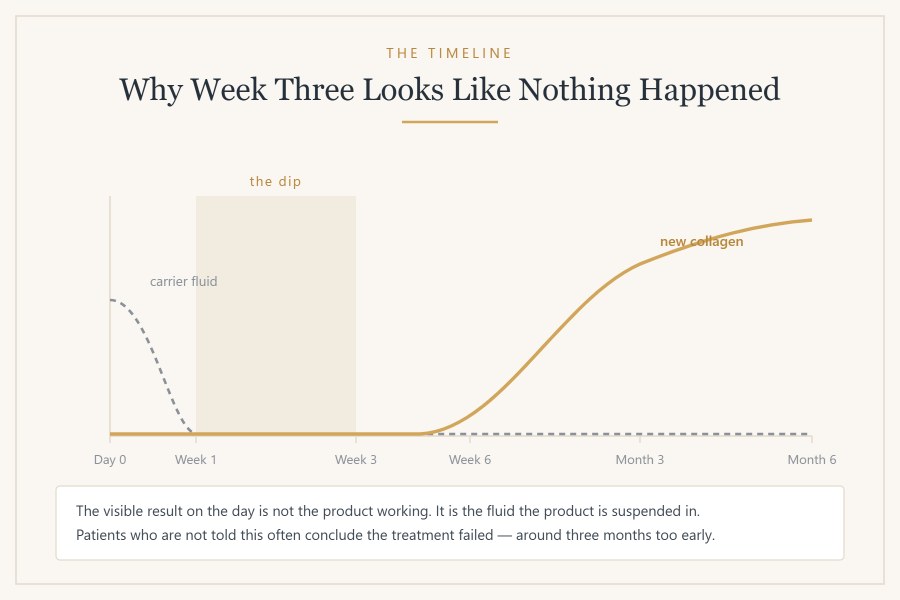
The behaviour of PLLA in the first fortnight causes more confusion than any other aspect of the category. Immediately after injection you look fuller — but that is the carrier fluid, not the product working. Over three to seven days the fluid is absorbed and the fullness disappears entirely. Nothing visible then happens for several weeks. Collagen deposition becomes clinically apparent from around six weeks, builds through months two and three, and continues to improve for up to six months after the final session.
A standard course is two to four sessions spaced four to six weeks apart. Longevity is one of PLLA’s strengths — pivotal studies of Sculptra reported persistence of effect out to around two years, and clinical experience often exceeds that. Lanluma is a more recent PLLA product available in different vial sizes for facial and body use.
PLLA has a history of nodules and subcutaneous papules that dates largely from its early years, when it was reconstituted in small volumes and injected too superficially. Modern protocols — higher dilution, longer reconstitution times, deeper placement, avoiding high-mobility and thin-skinned areas, and post-treatment massage — have substantially reduced that risk, but it has not been eliminated, and technique remains the dominant variable.
Calcium Hydroxylapatite — Radiesse
Radiesse consists of calcium hydroxylapatite microspheres suspended in a carboxymethylcellulose gel. It is the one product in this category with a genuine dual action: the gel carrier provides immediate volume, and as it resorbs over roughly three months the microspheres provide a scaffold along which fibroblasts deposit new collagen and elastin.
That makes it the most filler-like of the biostimulators — you leave with a visible result — while still delivering the collagen effect over the following months. Typical duration is twelve to eighteen months.
Radiesse is also used in a hyperdiluted form, mixed with saline and lidocaine to a much lower concentration and injected in a fine, even layer for skin quality rather than volume. This is a common approach for the neck, décolleté, upper arms and the backs of the hands, where crepey texture rather than hollowness is the complaint.
Poly-D,L-Lactic Acid — AestheFill
PDLLA is a more recent variant. The particles are porous and generally smaller and more uniform than conventional PLLA, which is the basis for manufacturer claims of a somewhat faster onset and a lower papule risk. Like PLLA it requires reconstitution before use, and like PLLA the result develops over months rather than days. Reported duration is broadly comparable, in the region of one to two years.
The independent comparative literature between PDLLA and PLLA is still relatively limited, so claims of superiority should be treated with the usual caution applied to newer entrants in any category.
Polycaprolactone — Ellansé
Polycaprolactone microspheres in a carboxymethylcellulose gel, available in formulations engineered to different durations — broadly one to four years depending on the version selected. Like Radiesse, it gives immediate volume from the carrier followed by collagen stimulation.
The long-duration formulations are attractive on paper and warrant careful thought in practice: if a result is not what you wanted, waiting it out takes considerably longer.
What the Timeline Actually Looks Like
For the PLLA and PDLLA products, a realistic sequence looks like this. Day 0: mild fullness from carrier fluid, sometimes swelling and bruising. Days 3–7: the fullness disappears; you look as you did before treatment. Weeks 2–5: nothing visible. Weeks 6–8: the first genuine change — usually described as the skin looking firmer rather than fuller. Months 3–6: the result consolidates, with continued improvement after the last session.
The middle section is where patients lose faith, and it is the reason a clinic should set this expectation clearly before the first injection rather than reassuringly at the follow-up. For Radiesse and Ellansé, the carrier volume persists rather than vanishing, so the early phase is less disconcerting — but the collagen component still develops on the same slow schedule.
Who Biostimulators Suit
They suit diffuse volume loss and generalised laxity better than they suit focal shaping. If the complaint is a flat, deflated midface, thin temples, a face that has lost overall support, or crepey skin on the neck, décolleté or arms, this category is well matched to the problem.
They suit patients who would rather change gradually than visibly, which for many people is the deciding factor. Nobody sees a moment at which you had something done.
They suit patients whose tissue can respond. Collagen stimulation requires functioning fibroblasts, so results are generally better in patients who are not heavy smokers, are reasonably nourished, and are not in a state of significant systemic illness.
Who They Do Not Suit
They are a poor choice for anyone who needs a defined shape change in a specific place — a projected chin, a defined lip border, a precisely contoured tear trough. Those are jobs for hyaluronic acid, where placement is exact and the result can be assessed and adjusted on the day.
They are a poor choice for anyone with an event in six weeks.
They are usually avoided in patients with active infection at or near the treatment site, a history of keloid or hypertrophic scarring, and — as a relative contraindication requiring individual assessment — active autoimmune connective tissue disease, on the reasoning that the treatment works by deliberately provoking an inflammatory healing response.
And they are a poor choice for anyone who is not comfortable with an irreversible decision.
The Reversibility Point
This deserves its own section because it is routinely underplayed.
Hyaluronic acid filler has an antidote. If placement is wrong, if the result is too much, if there is a vascular emergency, hyaluronidase dissolves it — usually within a day or two. That safety net is a large part of why hyaluronic acid became the default.
Biostimulators have no equivalent. There is no enzyme that reverses PLLA, PDLLA, calcium hydroxylapatite or polycaprolactone, and the collagen your body deposits in response cannot be dissolved at all. If the result is excessive, misplaced or asymmetric, the options are limited: wait, or in the case of persistent nodules, intralesional steroid, saline dilution or surgical excision — each with its own consequences.
This does not make biostimulators unsafe. It makes injector experience, product selection and conservative dosing considerably more important than in a treatment you can undo. It is a reasonable question to ask directly: how many of these has this practitioner done, and what is the plan if the result is not what we intended?
Risks, Honestly Stated
Common and expected: swelling, bruising, tenderness and small injection-site bumps for a few days.
Less common: nodules and papules, the characteristic complication of this category. Early nodules usually reflect product clumping or superficial placement; late nodules, appearing months afterwards, may relate to biofilm or a delayed inflammatory response. Risk is reduced by adequate dilution, correct plane, avoiding thin and highly mobile areas, and appropriate post-treatment massage where the protocol specifies it.
Uncommon but serious: vascular occlusion. Any injectable placed near a vessel can obstruct it, and biostimulator particles cannot be dissolved if that happens. Warning signs are severe pain out of proportion to the procedure, blanching, a developing mottled purple pattern, or any change in vision. These require immediate contact with your clinic, not an appointment next week.
Infection is uncommon with proper technique and sterile handling but is more consequential in a treatment involving a persistent particulate implant.
Collagen Biostimulator Cost in Dubai
Figures below are general market ranges observed across DHA-licensed clinics in Dubai and are given for orientation only. They are not an offer or a quotation, and pricing depends on the product, the number of vials and the assessment.
- Sculptra (PLLA), per vial: AED 2,500 – 4,500
- Lanluma (PLLA), per vial: AED 2,500 – 5,000
- Radiesse (CaHA), per syringe: AED 2,000 – 3,500
- AestheFill (PDLLA), per vial: AED 2,500 – 4,000
- Ellansé (PCL), per syringe: AED 3,000 – 5,500
- Hyperdiluted Radiesse for neck or décolleté, per session: AED 2,500 – 4,500
Because a course typically involves two to four sessions, the number that matters is the total programme cost. A per-vial price is not comparable between clinics unless you also know how many vials are proposed and how many sessions are planned. Ask for the whole plan in writing.
Questions Worth Asking Before You Book
Which product are you recommending, and why that one rather than the alternatives? How many sessions and how many vials in total, and what is the full cost? At what point should I expect to see a change, and what will I look like at week three? What is the plan if a nodule develops? How many of these treatments have you performed? Would hyaluronic acid filler achieve my goal more predictably, and if not, why not?
That last question is a useful test. A clinic that can explain clearly why a biostimulator is the better tool for your particular problem is thinking about your face. A clinic that recommends it regardless of the problem is thinking about its stock.
Treating With Dr Soheila
Dr Soheila Eskandari is licensed by the Dubai Health Authority and practises at Riviera Clinic on Al Wasl Road, Umm Suqeim 1. Consultations for volume loss begin with an assessment of what is actually deficient — bone support, deep fat compartments, skin quality — before any product is proposed, and the recommendation may well be that a biostimulator is not the right tool. You can read more about collagen biostimulators, Sculptra, Radiesse, AestheFill and Lanluma, or book an appointment.
Frequently Asked Questions
What is the difference between a filler and a collagen biostimulator?
A hyaluronic acid filler occupies space and produces an immediate result that can be dissolved with hyaluronidase. A biostimulator provokes your own fibroblasts to lay down new collagen, so the result develops over months, is not proportional to injected volume in a simple way, and cannot be reversed.
How long does it take to see results from Sculptra?
The initial fullness on the day is carrier fluid and disappears within about a week. Genuine collagen-driven change typically becomes visible from around six weeks and continues to build through months two to six, including after the final session.
Which biostimulator is best?
There is no single best product — they differ in mechanism and behaviour. Radiesse and Ellansé provide immediate volume from their carrier as well as collagen stimulation; Sculptra, Lanluma and AestheFill work almost entirely through collagen and show nothing for several weeks. The right choice depends on the problem being treated, the area, and how quickly you need to see a change.
Can collagen biostimulators be dissolved?
No. There is no antidote equivalent to hyaluronidase for PLLA, PDLLA, calcium hydroxylapatite or polycaprolactone, and the collagen your body produces in response cannot be dissolved. Persistent nodules can sometimes be managed with intralesional treatment or excision, but the treatment should be approached as a decision you cannot undo.
How long do the results last?
Broadly, calcium hydroxylapatite twelve to eighteen months, PLLA and PDLLA around two years, and polycaprolactone one to four years depending on the formulation. Individual duration varies with metabolism, area treated and how much collagen was generated.
Do biostimulators cause lumps?
Nodules and papules are the characteristic complication of the category, most associated historically with PLLA injected too superficially or at insufficient dilution. Modern protocols have reduced but not eliminated the risk, and technique remains the main variable. Late-onset nodules appearing months later can also occur.
Can I have a biostimulator and hyaluronic acid filler together?
Frequently the two are combined, with filler used for defined structural correction and a biostimulator for diffuse support and skin quality. They are usually placed in different sessions and often in different planes, and the sequencing should be planned rather than improvised.
Are biostimulators suitable for the under-eye area?
Generally not. The skin there is thin and mobile, which is exactly the setting in which nodules and irregularity are most likely and most visible. Under-eye hollowing is usually better addressed with an appropriate hyaluronic acid product placed deep, or by treating the cheek that is casting the shadow.
How much does a course cost in Dubai?
Market rates in DHA-licensed clinics generally run from around AED 2,000 to AED 5,500 per vial or syringe depending on the product, with two to four sessions typical. The meaningful figure is the total programme cost including all vials and sessions, which is what should be compared between clinics.
What are the warning signs I should watch for after treatment?
Severe pain out of proportion to the procedure, blanching of the skin, a mottled purple pattern developing over hours, or any change in vision. These suggest vascular compromise and require immediate contact with your clinic. A firm lump appearing weeks or months later should also be reviewed rather than left.
This article is general information about aesthetic treatments and is not medical advice, a diagnosis, or a treatment recommendation for any individual. Outcomes vary between patients and no result is guaranteed. All injectable treatments carry risks that should be discussed with a licensed physician during a personal consultation. Dr Soheila Eskandari is licensed by the Dubai Health Authority. Prices quoted are general market ranges for information only and are not an offer.


 English
  Arabic