
Sculptra in Dubai: How It Works, Sessions, Results, Risks and Who It Suits
Sculptra in Dubai: How It Works, Sessions, Results, Risks and Who It Suits
Sculptra in Dubai is a poly-L-lactic acid injectable that works by encouraging the skin to build its own collagen gradually, rather than by filling a line or adding volume on the day. It is usually given as two or three sessions about four to six weeks apart, results build over two to three months after each session, and the effect can last around two years. It suits gradual volume loss, hollowing and skin quality in the face and some body areas, but it is not used in the lips or directly around the eyes.
This guide explains what Sculptra is and how it works, which concerns and areas it suits, what a session involves, how many sessions are typical, recovery and aftercare, when results show and how long they last, the risks, who should avoid it, how it compares with filler and other biostimulators, and what it costs in Dubai. Suitability must be confirmed in person by a licensed physician.
What Is Sculptra?
Poly-L-lactic acid
Sculptra is made by Galderma. Its active ingredient is poly-L-lactic acid, a biocompatible and biodegradable material that has been used for decades in medicine, for example in dissolvable stitches. In Sculptra, it is supplied as a powder of tiny particles that the clinic mixes with sterile water, often with local anaesthetic, before injection.
A collagen stimulator rather than a filler
After injection, the water is absorbed within days, so any fullness you see on the day disappears quickly. The particles then trigger a controlled response in the deeper skin and the tissue beneath it, encouraging cells called fibroblasts to produce new collagen over the following weeks and months. The particles themselves are gradually broken down and cleared by the body. The visible result is therefore a gradual, natural-looking improvement in volume and firmness rather than an instant change.
What Does Sculptra Treat?
Gradual volume loss
With age, the face loses fat, bone support and collagen, which can lead to hollow temples, flattened cheeks, sunken areas beside the mouth and a less defined jawline. Sculptra can gradually restore some of this lost support across broad areas.
Skin quality and laxity
Because it stimulates collagen, Sculptra can improve skin thickness and firmness. It is sometimes used for crepey skin on the neck, chest, arms and above the knees, and for mild laxity, although it does not lift heavily sagging skin the way surgery can.
Body areas
Some clinicians use Sculptra to improve the appearance of cellulite dimpling or to add subtle volume to the buttocks. These uses are typically off-label in many markets, need larger volumes and are planned case by case.
Which Areas Is Sculptra Not Used For?
Sculptra is not used in the lips, where it can cause lumps, and it is not injected directly around the eyes, including the tear troughs and eyelids, where thin skin and muscle movement increase the risk of visible nodules. It is also not designed for sharp contouring of a small area, such as defining the edge of the chin; firmer fillers or calcium hydroxylapatite suit that kind of work better.
How Should I Prepare?
At the consultation, the doctor will review your medical history, medicines, previous fillers and threads, any autoimmune conditions and any tendency to keloid scarring. Avoid alcohol for a day before treatment, and do not stop prescribed medicines without speaking to the doctor who prescribed them. If you have dental work, a vaccination or travel planned, mention it so that the sessions can be spaced sensibly.
What Happens During a Session?
Preparation of the product
The powder is reconstituted with sterile water in advance, often many hours or a day before treatment, so that the particles disperse evenly. Clinics follow the manufacturer’s current guidance and their own protocols; a thorough mix and a suitable dilution help reduce the risk of nodules.
The treatment
The skin is cleansed, and the product is injected with a fine needle or a blunt cannula into the deeper layers of the skin or just beneath it, in a pattern that spreads it evenly across the area. A facial session usually takes around thirty to forty-five minutes.
Massage after treatment
Many clinicians massage the area at the end of the session and advise gentle massage at home for a few days to help distribute the product evenly. A frequently quoted rule is five minutes, five times a day, for five days, although advice varies between clinics and products. Follow the specific instructions you are given.
How Many Sessions Are Needed?
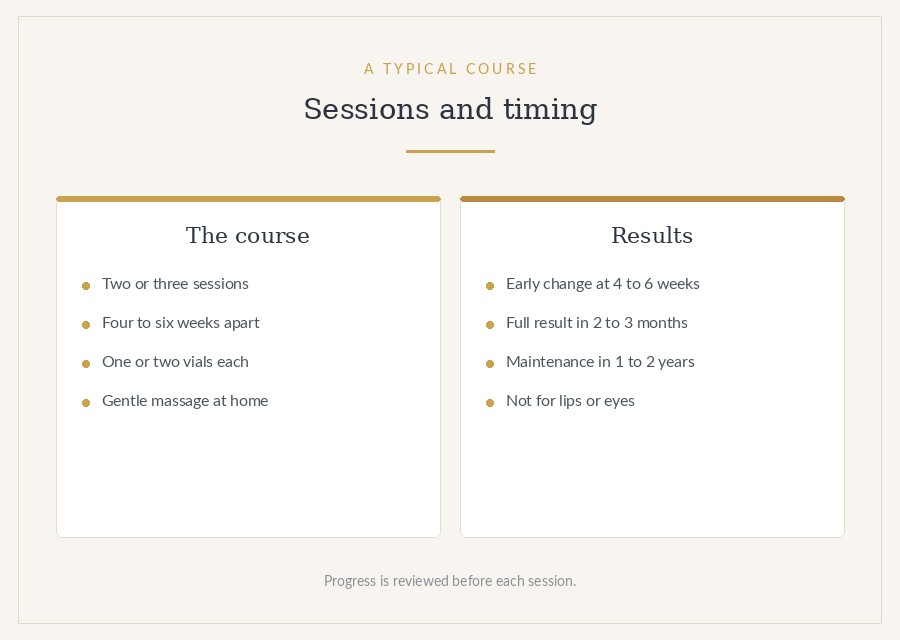
Most facial treatment plans involve two or three sessions spaced about four to six weeks apart, using one or two vials per session depending on the degree of volume loss. People with more significant loss may need more. Because the result develops gradually, the doctor reviews progress before each session rather than adding product too quickly, which is one of the main ways to keep the result natural.
كيف تكون فترة التعافي؟
Swelling, redness, tenderness and bruising are common for a few days. The swelling from the water carrier makes the face look fuller for the first day or two, then settles, which can be confusing: the early fullness is not the result. Most people return to normal activities straight away. Avoid strenuous exercise, saunas, steam rooms and alcohol for a day, and avoid facial treatments that press or heat the skin for about two weeks.
When Will I See Results?
Because collagen builds slowly, the first visible changes usually appear around four to six weeks after the first session, and the full result develops over two to three months after the final session. Many people notice that their skin looks firmer and healthier before they notice a change in volume. Photographs taken before treatment are useful, because gradual change is hard to judge in the mirror. Comparing photographs taken in the same light and position at each review gives a much clearer picture than day-to-day impressions.
How Long Does Sculptra Last?
Studies have reported results lasting around two years after a full course, and some people maintain the effect for longer with occasional top-up sessions. Longevity depends on age, lifestyle, sun exposure, smoking, the number of sessions and how much volume was lost at the start. Ageing continues, so maintenance is usually planned every one to two years rather than as a single lasting fix.
What Are the Risks of Sculptra?
The common effects are swelling, bruising, tenderness and redness at the injection sites, which usually settle within days. The main specific risk is the formation of small bumps under the skin, called papules or nodules. These are often not visible but can be felt, and they may appear weeks or months after treatment. Modern dilution, mixing and injection techniques have reduced this risk considerably. Visible nodules may need further treatment.
As with any injectable, there is a rare risk of the product entering or compressing a blood vessel, which needs urgent attention. Sculptra cannot be dissolved, so careful technique, suitable areas and an experienced injector are essential. Infection and allergic reactions are rare.
Who Should Avoid Sculptra?
Sculptra is not suitable during pregnancy or breastfeeding, for people with active skin infection or inflammation in the treatment area, for people with a known allergy to any component, or for those prone to keloid or hypertrophic scarring. People with autoimmune conditions, bleeding disorders or those taking blood-thinning medicines need an individual assessment. People who want an instant result for an event in the next few weeks are usually better suited to other options.
How Does Sculptra Compare With Filler?
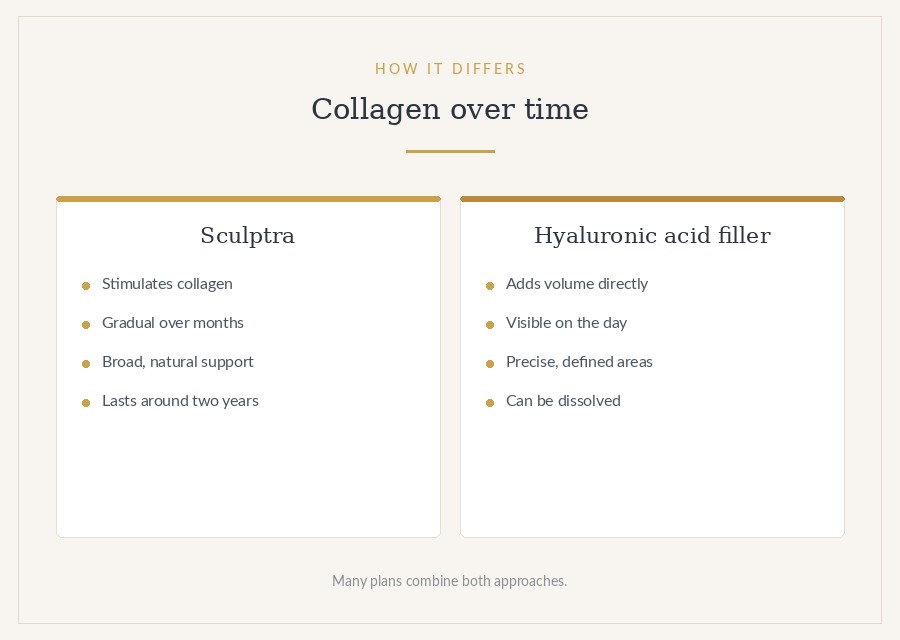
Hyaluronic acid filler gives an immediate, precise result, is ideal for defined areas such as the lips and under-eyes, and can be dissolved. Sculptra gives a gradual, diffuse improvement across broader areas and stimulates the skin’s own collagen, with a longer-lasting effect, but it cannot be dissolved. Many treatment plans use both: Sculptra for overall support and skin quality, and small amounts of filler for detail.
How Does Sculptra Compare With Other Biostimulators?
Radiesse and other calcium hydroxylapatite products give some immediate structure as well as collagen stimulation, which suits contouring areas such as the jawline. AestheFill and Lanluma are other poly-L-lactic acid products with similar principles but different particle designs and protocols. The guides on Sculptra وRadiesse و AestheFill and Sculptra compare these options, and the overview of المحفزات الحيوية للكولاجين explains the wider group.
Can Sculptra Be Combined With Other Treatments?
Sculptra often forms the foundation of a longer-term plan. Botox can be used for expression lines, small amounts of hyaluronic acid filler can refine detailed areas such as the lips or tear troughs, and skin boosters can add hydration and glow. Because Sculptra’s effect develops over months, it is usually planned first, with other treatments added at later appointments once the progress of the collagen response can be judged. Energy-based skin treatments over the same area are typically spaced a few weeks apart.
What Does a Typical Course Look Like?
A first consultation assesses the face, skin quality and goals, with photographs for comparison. The first session treats the main areas of volume loss. Four to six weeks later, the doctor reviews the early response and gives the second session, adjusting the plan if some areas are responding faster than others. A third session follows if needed. The full result is reviewed about three months after the last session, and maintenance is discussed for around one to two years later. This stepwise approach is slower than filler, but it allows the result to be built gradually and evaluated at each stage.
Is Sculptra a Good Choice for Someone in Their Thirties?
For some people, yes. In the thirties, collagen production begins to decline, and early hollowing at the temples or a slight loss of firmness can appear. A modest course of Sculptra can support the skin before more noticeable changes develop, but it is not necessary for everyone, and good sun protection and a healthy lifestyle remain the foundation. The decision should be based on an assessment rather than age alone.
Is Sculptra Suitable for Men?
Yes. Men often notice hollowing at the temples and cheeks and thinning skin with age. Sculptra can restore broad support while keeping a natural, masculine shape, and its gradual effect suits people who prefer that changes are not noticed overnight. Men tend to have thicker skin and may need slightly different volumes, which the doctor plans at the consultation.
Why Do Sculptra Results Vary?
Collagen production differs between people and declines with age, smoking and sun exposure. The amount of volume lost at the start, the number of sessions, the dilution and technique, and how closely the aftercare is followed all affect the result. Because the change is gradual, patience between sessions is part of the treatment.
Everyday habits also influence how well new collagen holds up. Daily broad-spectrum sun protection is especially important in Dubai, where strong ultraviolet light breaks down collagen throughout the year. Not smoking, sleeping well, eating enough protein and keeping weight stable all support the result, while rapid weight loss can make the face look hollow again even after a successful course.
اختيار من يعالجك
Because Sculptra cannot be dissolved and depends heavily on technique, choose a licensed physician whose DHA licence you can verify on the DHA Sheryan portal, who performs biostimulator treatments regularly, uses genuine product and explains the full course and cost before starting.
The page on Sculptra treatment describes the treatment at the clinic. At dr-soheila.com, treatments are planned and performed by الدكتورة سهيلة إسكندريطبيب عام مرخص من هيئة الصحة بدبي، يتمتع بصلاحيات تجميلية ولديه خبرة 20 عامًا في طب التجميل.
النسخة المختصرة
Sculptra is a poly-L-lactic acid injectable that stimulates new collagen gradually. It suits broad volume loss, hollowing and skin quality, is usually given as two or three sessions four to six weeks apart, and builds results over two to three months, with effects that can last around two years.
It is not used in the lips or around the eyes and cannot be dissolved. Swelling and bruising are common and short-lived, nodules are the main specific risk, and blood-vessel complications are rare but serious, so an experienced licensed injector and careful aftercare matter.
أسئلة تستحق الطرح
Is Sculptra right for my concern, or would filler or another biostimulator suit me better? The answer should depend on your anatomy and goals.
How many vials and sessions do you expect I will need? This determines the total cost of the course.
How do you prepare and dilute the product? Preparation and technique affect the risk of nodules.
What aftercare should I follow, and how can I reach the clinic? Clear instructions and access after treatment are part of good care.
الأسئلة الشائعة
What is Sculptra?
Sculptra is a poly-L-lactic acid injectable that stimulates the skin to produce new collagen gradually.
Is Sculptra a filler?
Not in the usual sense. It does not fill on the day; it encourages the body to rebuild collagen and support over months.
How many Sculptra sessions are needed?
Most facial plans involve two or three sessions about four to six weeks apart, using one or two vials per session.
When will I see results from Sculptra?
Early changes often appear four to six weeks after the first session, and the full result develops two to three months after the final session.
كم يدوم مفعول سكولبترا؟
Results have been reported to last around two years after a full course, with maintenance sessions extending the effect.
Is there downtime after Sculptra?
Most people return to normal activities straight away. Swelling and bruising usually settle within a few days.
Do I need to massage after Sculptra?
Many clinicians advise gentle massage for a few days, often five minutes, five times a day, for five days. Follow the advice you are given.
Can Sculptra be used in the lips?
No. Sculptra is not used in the lips or directly around the eyes.
What are the risks of Sculptra?
Swelling and bruising are common. Small nodules can form, and vascular complications are rare but serious, so treatment should be performed by an experienced licensed physician.
What does Sculptra cost in Dubai?
Market rates generally run from around AED 1,800 to AED 4,500 per vial, and most courses use several vials over two or three sessions. A personal quote follows the consultation.
هذه المقالة معلومات عامة حول العلاجات التجميلية والجلدية، ولا تُعدّ نصيحة طبية أو تشخيصًا أو توصية علاجية لأي فرد. تختلف النتائج من مريض لآخر، ولا يوجد ضمان لأي نتيجة. تنطوي الأدوية الموصوفة والمنتجات القابلة للحقن على مخاطر وموانع استخدام يجب تقييمها من قبل طبيب مرخص خلال استشارة شخصية. الدكتورة سهيلة إسكندري مرخصة من قبل هيئة الصحة بدبي. الأسعار المذكورة هي نطاقات السوق العامة لأغراض المعلومات فقط، وليست عرضًا.


 Arabic
 English